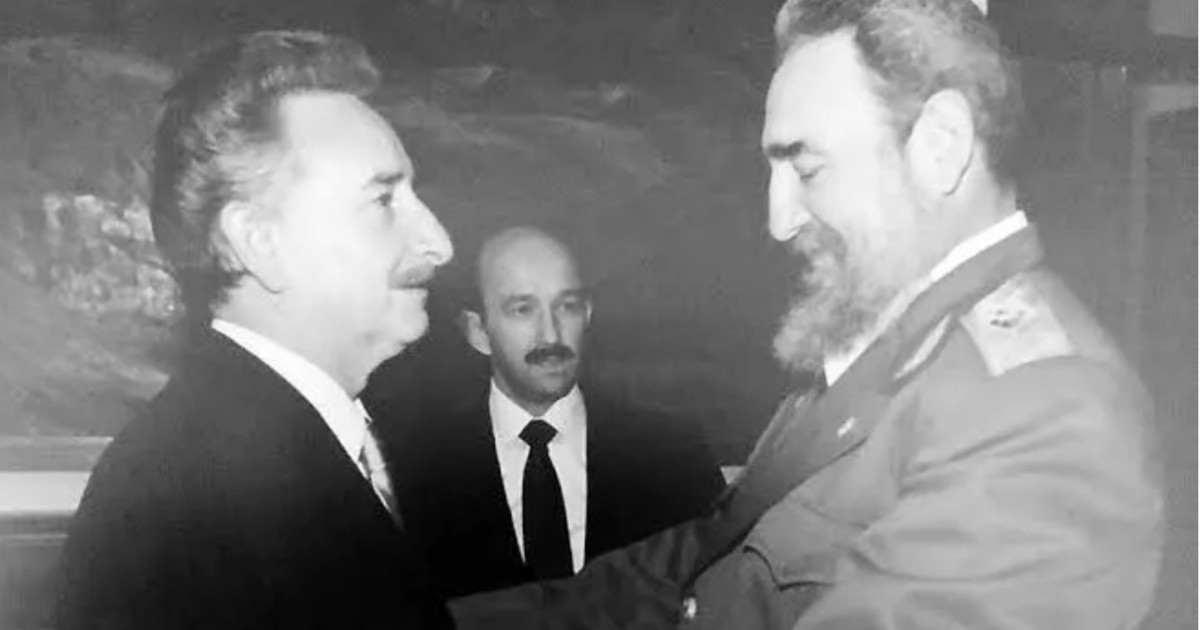
In a detailed examination featured in the Mexican magazine Siempre!, political analyst Joel Ortega Suárez dissects what he describes as the "insidious ties between Cuba and Mexico." This relationship, as outlined in the article, is not a mere coincidence but a result of decades of shared ideological affinities, mutual material interests, and collusion in illicit activities, all tied to the centenary of Fidel Castro.
The analysis argues that the connections between Cuba and Mexico extend beyond chance or circumstance, asserting that these ties are carefully constructed through a network of ideological relationships, shared worldviews, and cultural and traditional bonds. Additionally, it highlights how this deep-seated alliance has been exploited to facilitate illegal practices that flout international law.
One illustrative example cited in the article is the notorious drug trafficking scandal of the 1980s. During this period, the Cuban regime allegedly aided the Medellín Cartel by allowing cocaine to traverse Caribbean waters en route to the United States. This operation was managed by the so-called MC group—Moneda Convertible—which was also involved in the trade of ivory and the sale of counterfeit Cuban art by artists like Portocarrero.
When the U.S. government pressured Fidel Castro to dismantle this operation, Castro's response was a calculated purge. The analysis describes how Castro sacrificed General Arnaldo Ochoa, a celebrated hero of the Angolan war, along with the De la Guardia brothers, as scapegoats. This move not only fulfilled commitments to the United States but also eliminated potential internal threats.
Ochoa was recorded in Angola suggesting it was time for reforms in Cuba, which Castro interpreted as a sign of support for Gorbachev's perestroika. "Fidel decisively chose Arnaldo Ochoa as the scapegoat, offering his head to the Americans as proof of his genuine commitment to honoring agreements," the article states.
The trial, broadcast for weeks, was characterized as a "sham" where defendants were coerced into guilty pleas through blackmail. "The Moscow Trials of the 1920s pale in comparison to this orchestrated charade," the analysis concludes. Ochoa and Antonio de la Guardia were executed on July 13, 1989, marking one of the most controversial events in Cuban history.
Regarding the Mexico-Cuba connections, the article highlights figures such as Fernando Gutiérrez Barrios, former chief of the Mexican Federal Security Directorate, and Cuban commander Manuel Piñeiro "Barbarroja" and former Interior Minister Ramiro Valdés. "These connections were forged through the most clandestine dealings between both states," the analysis claims.
"From the outset, Mexico shared an ideological, cultural, and political kinship with Cuba, linking the two revolutions," the article notes, adding that Mexico's revolution, stemming from the 1910-20 conflict, held the longest political hegemony globally, surpassing the Soviet, Chinese, Cuban, and others like Algeria, Angola, and Congo.
The analysis continues, describing Castro's extensive network of power beyond Cuba's borders, driven by his ambition to be a contemporary Charlemagne or Hannibal, a figure admired by Fidel. This ambition led to Cuban operations on Mexican soil, including bank robberies, jewelry heists, and kidnappings, involving Che Guevara's own brother, all under the protection of Mexican security and intelligence led by Fernando Gutiérrez Barrios.
Looking at current affairs, the article points to Raúl Guillermo Rodríguez Castro, "El Cangrejo"—Raúl Castro’s grandson—as orchestrating a migrant smuggling network using Nicaragua as a gateway for a mass exodus of Cubans to the United States via Mexico. The New York Times linked "El Cangrejo" to a criminal network in Quintana Roo in a recent report, although he has yet to face formal charges in the U.S.
"Cuba has persistently used its power to conduct illegal operations, from its association with Colombian cartels to now facilitating migrant smuggling," the analysis concludes, describing the Cuban exodus as "orchestrated by the Cuban state."
Exploring the Cuba-Mexico Connection
What are the alleged ties between Cuba and Mexico?
The ties between Cuba and Mexico are characterized by shared ideological beliefs, mutual material interests, and involvement in illegal activities, as detailed in Joel Ortega Suárez's analysis.
How did Fidel Castro respond to U.S. pressure in the 1980s?
Fidel Castro responded to U.S. pressure by orchestrating a purge, sacrificing General Arnaldo Ochoa and the De la Guardia brothers as scapegoats to satisfy American demands and eliminate internal rivals.
Who are some key figures in the Mexico-Cuba relationship?
Key figures include Fernando Gutiérrez Barrios from Mexico and Manuel Piñeiro "Barbarroja" and Ramiro Valdés from Cuba, who played significant roles in fostering clandestine connections between the two nations.