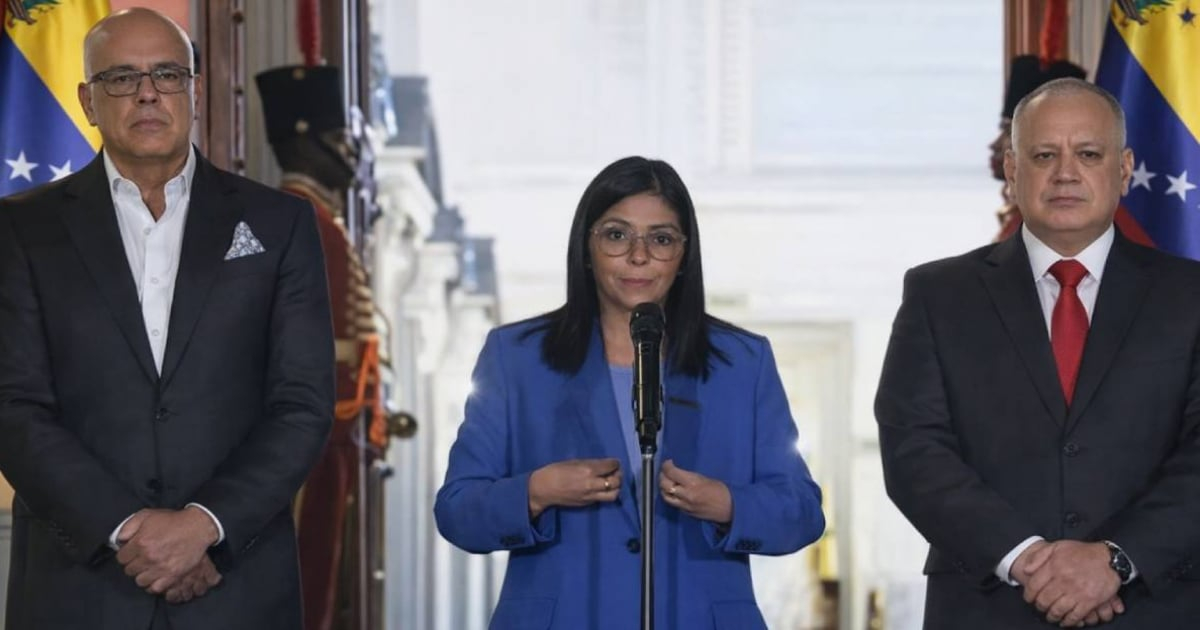
The Venezuelan government, under the leadership of Delcy Rodríguez, has announced the release of 131 political prisoners. This decision follows closely on the heels of the conclusion of the initial round of formal talks between the government and opposition, which took place at the La Carlota Air Base in Caracas.
The announcement was made through a statement from the Program for Peace and Democratic Coexistence, an initiative spearheaded by the acting president, Delcy Rodríguez.
According to the official statement, the country's courts have implemented "alternative measures to deprivation of liberty" upon the request of the Public Ministry, after reviewing cases involving individuals charged or convicted of crimes related to "attacks against democratic institutions."
U.S. Secretary of State Marco Rubio welcomed the move, describing it as a "crucial step towards national reconciliation."
In a post on the social media platform X, Rubio noted that since January 3rd, 1,046 Venezuelans have been freed, while emphasizing that Washington continues to closely monitor the face-to-face dialogue process between the Venezuelan government and interim authorities, as part of the three-phase plan advocated by the Trump administration.
However, the official numbers have yet to be fully verified. The NGO Foro Penal, which independently tracks these releases, confirmed by the end of Friday only 64 of the 131 announced releases, noting that verification was ongoing. As of August 10th, the organization documented 391 active political prisoners in Venezuela.
Among those released was Christian Quintero, who was freed from El Rodeo I prison. He publicly expressed gratitude to opposition leader María Corina Machado.
"I am thankful to Nobel Peace Prize winner María Corina Machado for always supporting us. We heard her daily advocating and demanding our immediate freedom," Quintero stated, as reported by Venezuelan channel VPItv.
Machado, who was excluded from the formal negotiations for not being part of the National Assembly elected in 2015, responded with a message to Quintero, attributing the releases to the pressure exerted by Donald Trump and the U.S. government.
"Your freedom and that of the recently released citizens have been made possible thanks to [...] President Donald Trump and the U.S. government, who, by seeking justice against Maduro, paved the way for the release of all political prisoners," Machado wrote on X.
The releases come at a politically sensitive time. The first round of talks between the Chavista regime, represented by Jorge Rodríguez, and the opposition delegation led by Dinorah Figuera, began on August 6th and continued until August 12th. The releases are seen as a political gesture within this context.
Critics, however, have questioned the scope of the measure. Analyst Pedro Mario Burelli directly asked, "Why not more? Why not all?" suggesting that the U.S. has not applied enough pressure to secure the release of all detainees. Activist Bárbara A. De Jesús also reminded that over 200 individuals remain imprisoned.
Machado vowed to persist in her efforts until complete freedom is achieved: "We will not rest until EVERYONE is reunited with their families and our nation is fully FREE."
Frequently Asked Questions About Venezuelan Political Prisoners
How many political prisoners were released in Venezuela?
The Venezuelan government announced the release of 131 political prisoners.
Who attributed the release of political prisoners to U.S. pressure?
Opposition leader María Corina Machado attributed the releases to pressure from President Donald Trump and the U.S. government.
What is the stance of the U.S. regarding the release of Venezuelan political prisoners?
U.S. Secretary of State Marco Rubio welcomed the release as a crucial step towards national reconciliation, and the U.S. continues to monitor the dialogue process closely.