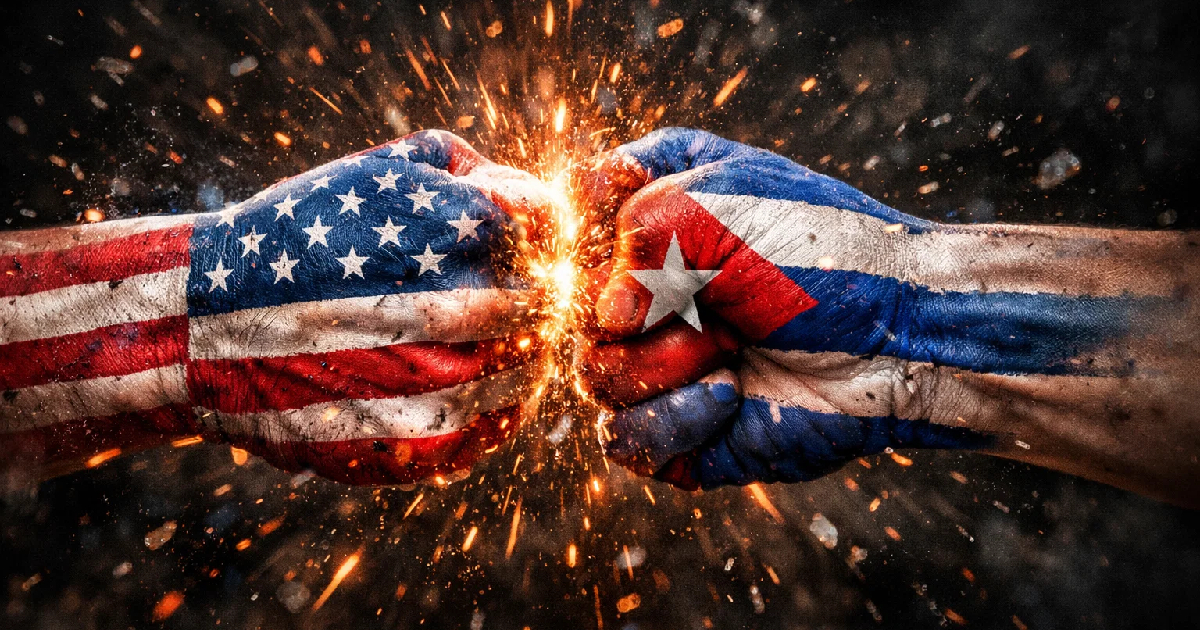
A legislative advisor from Florida has called for open dialogue between Cuba and the United States, cautioning that the Cuban government should not underestimate Washington's military threats amidst heightened tensions in the hemisphere driven by the Trump administration.
Miguel Granda, advisor to Florida State Representative David Borrero, told the Daily Signal that both nations stand to gain more from dialogue than from confrontation.
"The wisest path for Cuba involves increased cooperation with the U.S., alongside a genuine shift towards democratic governance and economic openness," Granda stated.
Granda emphasized that Washington prefers partnership over pressure: "America's military strength speaks for itself, but our preference is to lead through partnership, not pressure."
Warnings of Military Action
However, Granda warned that if Havana does not pursue this path, comments from Secretary of War Pete Hegseth regarding military force "should not be taken lightly."
Hegseth has been a prominent voice in the Trump administration's policy towards Cuba. This week, he stated that "countries like Cuba have been warned" and that Washington "will not tolerate such malign influence" in the hemisphere.
In a recent speech, he declared, "We will defend our hemisphere from external threats to national sovereignty, whether from narco-terrorism or malign foreign actors."
Earlier in June, Hegseth issued similar warnings during a visit to the Guantanamo Naval Base, cautioning Cuba against acquiring weapons capable of reaching the base or the U.S. mainland, invoking a so-called "Donroe Doctrine" as a modern take on the historic Monroe Doctrine.
Tensions with Dominican Republic
Florida Senator Juan Carlos Porras, representing a predominantly Cuban-American district, was more assertive: "This administration has made it clear that all options are on the table, and the Castro regime should be counting its final days."
Porras also praised the Dominican Republic's decision to expel nine Cuban diplomats, giving them a deadline of August 16.
"I commend the Dominican government for standing up for freedom in the hemisphere. The United States and our allies want to see a free Cuba," he asserted.
The Cuban regime responded by accusing Santo Domingo of acting under U.S. influence, claiming ten officials were affected, compared to the nine reported by the Dominican Foreign Ministry.
Diplomatic sources attributed the expulsions to alleged intelligence activities by some of these officials, although the Santo Domingo government did not officially confirm this.
Concerns Over Foreign Influence
Mike Gonzalez, a senior fellow on security and foreign policy at The Heritage Foundation, supported the Trump administration's stance and pointed out that the presence of powers like China, Russia, and Iran in Cuba poses a direct threat: "Their support for the Cuban dictatorship has resulted in hardships for the Cuban people."
In this context, Cuban Prime Minister Manuel Marrero confirmed in July that a working group is negotiating with the U.S., though without any concrete results or public acknowledgment of formal progress.
Granda's position encapsulates the current tension: the door for dialogue remains slightly ajar, but time is running out, and military options are still on the table.
Key Questions on U.S.-Cuba Relations
What is the current state of U.S.-Cuba relations?
U.S.-Cuba relations are tense, with calls for dialogue overshadowed by military warnings from the U.S. and continued political differences.
Who is advocating for dialogue between the U.S. and Cuba?
Miguel Granda, an advisor to Florida State Representative David Borrero, is advocating for dialogue over confrontation between the U.S. and Cuba.
What are the potential consequences if Cuba ignores U.S. warnings?
Ignoring U.S. warnings could lead to military action as indicated by recent statements from U.S. officials.