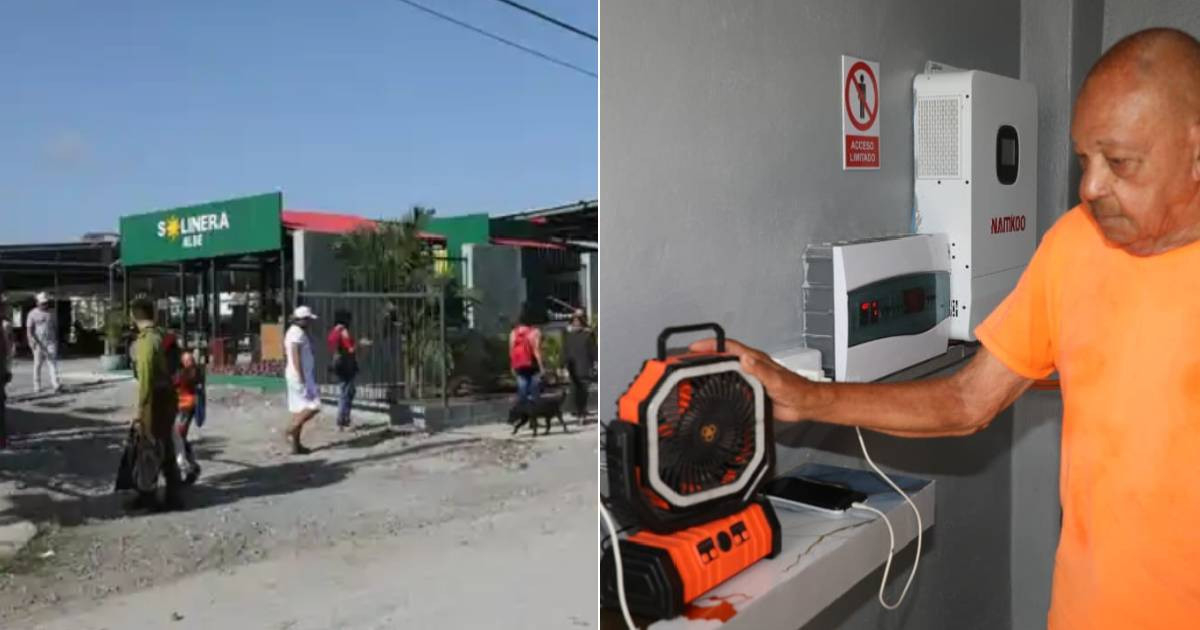
In response to prolonged blackouts affecting residents, the José Martí community in Santa Clara has introduced two new solar-powered charging stations for electronic devices, electric scooters, and tricycles.
The "Albe" solar station, equipped with photovoltaic panels and battery storage systems, operates independently from the national power grid. Locals can charge their cell phones, fans, lamps, scooters, and electric tricycles at this facility.
The second station, known as "La Verbena," is located on Gloria Street between Maceo and Unión. It offers fixed charging services to the public from 9:00 a.m. to 3:00 p.m., according to CMHW radio station.
These inaugurations were part of events in Villa Clara commemorating the 100th anniversary of dictator Fidel Castro's birth (1926-2016) and were attended by Susely Morfa González, the Communist Party's first secretary in the province, along with Governor Milaxy Yanet Sánchez Armas.
Decentralized Energy Solutions in Villa Clara
Both stations are part of a broader solar infrastructure initiative launched in April in Villa Clara as a decentralized response to the ongoing electrical crisis. The term "solinera," a Cuban neologism combining "solar" and "gas station," has emerged in response to the country's worst energy crisis in decades.
This crisis has been exacerbated by the halt in Venezuelan crude shipments, reduced Mexican oil exports under U.S. sanctions, and decades of governmental economic mismanagement prioritizing luxury hotel construction over energy infrastructure modernization.
The central province's first solinera was inaugurated on April 5 in the Virginia community, constructed in just nine days by the Local Development Project Gomate. It features 56 solar panels, providing 30 kW of power and 60 kWh of storage capacity.
Since then, the model has been replicated in Sandino, José Martí, and Ciro Redondo neighborhoods. Additionally, during July 26 celebrations, the country's first fast-charging station for electric vehicles was opened by the private microenterprise Solguara at kilometer five on the Santa Clara highway.
Expansion of Solar Charging Infrastructure
The Cuban government has recently introduced tax incentives, such as the Ministry of Finance and Prices' Resolution 180/2026, published on August 7 in the Official Gazette. This resolution extends the exemption of tariffs for importing solar panels, batteries, inverters, and electric vehicle chargers using renewable sources until December 31, 2027.
The "solinera" model is spreading across the island. Matanzas plans to establish nine collective charging points, Havana announced a station in Vedado, Holguín has already inaugurated its facility, and Guantánamo has a plan to construct about 15, highlighting the magnitude of an energy crisis that the state has struggled to solve through conventional means.
Understanding the Solar Charging Stations in Cuba
What is the purpose of the new solar charging stations in Villa Clara?
The new solar charging stations in Villa Clara aim to provide a decentralized energy solution for residents affected by prolonged blackouts. They allow for the charging of electronic devices, electric scooters, and tricycles.
How do these solar stations operate independently of the national power grid?
These solar stations are equipped with photovoltaic panels and battery storage systems, enabling them to function without reliance on the national electricity grid.
What measures has the Cuban government taken to support the development of solar infrastructure?
The Cuban government has introduced fiscal incentives such as the exemption of tariffs for importing solar energy components, as per Resolution 180/2026, to encourage the growth of solar infrastructure.