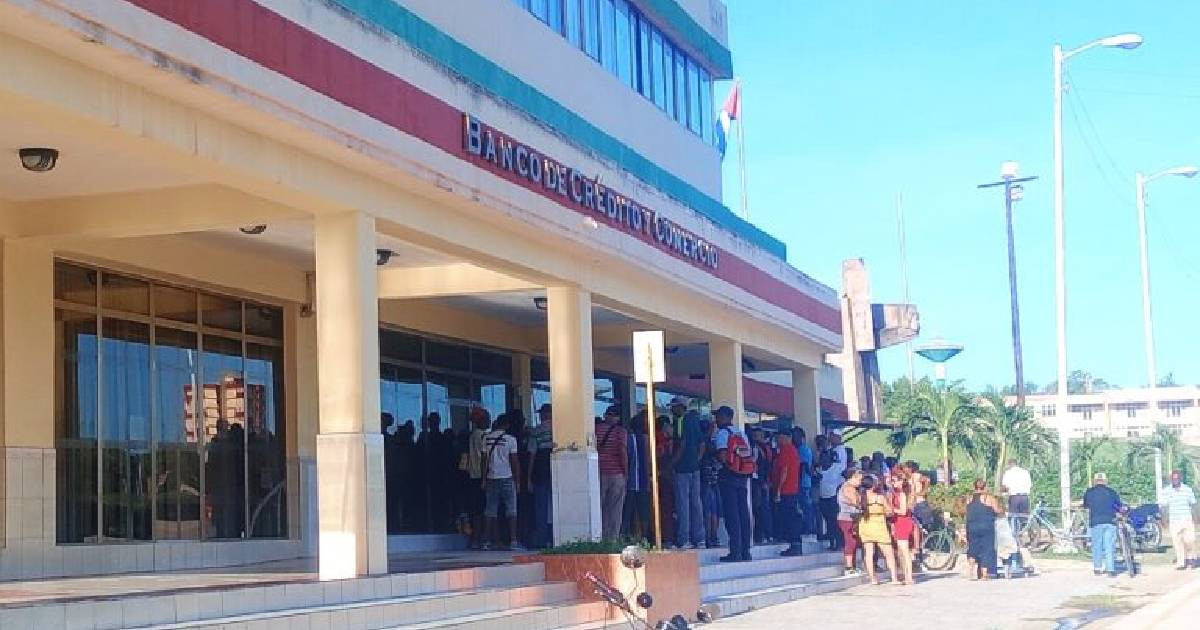
The Guantánamo branch of the Banco de Crédito y Comercio (Bandec) announced on Friday a strategic initiative to engage private businesses as financial agents for distributing pension payments to retirees directly at their locations. This move comes with a range of incentives for those who voluntarily participate.
The update was provided by Júder Ortiz González, the accounting subdirector of Bandec's Provincial Directorate in Cuba's easternmost province. He specified that pension payments for August will commence on Monday, August 18, and will continue into early September, with five days dedicated to prioritized service.
Ortiz emphasized that participation is not mandatory for economic actors, yet those who collaborate with the bank will enjoy preferential treatment, as reported by Radio Guantánamo. These benefits include financial bonuses for each "extra cash" operation conducted for retirees, prioritized banking services, expedited credit applications, and prioritized access to cash for their own business transactions.
The subdirector was clear about the implications of opting out: "It's different for someone who becomes a financial agent and helps the bank process payments compared to an actor who does nothing. All these factors will be considered when interacting with an economic entity."
The official rationale for shifting this duty to the private sector is to reduce wait times faced by retirees at bank branches. "Being closer to the economic actor means they don't have to wait in long lines or spend days collecting their pension checks," Ortiz explained.
At the time of the announcement, the recruitment process was still under review, with no specific details on the number of businesses involved or when they might start operating as payment sites.
National Expansion and Economic Challenges
This initiative in Guantánamo mirrors a national strategy that has been underway for months. The pilot program began in April across four municipalities in Havana and expanded in May to Holguín, where approximately 20 private enterprises started paying pensions to about 5,000 retirees.
In July, the Central Bank of Cuba formalized this approach as a national policy within a package of 176 economic measures approved by the National Assembly. The underlying issue is a liquidity crisis, with over 50% of the country's ATMs either malfunctioning or out of cash, forcing retirees to endure long waits for their payments.
Cuba's pensioners, numbering over 1.7 million, receive a minimum pension of 4,000 pesos monthly, equating to less than $10 on the informal exchange market, while an individual's basic needs require over 30,000 pesos per month.
Criticism and Concerns from Economists
Economist Elías Amor has been a vocal critic of this scheme, asserting that pension payments are a government obligation that should not be outsourced to the private sector. He warned that this measure might be used as a pretext to penalize or shut down businesses unable to meet cash demands.
"The first step should be to immediately abolish this madness. This is yet another ill-conceived idea by the Castro regime, which, when it fails, blames the blockade and embargo for its failures," Amor stated.
The situation in Guantánamo is particularly strained. In July, the provincial government admitted to a cash shortfall in banks, with a daily gap of at least three million pesos. Local authorities have simultaneously threatened fines against businesses that refuse electronic payment methods, pressuring the private sector from multiple angles.
FAQs on Pension Payment Scheme in Guantánamo
What incentives are offered to businesses participating in the pension payment scheme?
Businesses that participate will receive financial bonuses for each pension payment transaction, prioritized banking services, faster credit application processes, and prioritized access to cash for their business operations.
Why is the pension payment responsibility being shifted to the private sector?
The shift aims to alleviate the long lines and wait times retirees face at bank branches by providing a more convenient payment option through nearby private businesses.
What criticism has the pension payment scheme faced?
Critics argue that pension payments are a government responsibility and should not be transferred to the private sector. There are concerns it could lead to penalties or closures of businesses unable to maintain cash supplies.