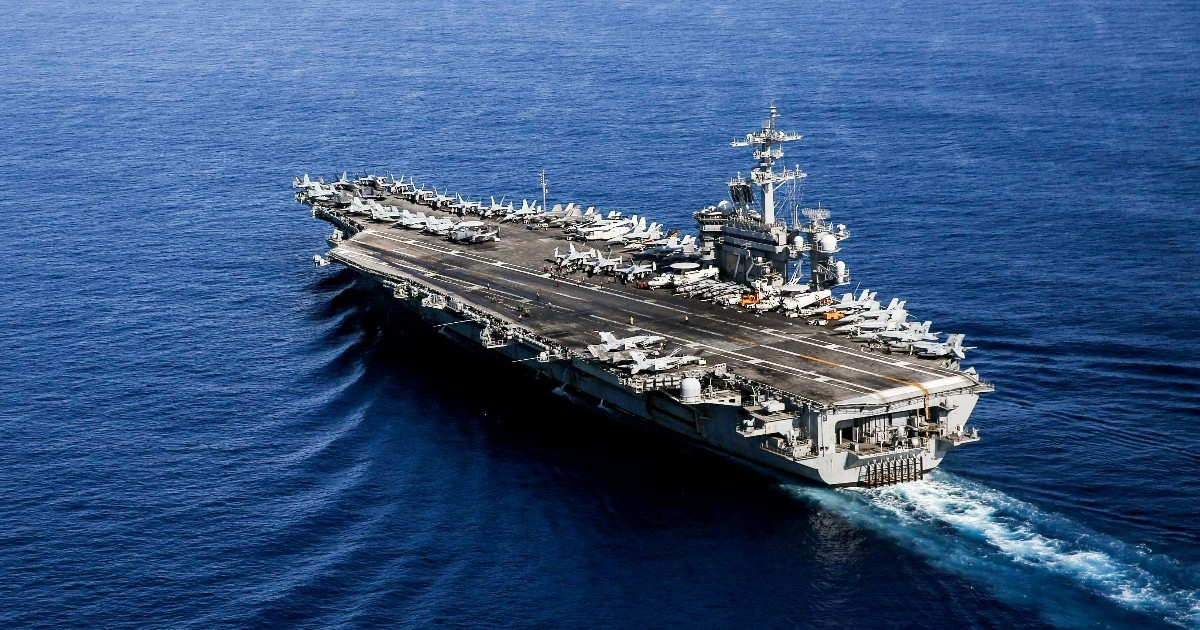
The USS George Washington has set sail for the Middle East from the Pacific Ocean to take over for the USS Abraham Lincoln. The Lincoln has been deployed for over 260 consecutive days, and reports indicate a mental health crisis and deteriorating conditions onboard, as announced by the U.S. Navy this Friday.
The Abraham Lincoln departed from the San Diego Naval Base on November 21, 2025, with an initial deployment planned for seven months, which has since been extended twice.
The carrier arrived in the Middle East in January 2026, just weeks prior to the outbreak of war with Iran, and has since remained at sea for over 200 days without docking, a record-breaking stretch according to Democratic lawmakers.
Among the most alarming details leaked to the press are accounts from families claiming that two sailors attempted to jump overboard during the extended deployment.
The Navy acknowledged in a statement that the conflict has created "a highly challenging environment where traditional supply centers in the Middle East have been disrupted by combat activities," resulting in shortages of essential goods and loss of mail onboard.
The statement clarified that "leadership prioritized mission-critical supplies: food first, then hygiene items, followed by mail," and assured that sailors now have access to clean water and "healthy meal options."
Defense Secretary Pete Hegseth dismissed the reports on Thursday, calling them "completely misrepresented."
On Friday, President Donald Trump denied that families of the sailors were worried. "No, they're not worried," he responded to a journalist's question before a trip to New York.
When asked if the deployment had been excessively long, Trump was adamant: "No, no, no. It’s far from being too long."
However, the president confirmed that the Lincoln "is moving, or will be moving very soon, and will be replaced by a very similar vessel," referring to the George Washington.
The USS George Washington departed from Da Nang, Vietnam, on August 5 and was reported to be navigating the Strait of Malacca with a cruiser and a destroyer, en route to the Indian Ocean.
Its move to the Middle East will temporarily leave the Pacific waters without a U.S. aircraft carrier presence, raising strategic concerns regarding China.
Several Democratic legislators have demanded accountability from the Pentagon. Senator Richard Blumenthal, a member of the Senate Armed Services Committee, sent a formal letter to Hegseth and Acting Navy Secretary Hung Cao last Tuesday.
"The prolonged deployment of the Lincoln is particularly significant because it occurs in the context of ongoing military operations against Iran and the possibility that substantial U.S. naval forces will be required in the region for an extended period," Blumenthal wrote.
Although direct hostilities between Washington and Tehran have subsided in recent weeks, the Navy reimposed a naval blockade on Iranian ports in the Strait of Hormuz in July. Hegseth stated that the U.S. could maintain it "indefinitely," while the Trump administration has not clarified how it intends to resolve the conflict.
The Lincoln has a unique connection to Cuba: in May 2026, Trump threatened to send the carrier within 100 yards of Cuban shores once operations in Iran concluded, a threat dismissed by Cuban Foreign Minister Bruno Rodríguez Parrilla, who stated Cuba "will not be intimidated." This threat never materialized as the vessel now returns to U.S. territory after more than eight months at sea.
Understanding the U.S. Navy's Strategic Moves in the Middle East
Why is the USS Abraham Lincoln being replaced by the USS George Washington?
The USS Abraham Lincoln is being replaced due to its extended deployment of over 260 days, which has led to reports of a mental health crisis and deteriorating conditions on board. The USS George Washington is being deployed to relieve the Lincoln in the Middle East.
What issues have been reported on the USS Abraham Lincoln?
Reports have highlighted a mental health crisis among the crew and deteriorating conditions during its prolonged deployment. Specific incidents include two sailors attempting to jump overboard, and shortages of essential supplies and mail due to disrupted supply lines.
How has the U.S. Navy addressed the supply shortages on the USS Abraham Lincoln?
The U.S. Navy has prioritized essential supplies for the mission, ensuring sailors have access to food, hygiene items, and eventually mail. They have also secured clean water and healthy meal options for the crew.