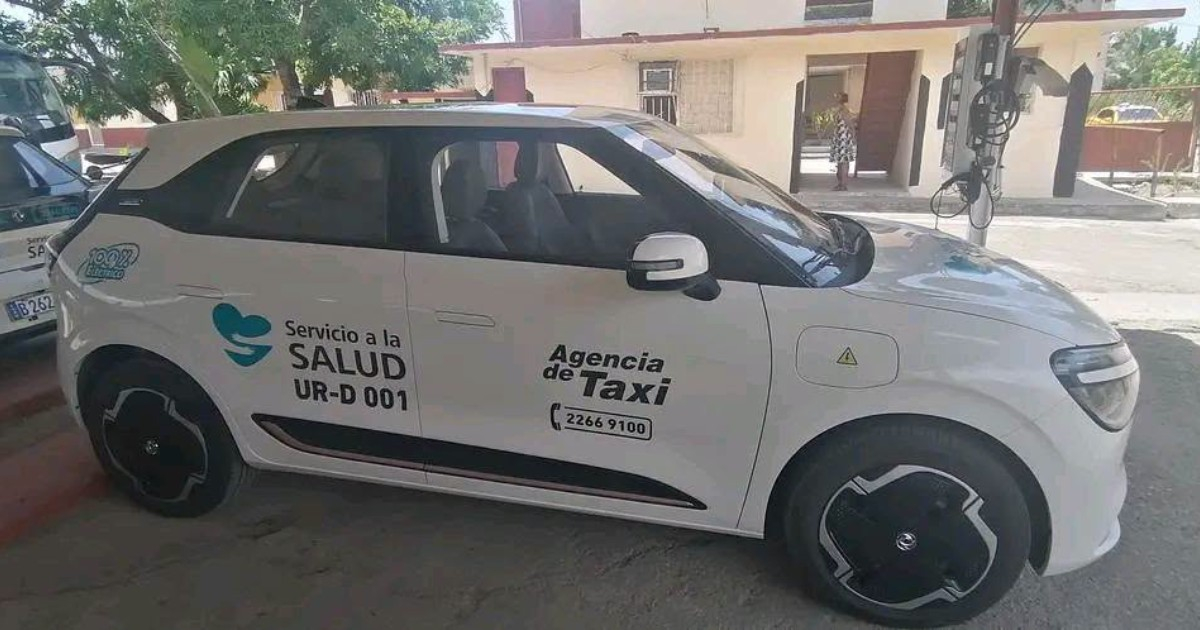
The Santiago de Cuba Base Taxi Unit has acquired 10 fully electric vehicles from the Chinese brand Dongfeng to specifically assist patients undergoing dialysis treatments at hospitals in the eastern city.
These new vehicles have been funded by the Public Transport Development Fund under the Ministry of Transport and will operate from the Rajayoga Base, which is already experienced in providing services to healthcare facilities in Santiago.
Gustavo Garlobo Enamorado, the director of the Base Taxi Unit, announced the details of the acquisition, stating that these cars will serve 106 patients suffering from chronic renal failure in Santiago de Cuba's head municipality.
Adorned with the label "Health Service," these taxis will be stationed at five hospitals: Provincial Saturnino Lora Torres, Clínico Quirúrgico Juan Bruno Zayas Alfonso, Oncological Conrado Benítez, Infantil Sur José María Béguez César, and Maternal North Tamara Bunke.
Niurka Bell Calzado, a member of the Executive Bureau of the Provincial Committee of the Communist Party of Cuba in Santiago, urged drivers and mechanics to adhere to the planned maintenance and take care of the vehicles, emphasizing the "high human value" of their task.
National Plan for Electric Vehicles
This initiative is part of a nationwide plan announced in March 2026, where the Cuban regime pledged 400 Dongfeng Box 01 electric vehicles to assist over 3,000 renal patients reliant on regular treatments in the 57 dialysis units across the nation.
By May 2026, 200 of these vehicles were already operational as the first half of the batch. The allocation includes 40 vehicles to Havana, 20 to Guantánamo, 15 to Granma, 10 to each remaining province, and five to Isla de la Juventud.
Prior to Santiago, Las Tunas and Matanzas received their share of 10 vehicles each at the start of July, while Villa Clara incorporated 10 of its 20 allocated vehicles by mid-June.
Responding to a Humanitarian Crisis
This measure is a response to a worsening humanitarian crisis since February 2026, when a chronic fuel shortage halted medical transport in several provinces, forcing dialysis patients to pay up to 500 pesos per trip in informal taxis.
Santiago de Cuba faced a specific crisis in July 2026 when the Provincial Hospital Saturnino Lora Torres reduced hemodialysis sessions from four to two hours due to a lack of supplies.
In Camagüey, the situation reached a critical level in June 2026, as patients went nearly a week without treatment due to the absence of acid concentrate and bicarbonate.
The Ministry of Public Health acknowledged in June 2026 that the ambulance system covers less than 40% of national demand, while Energy and Mines Minister Vicente de la O Levy admitted the same month that Cuba had "absolutely no" diesel or fuel oil.
The project's sustainability heavily relies on the national electric grid, although plans for photovoltaic installations are underway as a backup in a country plagued with blackouts lasting up to 20 hours daily in several provinces.
Frequently Asked Questions about Electric Taxis for Healthcare in Cuba
What is the purpose of the new electric taxis in Santiago de Cuba?
The new electric taxis are intended to transport patients in need of dialysis treatment to hospitals in Santiago de Cuba, ensuring they receive necessary medical care.
How many electric vehicles has the Cuban government pledged for dialysis patients?
The Cuban government has committed to providing 400 Dongfeng Box 01 electric vehicles to aid more than 3,000 dialysis patients nationwide.
What challenges does the electric taxi project face in Cuba?
The project's sustainability depends significantly on the national electric grid, with planned photovoltaic installations as a backup due to frequent blackouts across the country.