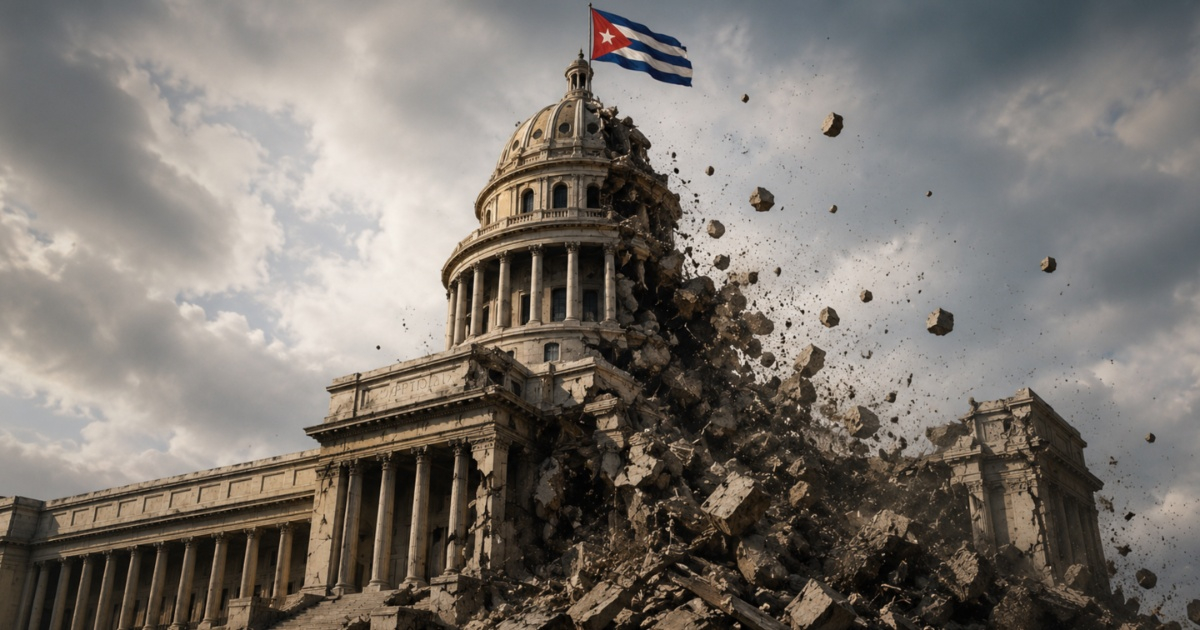
The Trump administration has crafted a policy towards Cuba that aims to create internal divisions within the regime and open up negotiation channels through maximum economic pressure, while currently ruling out military intervention.
According to anonymous sources familiar with the administration's strategy and cited by Bloomberg on Friday, the stated goal of Washington is not just to financially suffocate the regime but also to create rifts among the various factions that control power in the country.
These factions include the Castro family, the military, the Communist Party bureaucracy, and descendants of other revolutionary figures.
The fractures, the sources suggest, could serve as leverage to push for negotiations that Havana has consistently rejected for nearly seventy years.
A U.S. official quoted by Bloomberg noted that the administration is open to "a new chapter" in relations with Cuba, but the only impediment is the current leadership of the country.
The same official warned that a failed state on the island would pose a threat to U.S. national security, recalling that virtually all leftist militant groups in the Western Hemisphere have received Cuban support at some point.
The State Department has kept all options open: "As with any foreign policy issue, President Trump has many options at his disposal. The United States will continue to use all available means to address the national security threats posed by the Cuban communist regime and to push for economic and political reforms that offer a better future for Cuba."
While military action is not explicitly ruled out—Trump views unpredictability as a political tool—it has been pushed to the back burner.
The ongoing war in Iran, now in its fifth month, consumes political and military resources, and the president wants to avoid deploying ground troops.
Bombing targets in a poor island nation off the coast of Miami also lacks clear strategic utility, according to the same sources.
Since January 2026, the administration has imposed more than 240 sanctions against Cuba and intercepted at least seven tankers, resulting in an estimated 80-90% drop in the island's energy imports.
Recent measures include sanctions against GAESA in May, the business conglomerate of the Armed Forces; sanctions on the Ministry of Tourism in July; and sanctions against five entities and eight individuals linked to arms procurement, announced on August 6.
The UN has warned of food and medicine shortages and power outages affecting hospitals and oncology centers.
The Cuban case is more complicated than the Venezuelan one. After capturing Nicolás Maduro in January, Washington installed Delcy Rodríguez as interim president, gaining direct influence over the government.
In Cuba, however, U.S. officials believe that Miguel Díaz-Canel is controlled by the Castro family, with power dispersed among its members and military leaders, complicating any strategy for internal division.
Adding to this is the lack of a credible political opposition and a consensus alternative leader.
Marco Rubio, a central figure in this policy, has moderated his rhetoric in recent weeks.
In a podcast with Katie Miller released this week, he answered a question about whether Cuba would be "next" after Venezuela with a more cautious response than in January: he is confident that Cuba will be "on an irreversible path to a very different future" by the time "this administration ends" in January 2029.
He added, "You can't keep something standing for 70 years—that takes root—and then think that overnight, you're going to uproot it all and plant something completely new."
Understanding Trump's Policy on Cuba
What is the primary goal of Trump's strategy towards Cuba?
The primary goal of Trump's strategy is to create internal divisions within the Cuban regime and open up negotiation channels through maximum economic pressure, without resorting to military intervention.
Why does the U.S. consider Cuba a national security threat?
A failed state on the island could threaten U.S. national security, as Cuba has historically supported various leftist militant groups in the Western Hemisphere.
What measures has the Trump administration taken against Cuba?
The administration has imposed over 240 sanctions, including actions against GAESA and the Ministry of Tourism, leading to a significant drop in energy imports to the island.