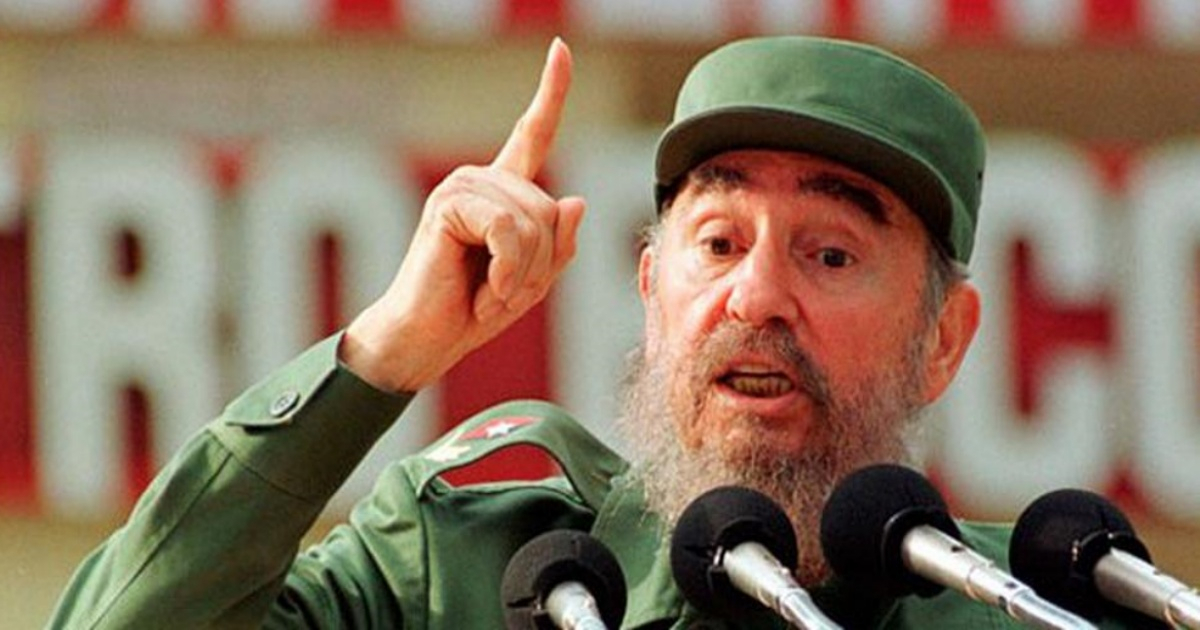
Mario Juan Valdés Navia, a Cuban historian and Associate Researcher at the National Humanities Center and Duke University, released an essay this past Friday dissecting the ideological framework of Castroism. He argues that Fidel Castro's leadership was underpinned by an unspoken yet universally understood maxim: "I am the Revolution."
The essay posits that Castro crafted a demagogic narrative intertwining three key concepts—"Nation," "Revolution," and "Socialism"—which Valdés Navia describes as a "new Holy Trinity" in which people were expected to place their faith and hope. In this context, according to Valdés Navia, Castro acted as a kind of high priest, guiding the populace on how to support him.
Spanning nearly six decades, from 1956 until Castro's death on November 25, 2016, the essay chronicles how his will "was imposed on the nation to fracture and reshape it, akin to a collective Frankenstein, through campaigns, battles, offensives, tasks, strategies, plans, missions, programs, and any voluntarist social engineering scheme he could conceive."
As early evidence of this logic of absolute control, Valdés Navia references a letter from Castro to the National Directorate of the 26th of July Movement in September 1955: "there will be no talk of coordination of efforts but of the plain and simple acceptance that revolutionary leadership has changed hands and that all other factors must subordinate to its new strategy, discipline, and program."
Concentration of Power and Ideological Control
Once in power, consolidation was immediate. The Fundamental Law of February 7, 1959, granted the Prime Minister both executive and legislative powers, relegating the president to a secondary role. That same year, the Council of Ministers approved a provision stating that in the absence of the Commander in Chief, Raúl Castro would take command of the Armed Forces. "Free elections were never mentioned again," the historian notes.
On an ideological front, Castro's "Words to the Intellectuals" on June 30, 1961, established cultural censorship with a mantra still echoed by the regime: "Within the Revolution: everything; against the Revolution: no rights." That year, Castro openly declared his Marxist-Leninist stance, admitting he had previously concealed it for strategic reasons: "if we had stood on Pico Turquino when we were 'four cats' and said: we are Marxist-Leninists, we might not have been able to make it down to the plains. So we called ourselves something else."
Emigration as a Political Tool
The essay also illustrates how Castro utilized emigration as a bargaining chip. The Freedom Flights, between 1965 and 1973, saw 260,561 Cubans relocate to the United States. Three decades later, following the popular uprising known as the "maleconazo" in August 1994, Castro deliberately triggered the Balseros Crisis: 47,844 individuals reached U.S. shores, 32,362 were intercepted at sea and detained in Guantanamo, and an estimated 8,000 perished during the journey.
In his later years, Castro acknowledged to journalist Jeffrey Goldberg and researcher Julia Sweig that "the Cuban model no longer works even for us," though he later attempted to retract this statement. He also admitted to Carmen Lira, director of the Mexican newspaper La Jornada, his culpability in the Production Support Military Units (UMAP): "those were moments of great injustice, a great injustice! [...] If anyone is responsible, it's me."
The Legacy of Castro's Ideological Constructs
Valdés Navia, born in Sancti Spíritus in 1961 and expelled from Cuban universities in 2011 for his critical writings on the regime's policies, has been welcomed since 2023 as a Scholar at Risk at Duke University. His analysis links Castro's legacy to the current crisis: the single party he founded remains the only legal one, the Castro power group controls the economy through the GAESA holding, and the Rapid Response Brigades he institutionalized continue to act against any dissent.
The triad of "Nation-Revolution-Socialism," analyzed in the essay as a tool of symbolic domination, is still invoked by the regime amid energy collapse, food shortages, and mass exodus. The country is falling apart; yet, the government uses all its resources to celebrate the 100th anniversary of the dictator's birth.
In 1987, Castro claimed that "the supreme test of a citizen's identification with the State... is their total commitment to that process, their willingness to defend it with their life." For Valdés Navia, this statement doesn't describe any identification but rather the abduction of individual will by those who control the state's apparatus.
Understanding the Influence of Castro's Ideology
What was the core message of Valdés Navia's essay?
Valdés Navia's essay argues that Fidel Castro's leadership was built on an unspoken axiom, "I am the Revolution," and that his demagogic narrative fused the concepts of Nation, Revolution, and Socialism into a symbolic trinity.
How did Castro use emigration as a political strategy?
Castro used emigration as a political tool, notably through the Freedom Flights and the Balseros Crisis, to negotiate and manipulate both domestic and international perceptions.
What impact did Castro's ideology have on Cuba's current situation?
Castro's legacy continues to affect Cuba through the continued dominance of the single party he established, economic control by the Castro power group, and the operation of Rapid Response Brigades against dissent.