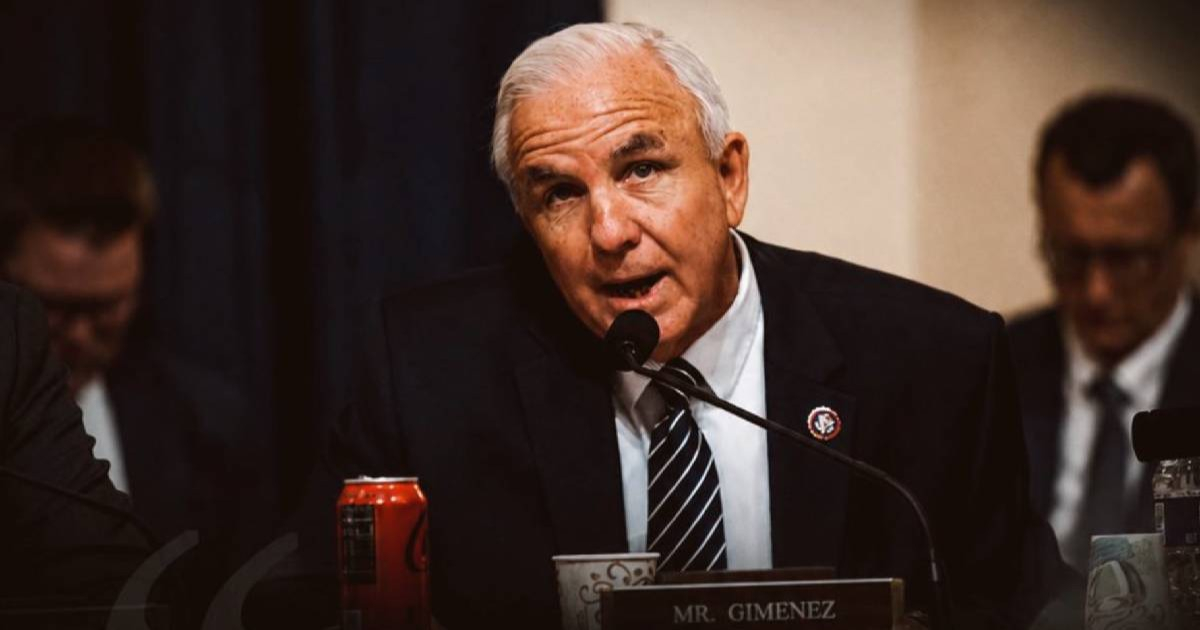
Cuban-American Congressman Carlos A. Giménez expressed his approval on Thursday regarding the Dominican Republic's decision to expel nine Cuban regime diplomats from Santo Domingo, calling it a historic demonstration of democratic resolve.
In a statement shared on his social media account, the representative for Florida's 28th District extended his gratitude to the Dominican government for "standing firm on the right side of history."
"By expelling the diplomats from the Havana regime, they firmly demonstrate their stance in history. This sends a clear message to the world: Cuba's freedom is non-negotiable," Giménez asserted, also thanking Santo Domingo for "supporting the Cuban people and refusing to be complicit with the dictatorship."
This action was ordered the same day by President Luis Abinader's administration.
The Dominican Ministry of Foreign Affairs informed the nine Cuban Embassy officials — along with their families, totaling 21 individuals — that they must leave the country by Sunday, August 16.
The Dominican government justified the expulsion under Article 9 of the Vienna Convention on Diplomatic Relations, which allows for declaring a member of a mission persona non grata without publicly providing reasons, and stated it would handle the matter with "due discretion" through diplomatic channels.
The Cuban regime promptly rejected the decision. Foreign Minister Bruno Rodríguez Parrilla claimed there was "no justification for the measure" and labeled it an act of "submission" to U.S. pressures.
This expulsion was not sudden, as tensions between Santo Domingo and Havana had been escalating since October 2025, when the Dominican Republic excluded the Cuban regime from the X Summit of the Americas in Punta Cana, along with Nicaragua and Venezuela.
In May 2026, President Abinader publicly stated that Cuba "is clearly not a democratic state," and in July, the Caribbean nation abstained from the UN vote regarding the U.S. embargo on Cuba.
The Dominican decision is part of a broader trend of diplomatic isolation faced by the Cuban regime in the region during 2026.
In March, Ecuador expelled the entire Cuban diplomatic mission in Quito within a 48-hour deadline; Costa Rica closed its embassy in Havana the same month; and in July, Colombia's new government announced a severance of relations with both Cuba and Nicaragua.
Born in Cuba in 1954 and residing in Miami since childhood, Giménez is one of the most vocal U.S. lawmakers in condemning the Cuban dictatorship. In February 2026, he described the regime as "pathetic" and asserted it should be "completely annihilated."
"Thank you for not supporting the dictatorship and for standing by our people," concluded Giménez in his statement, marking the most severe diplomatic rift between Santo Domingo and Havana in decades.
Implications of Diplomatic Expulsions on Cuba-Dominican Relations
What prompted the Dominican Republic to expel Cuban diplomats?
The expulsion was driven by escalating tensions and previous diplomatic actions that highlighted the Dominican Republic's disapproval of the Cuban regime's policies and lack of democratic governance.
How has the Cuban government responded to the expulsions?
The Cuban government has rejected the decision, with its Foreign Minister calling it unjustified and an act of submission to U.S. pressure.
What does this expulsion mean for Cuba's diplomatic standing in the region?
The expulsion is part of a larger pattern of diplomatic isolation Cuba is experiencing in Latin America, reflecting growing regional discontent with the Cuban regime.