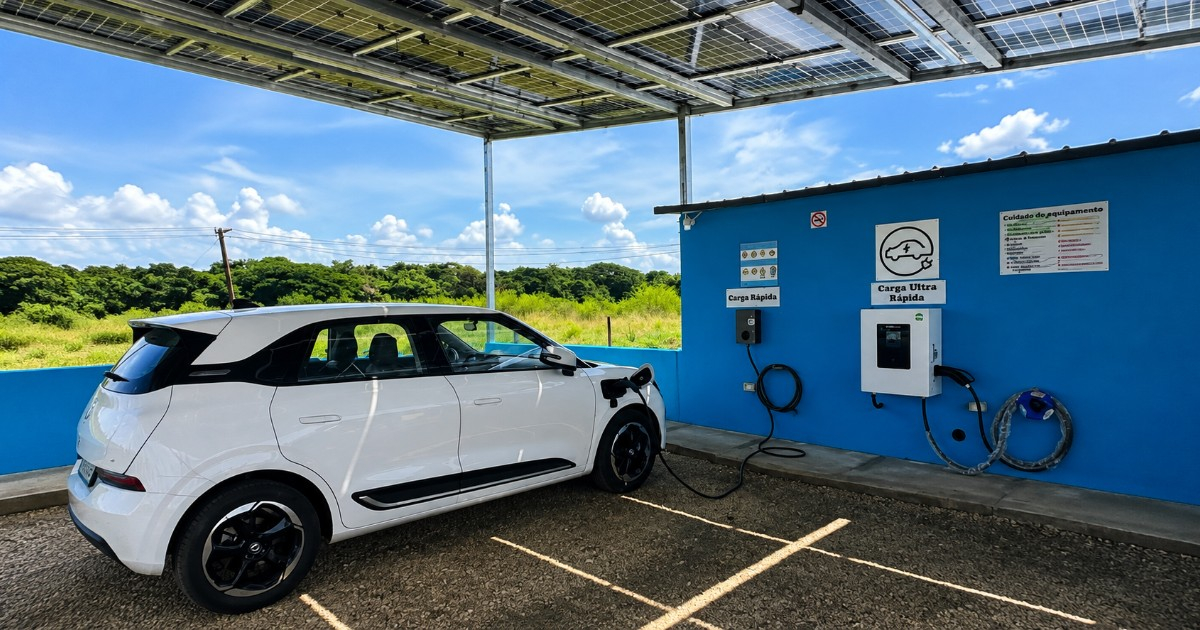
Cuba has launched its inaugural solar-powered fast and ultra-fast charging station for electric vehicles in Villa Clara. This facility operates independently from the National Electrical System (SEN) while millions of Cubans continue to endure prolonged blackouts amid one of the worst energy crises in recent decades.
The EFE agency reported this past Wednesday that the so-called "solinera" is located on the National Highway, approximately five kilometers from Santa Clara, and is constructed and managed by the private small business, Solguara.
This station derives its power from solar panels and is not reliant on the national grid. It offers two charging modes, fast and ultra-fast, with connectors compatible with various international standards, aiming to serve electric vehicles traveling on one of the country's main roadways.
Caibarién's CNTV Telecenter highlighted that the facility operates entirely separate from the SEN, presenting the project as part of the official policy to boost the use of renewable energy sources. Beyond charging cars, the solinera will allow people to connect cell phones, fans, and rechargeable lamps. These additional services will be free, making them especially valuable in a nation where blackouts often exceed 24 continuous hours.
Solguara's facility is part of a series of new solar infrastructures that were inaugurated recently in Villa Clara. Among them is this station, conceived as the nation’s first dedicated to fast and ultra-fast charging for electric vehicles. However, it is not the first "solinera" in Cuba; for instance, Santa Clara has had a solar station in the Virginia popular council since April, equipped with 56 panels, 30 kilowatts of power, and 60 kilowatt-hours of storage.
Other stations are operational in the Sandino, José Martí, and Ciro Redondo districts of Santa Clara. Some not only charge devices but also allow cooking using the electricity generated by solar panels, a feature that has gained importance given the extended duration of power outages.
The opening coincides with new regulations that took effect this Tuesday, allowing individuals to directly import electric vehicles alongside renewable energy charging systems without commercial intent. The government has also approved customs benefits for photovoltaic solar systems and electric vehicle chargers that utilize renewable energies.
This rollout comes over a year after CIMEX announced a project to install 40 solar charging stations for electric vehicles across the country by 2026. The plan involved autonomous installations, disconnected from the SEN, promising the capacity to charge hundreds of vehicles daily. The timeline shared then anticipated the first station would be operational by the second half of 2025, with locations including Havana, Mayabeque, Varadero, Cienfuegos, Villa Clara, Sancti Spíritus, and Ciego de Ávila.
"Solineras" have been expanding as the decline in electrical service necessitates seeking alternatives outside the national network. In May, a small private business began developing a solar station in Holguín for charging electric vehicles in a space previously occupied by a fuel service center. This project was specifically presented as an alternative to the critical energy situation in that province.
In Matanzas, authorities announced the installation of nine "solineras" designed to allow the community to charge electric equipment and even cook collectively during blackouts.
Understanding Cuba's Solar Charging Stations
What is a "solinera"?
A "solinera" is a solar-powered station designed for fast and ultra-fast charging of electric vehicles, operating independently from the national electrical system.
Why are solar stations important for Cuba?
Given Cuba's frequent and prolonged blackouts, solar stations offer a reliable alternative for electric vehicle charging and other essential services, reducing dependency on the unstable national grid.
What additional services do solineras provide?
Beyond charging vehicles, solineras offer free charging for cell phones, fans, and rechargeable lamps, with some even providing facilities to cook using solar-generated electricity.