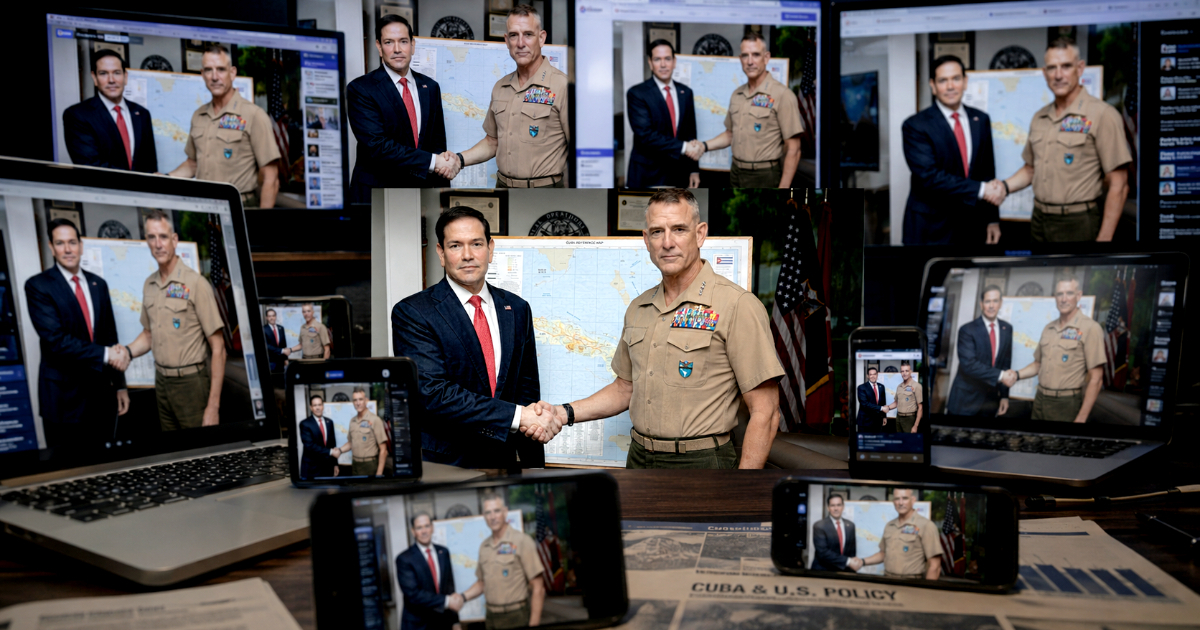
This past Tuesday, the Media Observatory of Cubadebate released an extensive study analyzing 57,695 online mentions concerning Marco Rubio and the Department of State from July 20 to August 9.
The report's boldest assertion goes beyond acknowledging the escalating pressure from Washington on Havana, suggesting instead that the online conversation indicates a "foreign interference operation."
However, the data presented fails to substantiate such a claim.
Evaluating the Digital Discourse
The study offers valuable insights into the evolution of discussions about Cuba over recent weeks. It pinpoints two major spikes in activity, assesses the presence of official U.S. accounts, scrutinizes the repetition of specific messages, and reconstructs the sequence following the report "Cuba: The Capital of 21st Century Communism," subsequent sanctions, and related journalistic reports on intelligence operations and potential scenarios of transition.
These findings suggest a deliberate U.S. strategy of exerting pressure, a strategy openly acknowledged by Washington. Marco Rubio has publicly advocated for increased pressure, mirrored by the Department of State's concrete actions.
Methodological Concerns
The crux of the issue arises when Cubadebate attempts to assert something different: that the patterns identified online constitute evidence of an interference operation by themselves.
One of the primary "discoveries" is that 52.2% of geolocated mentions originate from the United States, compared to just 5.4% from Cuba. From this disparity, Cubadebate infers an "external interference operation."
This logical leap is difficult to justify. The study examines U.S. policy towards Cuba, statements from the U.S. Secretary of State, and a report by the Department of State. Given this context, it is expected that a significant portion of the conversation would occur within the United States.
Correlation vs. Causation
Knowing the geographical origins of a conversation reveals where it is happening, but does not inherently indicate who orchestrates it, if there is organized coordination, or what the intentions of the participants are.
To credibly assert a coordinated operation, further evidence is necessary: connections between accounts, unusual synchronization, automation, common directives, funding, inauthentic behavior, or another mechanism that shifts from correlation to attribution.
None of these elements are substantiated within the report.
Content Amplification and Coordination
The Observatory also notes that 47.3% of the posts analyzed are retweets and observes that official accounts like @StateDept and @SecRubio coexist among key nodes with political profiles, media, and conservative users.
From this, they claim there is "discipline and message convergence." While convergence can be observed, coordination still requires proof.
It's not unusual for supporters of specific policies to echo messages from the Secretary of State or for conservative accounts to amplify content aligning with their ideological stance on social media. This phenomenon is common in any highly polarized political topic.
Retweets measure amplification but do not automatically identify the source of that amplification or whether it was directed by someone.
Distinguishing Governmental Coordination from Digital Conversation
There is a notable distinction between governmental coordination and digital conversation coordination. The consistency in messaging by the Department of State and its secretary is not anomalous; it is part of the standard operations of an institution communicating its foreign policy.
Proving that media, journalists, and users act as coordinated components of a Washington-designed operation is another matter. The data provided by Cubadebate does not reach that conclusion.
A similar situation arises with the chronological sequence.
Cubadebate observes the order of events: first, the Department of State's report; followed by sanctions, Rubio's declarations, social media amplification, and eventually reports by POLITICO and The New York Times on increased U.S. intelligence capabilities related to Cuba.
While the timeline shows a coherent and cumulative U.S. policy towards the Cuban regime, successive events sharing a political direction do not automatically equate to a single communicational operation.
Even more, it does not justify including independent media coverage as part of a State Department-directed strategy. Publications by POLITICO, The New York Times, or Axios based on leaks from U.S. officials demonstrate that journalists have accessed information from governmental sources, not that these outlets are part of a State Department-led strategy.
The Observatory itself acknowledges that reports on intelligence operations come from anonymous sources and "do not equate to an official admission."
Analyzing Methodological Limitations
The primary limitation of the report, paradoxically, lies in its own methodology.
Cubadebate explains at the study's conclusion that their research "describes patterns of discourse and amplification" and does not independently verify the truth of the accusations analyzed.
This methodological caution is correct. However, the same principle should apply to the conclusion regarding supposed interference.
The data indicates an intense conversation; that Washington has focused on Cuba within its national security agenda; that certain formulations recur; that official accounts have amplification power; and that there exists a political and media community in the U.S. that echoes these messages.
What the data does not demonstrate, without additional evidence, is that this conversation constitutes a "foreign interference operation."
This distinction is crucial because measuring a narrative is not equivalent to demonstrating who controls it.
The Observatory has gathered data that aids in understanding the changing conversation about Cuba. It even offers intriguing hints that the new framework promoted by Washington—viewing Cuba not just as a political and human rights issue, but also one of security, espionage, and influence—is gaining traction in the U.S. debate.
This phenomenon warrants further study.
Yet precisely because the data is intriguing, it should not be made to suggest more than it can substantiate. Washington's pressure is a public fact. The existence of a digital interference operation, however, is an allegation.
And an allegation requires proof, not just percentages, retweets, and correlations.
Understanding the Discussion on Cuba's Digital Conversations
What did Cubadebate's analysis focus on?
Cubadebate's analysis concentrated on online mentions of Marco Rubio and the U.S. Department of State, aiming to understand the evolution of conversations about Cuba and to assert the existence of a foreign interference operation.
Why is the U.S. involvement in conversations about Cuba expected?
Considering the focus on U.S. policy towards Cuba, it's anticipated that a significant portion of the conversation would occur in the United States. This involvement aligns with the U.S. government's public stance and actions regarding Cuba.
What evidence is needed to prove a coordinated interference operation?
To prove a coordinated interference operation, additional evidence beyond online conversation patterns is required, such as connections between accounts, unusual synchronization, shared directives, funding, inauthentic behavior, or automation.
Does the report from Cubadebate prove the existence of a foreign interference operation?
No, the report does not provide evidence to substantiate the claim of a foreign interference operation. It highlights a conversation about Cuba but lacks proof of organized coordination or intention.