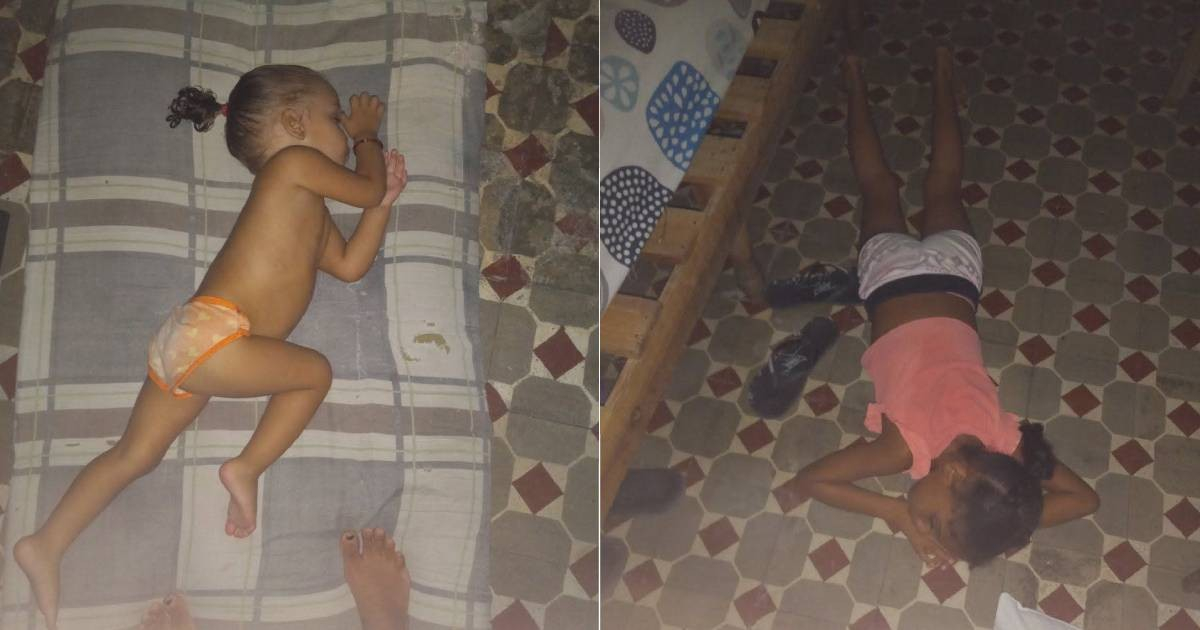
The heart-wrenching images of her young daughters sprawled on the tiled floor, trying to escape the oppressive heat, accompany a Cuban mother's plea as she endures her fourth consecutive day without electricity amid one of the island's most severe blackouts.
Amelia Cabrera, the mother in question, took to Facebook on Tuesday to share a poignant message directed at the Unión Eléctrica (UNE) and the government. She detailed her family's exhaustion after days of cooking with wood, battling mosquitoes, and enduring high temperatures without fans or refrigeration.
"How long must my daughters suffer from the heat and mosquito bites just because we don't live in a 'protected circuit'—or rather, because no communist lives in this circuit, hence we're not protected," she lamented.
Unveiling Inequities in Power Distribution
Her complaint highlights a major source of frustration among Cubans during the current energy crisis: the disparity between so-called "protected circuits," which for certain reasons are exempt from scheduled outages, and areas where power cuts can last nearly all day.
Cabrera recounted her desperation, to the point of considering bringing her soot-blackened pots to the authorities to illustrate her family's living conditions.
Ultimately, she refrained, fearing the repercussions of such a protest. "I remembered that in this country, there is no freedom, that we're imprisoned and shackled, and if you speak up or say anything, you get arrested and the key is thrown away as a counter-revolutionary," she shared.
Nationwide Power Grid Crisis
Her testimony surfaces during one of the most critical weeks of the year for the National Electric System (SEN). On Tuesday, the UNE projected an availability of just 933 MW during peak demand hours, against an estimated need of 3,250 MW. The anticipated shortfall reached 2,317 MW, and the impact could be as high as 2,347 MW, highlighting the severe degradation of Cuba's electrical infrastructure.
In reality, the available power amounted to less than a third of what the country required during peak consumption times.
Widespread and Prolonged Blackouts
This crisis has led to increasingly extreme situations in various provinces. In Matanzas, outages lasting up to 87 consecutive hours have been reported; in parts of Santiago de Cuba, residents claim to have only one or two hours of electricity per day, while in Havana, unprotected circuits have faced blackouts exceeding 20 hours daily.
Additionally, the SEN has suffered repeated total system failures. By 2026, Cuba had experienced at least seven complete blackouts, the most recent occurring on August 3, leaving the island in darkness once more.
Fear of Repression Amidst Growing Dissent
The fear expressed by Cabrera also arises in a context highlighted by independent organizations' reports of repression against those who protest or publicly voice their discontent. The Cuban Observatory of Human Rights documented nearly 2,000 repressive actions in the first half of 2026, while Prisoners Defenders reported 1,306 political prisoners in July, according to its monthly report.
Blackouts have been a key trigger for spontaneous protests in Cuba over recent years, amid the worsening living conditions, food and fuel shortages, and the exhaustion of a population enduring entire days without electricity.
For Cabrera, the gravity of the crisis is evident not only in the official energy deficit figures but in a much more mundane scene: two young girls seeking relief from the heat on their home's floor after days without power.
The mother concluded her post with a message aimed at those she accused of remaining indifferent to the hardships faced by many Cuban families: "This message is for all those living comfortably at the top. Long live a free Cuba, without blackouts or hunger."
Understanding Cuba's Energy Crisis
What are "protected circuits" in Cuba's power system?
"Protected circuits" are areas that, for various reasons, are exempt from scheduled power outages. These circuits typically receive continuous electricity supply, unlike other areas that experience frequent and prolonged blackouts.
How severe is the current power crisis in Cuba?
The power crisis in Cuba is extremely severe, with electrical availability falling far short of demand. This has resulted in widespread and lengthy blackouts across the country, significantly affecting daily life and leading to increased public dissatisfaction.
Why are blackouts a major issue for Cuban citizens?
Blackouts are a major issue because they disrupt essential daily activities, impede access to basic services, and contribute to the overall decline in living conditions. They also heighten public frustration and have been a catalyst for protests.