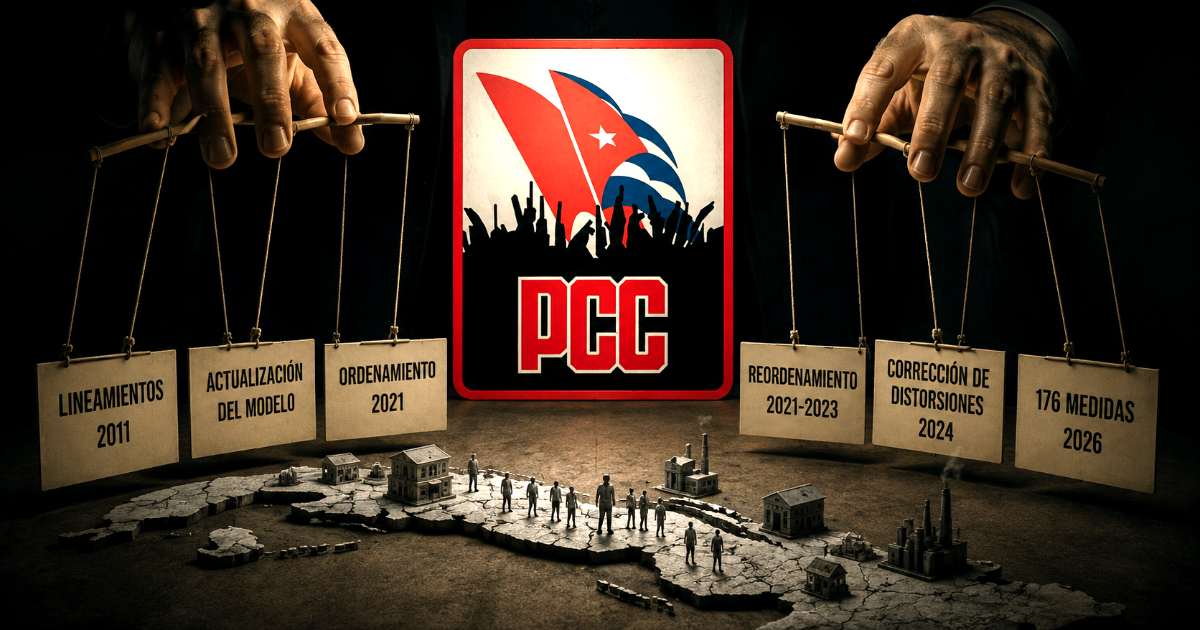
The recent economic transformation announced by the Cuban regime is profoundly revealing. It's not just that a communist government is allowing private banking, joint stock companies, foreign investment in private businesses, greater business autonomy, and other mechanisms typical of a market economy.
The truly striking issue that best illustrates the nature of power within Cuba's totalitarian system is this: who takes responsibility when reforms fail?
In Cuba, the answer seems to be consistent: no one relinquishes power. The Communist Party diagnoses the problem, designs a solution, implements it, acknowledges its "distortions," and then positions itself as the sole force capable of executing the next plan.
Citizens watch this ongoing experiment, lacking the fundamental tool available in a democratic society to evaluate such outcomes: the ability to vote for a different government.
The Long Struggle for Economic Reform
The 176 measures announced are not the start of Cuba's shift towards a market economy. This shift has been brewing for years. In 2011, under Raúl Castro’s leadership, the Sixth Congress of the Communist Party of Cuba (PCC) approved the Economic and Social Policy Guidelines. By 2017, the communist regime decided it was time to "update" these Guidelines, which had failed in their implementation.
Reforms were needed to introduce non-state management, allow market spaces, and correct structural problems without endangering socialism. Just a year after this decision, Raúl Castro appointed Díaz-Canel as his successor, ushering in the disastrous economy under the so-called "continuity" government.
Three months into his presidency, Miguel Díaz-Canel wanted to clear any doubts: "There are no, and there will be no, capitalist turns in Cuba."
Following this, the "Ordering Task" was initiated, only to later require "ordering the Ordering." Díaz-Canel acknowledged the need to analyze "where we might have gone wrong" and "what we might have done poorly."
Adjustments Without Political Change
The cycle continued with promises to "rectify," followed by the need to "correct distortions and reinvigorate the economy." Now, there are 176 measures that significantly deepen the role of the market, private enterprise, and foreign capital.
Updating, ordering, reordering, rectifying, correcting, reinvigorating, and reforming again—the names may change, but the decision-making Party remains the same.
Privilege of Power Without Accountability
Any government can make mistakes and radically alter its economic policy. Rectification shouldn't be condemned when the alternative is to persist in error.
The Cuban issue is different. In a democracy, a government that promises a policy, delivers poor results, and ends up implementing nearly the opposite must eventually face the citizens' judgment.
It could explain what went wrong. The opposition could hold it accountable for the failure and present an alternative. Economists with different programs could become candidates. Parties could confront projects, and citizens would decide which one they want to try.
The leader could lose. This potential for change is crucial.
Accountability isn't just about a president admitting mistakes on television. It's also about the possibility of political consequences for those mistakes.
In Cuba, that possibility is closed off. The Communist Party can design the model, manage its outcomes, correct it, and redesign it because no other party can compete electorally to replace it in government.
The PCC thus enjoys an extraordinary privilege: it can fail without risking power.
Capitalism by Communists
And so we reach the paradox of 2026: the regime needs more market influence but refuses to call it capitalism. It requires private capital, foreign investment, non-state enterprises, economic incentives, and financial and business mechanisms long associated with capitalism by its propaganda.
Díaz-Canel now acknowledges that recovery will be the task of both state and non-state enterprises, alongside other forms of economic management. Yet, he immediately dictates from his position of power what their ultimate goal should be: "focused on a sole purpose: building prosperous and sustainable socialism."
This encapsulates the entire contradiction: you can own private property, invest capital, and operate within the market, but the Party has predetermined the "sole purpose" of the economic system in which you participate.
And if there were any doubts about who will administer the experiment, Díaz-Canel makes it even clearer: the update will continue "under the leadership of the Communist Party of Cuba" and "without ever renouncing the principles of socialism."
Capitalism may enter through the economy, but political competition is barred.
Why Not Let Cubans Decide?
Suppose Díaz-Canel is right. Suppose the 176 measures are precisely what Cuba needs and that a blend of market, private enterprise, and socialist direction will finally pull the country out of crisis.
Why not allow this program to compete with others? Why can't a liberal economist present a deeper market economy project to Cubans? Why can't a social democrat advocate for a different balance between state and private sectors? Why can't a Christian democrat, a conservative, or any other political current organize, form a party, present candidates, and seek votes?
Why is the only permissible discussion about how much market the Communist Party will accept within socialism? This is what transforms the economic issue into an essentially political one.
It's not about debating whether a society should have more state or more market—democracies do that constantly. It's about who has the right to decide.
In Cuba, the PCC reserves that right.
The market can adjust socialism; the polls cannot.
The contradiction extends even to Díaz-Canel's language. In 2018, he declared: "There are no, and there will be no, capitalist turns in Cuba." By 2026, he talks about "a process to energize the economy, not to establish capitalism." He adds, "There will be no wholesale privatization."
We are no longer witnessing an absolute denial of the shift. We are witnessing the administration of its limits: how much market, how much private ownership, how much foreign capital, what can be privatized, and to what extent.
Everything can be debated—except who has the right to make those decisions.
Díaz-Canel has just reaffirmed in his speech the "role of the sole Party" of the PCC and assured that it will continue as the "jealous guardian" of the people's interests.
But perhaps after so many economic experiments, it's time to ask a more fundamental question: who guards the people from their "guardian's" mistakes?
The Reform Cuba Never Attempts
The 176 measures may work or fail. Some are probably necessary; others might prove insufficient. The market could improve resource allocation in certain areas, and private initiative could generate wealth where the state apparatus has shown enormous inefficiencies.
But there's one reform the regime never includes among its experiments: allowing Cubans to peacefully change their government. That would be a true break from the logic of the past 15 years.
Because Cuba doesn't need its rulers to have the right to rectify; it needs its citizens to have the right to replace them.
After the Guidelines, updating, Ordering, reordering, rectifications, distortions, reinvigoration, and now the 176 measures, the PCC once again asks for another chance to fix an economy it has governed for decades.
In a democracy, it could ask. And citizens could grant it. Or they could say no.
That second option is precisely what the Cuban regime is unwilling to put on the table.
Understanding Cuba's Economic and Political Dynamics
What are the new economic measures introduced in Cuba?
The Cuban government has announced 176 measures that deepen the role of the market, private enterprise, and foreign capital in the economy.
Why is political competition not allowed in Cuba?
The Communist Party of Cuba holds exclusive power and has not allowed other parties to compete electorally, which prevents political competition.
How does the Cuban regime handle economic failures?
The regime acknowledges failures but retains power, often redesigning and implementing new plans without risk of losing authority.