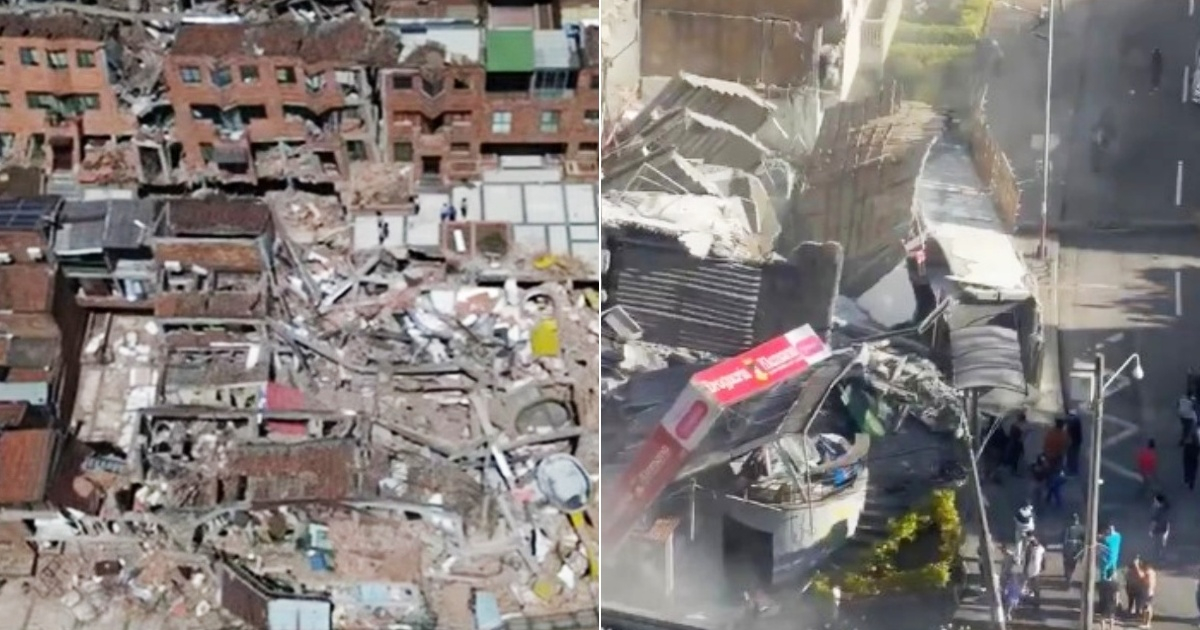
The Colombian Geological Service (SGC) addressed a common question following the severe 7.4 magnitude earthquake that struck western Colombia on Monday: Is there any connection between this earthquake and the dual tremors that hit Venezuela on June 24?
The answer is no, as stated by the SGC on their social media platform, and the reasons are purely geological.
Distinct Dynamics Behind Two Tragic Events
The Colombian quake, centered in San José del Palmar in the Chocó department at a depth of 103 kilometers, is the strongest recorded in Colombia during the 21st century. Despite initial reports with varying magnitude estimates, it was confirmed as a single primary tremor, later officially measured at a magnitude of 7.4.
While the Colombian earthquake and the Venezuelan twin quakes—recorded at magnitudes of 7.2 and 7.5, respectively—exceeded the magnitude 7 threshold, the SGC has firmly ruled out any link between them.
According to the SGC, "There is no connection between the events because they result from different dynamics. The Venezuelan quake was shallower and related to the lateral shear interaction of the Caribbean and South American plates, involving a lateral (transcurrent) movement. In contrast, the Colombian earthquake was due to the subduction of the Nazca plate beneath the South American plate at a depth of 103 km, illustrating their independence."
The Role and Importance of Subduction
Viviana Dionisio, a seismologist with Colombia's National Seismological Network, explained to EFE that the Colombian event was a tectonic earthquake primarily associated with subduction, where the Nazca plate from the Pacific Ocean dives beneath the South American plate.
"When one tectonic plate is going under another, it's called a subduction earthquake. These generally occur along coastlines," Dionisio detailed, comparing it to significant quakes in Chile, Japan, and Ecuador. This mechanism also accounts for the earthquake's depth, over 100 kilometers beneath the surface, classifying it as "intermediate depth" and allowing its effects to spread over a vast area.
Venezuelan Earthquakes: Shallow and Lateral
The Venezuelan scenario was markedly different. The June 24 earthquakes occurred less than 20 kilometers deep, resulting from lateral movement between the Caribbean and South American plates, unrelated to subduction processes.
"The Venezuelan earthquakes are shallower and relate to a different mechanism, a strike-slip one. This Colombian quake is deeper, a subduction event," Dionisio emphasized.
Dr. Gustavo Ortiz, a geological sciences expert with Argentina's National Scientific and Technical Research Council, summarized to CNN: "The only common factor between these catastrophic events is they occur on the South American plate, but their geological and tectonic contexts are entirely distinct."
Understanding Colombia's Frequent Earthquakes
The SGC reminded that Colombia experiences significant seismic activity due to the interaction of the Nazca, South American, and Caribbean plates, which causes frequent movements across much of the country.
On average, about 2,500 earthquakes are recorded monthly in Colombia, though the vast majority go unnoticed by the population and are only detected by seismographs. The SGC also clarified that there isn't an increase in earthquake frequency; rather, the improved ability to detect and disseminate information contributes to heightened public awareness.
Aftershocks Expected to Persist
As of 6:30 p.m. on Monday, the SGC had recorded 47 aftershocks, the strongest measuring 4.8. These smaller tremors occur following the main earthquake in the same region as energy continues to release and nearby areas return to equilibrium.
Aftershocks can last for days, weeks, or even months, making it likely that additional tremors will occur. The SGC also emphasized that no scientifically proven method exists to predict the timing or magnitude of earthquakes or aftershocks.
No Connection to Puracé Volcano
The SGC further clarified that the Colombian earthquake is unrelated to the activity of the Puracé Volcano, which has been on orange alert since August 1 for independent reasons: "The seismic event is not connected to the volcano's current behavior and did not cause ash emissions."
Seismologist Rodrigo León, from the University of the Andes' Department of Geosciences, cautioned that earthquakes cannot be predicted. Although the damage was extensive, it could have been worse, considering the magnitude.
Preliminary Death Toll
At least 224 people have died, and hundreds were injured in Colombia due to the 7.4 magnitude earthquake that hit the country's west at 7:34 a.m. local time on Monday, according to local authorities.
Colombian President Abelardo de la Espriella reported 188 people missing in Cali and explained that search and rescue efforts for survivors continue through the night. A significant number of fatalities are concentrated in the metropolitan area of Pereira, with severe damage also reported in Cali.
Frequently Asked Questions About the Colombian and Venezuelan Earthquakes
What caused the Colombian earthquake?
The Colombian earthquake was caused by the subduction of the Nazca plate beneath the South American plate, a process involving one tectonic plate moving under another.
How are the Colombian and Venezuelan earthquakes different?
The Colombian earthquake resulted from subduction at a depth of 103 km, while the Venezuelan earthquakes were shallower, involving lateral movement between the Caribbean and South American plates.
Can earthquakes be predicted in Colombia?
Currently, there is no scientifically proven method to predict when an earthquake or its aftershocks will occur or their magnitude.