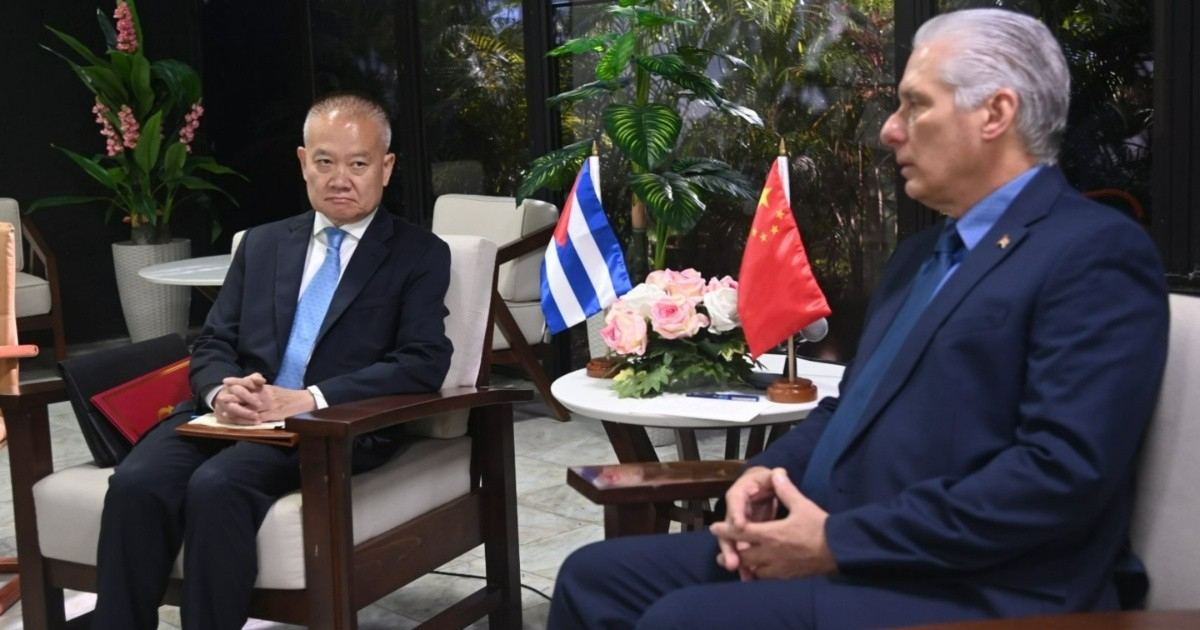
On Monday, Miguel Díaz-Canel welcomed Liu Haixing, a member of the Central Committee of the Communist Party of China and head of its International Department, at the Havana Convention Palace. The Cuban regime framed this meeting as a gesture of Beijing's solidarity with the island.
The meeting occurred just before the opening of the first International Colloquium "Fidel: Legacy and Future," an event organized as part of the official celebrations for the centennial of Fidel Castro's birth, scheduled for August 13.
Díaz-Canel was accompanied by Roberto Morales Ojeda, a member of the Political Bureau and Organizational Secretary of the Central Committee of the Communist Party of Cuba, along with Emilio Lozada García, head of the International Relations Department of the same organization.
The Cuban leader described the Chinese official's visit as "an expression of the Communist Party of China's support for the island during the challenging times currently faced by the Caribbean nation."
During the encounter, Díaz-Canel took the opportunity to criticize Washington, attributing Cuba's crisis to external pressures. He denounced what he termed "the multidimensional war waged by the United States against Cuba," which he claimed includes "a criminal energy blockade" and secondary sanctions against global companies that hinder Cuba's access to economic and social resources.
He went on to label the Trump administration's pressure tactics as "a genocidal and criminal program, meticulously calculated by the U.S. government, accompanied by a narrative construction by the State Department to fabricate justifications for aggression."
The meeting coincided with statements from China's Foreign Ministry spokesperson, Guo Jiakun, who demanded on Monday that Washington "immediately" lift sanctions against Cuba and accused the United States of "shifting blame to others."
These remarks were made during a regular press briefing of the Chinese Foreign Ministry, following a question from a Prensa Latina journalist regarding Beijing's stance on sanctions announced on August 6 against five entities and eight individuals linked to Cuba's military apparatus and its ties with China and Russia.
"China has repeatedly expressed its position on this issue. We urge the U.S. to lift the sanctions and blockade against Cuba as soon as possible and stop blaming others," Guo stated, according to a tweet by the Chinese ambassador in Havana, Hua Xin.
The Asian giant has become the regime's main partner for the so-called energy transition. Díaz-Canel explicitly thanked the Chinese government and Communist Party for "the support they have provided in our country's energy transition program towards Renewable Energy Sources."
Just three days before this meeting, China delivered a second batch of 5,000 photovoltaic systems for rural homes and essential services to Cuba. The bilateral plan includes the construction of 92 solar parks by 2028, with a combined capacity of approximately 2,000 MW.
Díaz-Canel also relayed "the fraternal greetings from Army General Raúl Castro" to Liu Haixing for himself and Chinese President Xi Jinping, expressing gratitude for "Comrade Xi Jinping's sensitivity regarding Cuba's situation and his personal attention."
Meanwhile, Liu Haixing conveyed to the Cuban leader "the sincere greetings and best wishes from Secretary General and President Xi Jinping," both for Díaz-Canel and Raúl Castro, and promised to inform the Communist Party of China's Central Committee about the meeting's content.
This is not Liu Haixing's first interaction with Cuban diplomacy; in February of this year, he met in Beijing with Cuban Foreign Minister Bruno Rodríguez Parrilla, in a visit that also included Chinese Foreign Minister Wang Yi and senior official Wang Huning.
Understanding Cuba-China Relations
What was the purpose of Liu Haixing's visit to Cuba?
Liu Haixing visited Cuba to demonstrate solidarity from the Communist Party of China with the Cuban regime, especially in light of the challenging circumstances faced by the island nation.
How did Díaz-Canel describe U.S. policies towards Cuba?
Díaz-Canel criticized U.S. policies as a "multidimensional war" against Cuba, accusing the U.S. of implementing a "criminal energy blockade" and other measures to hinder Cuba's access to resources.
What support has China provided to Cuba recently?
China has provided Cuba with photovoltaic systems for rural areas and is collaborating on a plan to build 92 solar parks by 2028, as part of Cuba's energy transition towards renewable sources.