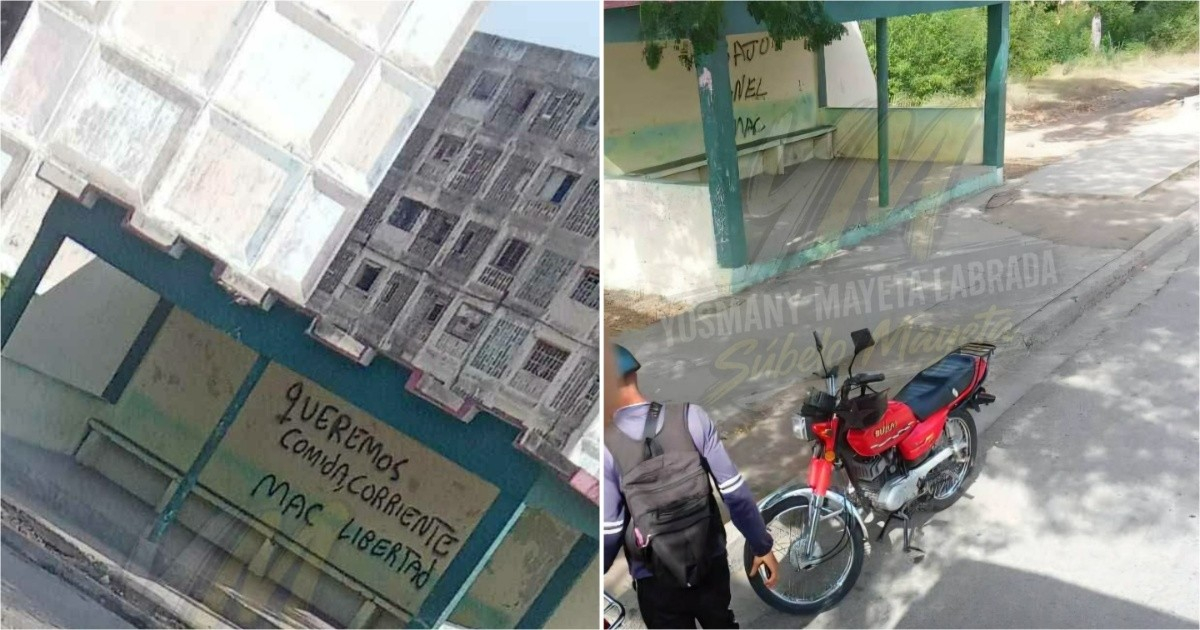
On Monday, protest posters and graffiti surfaced at bus stops in the Micro 7 neighborhood of Santiago de Cuba. These images were circulated by independent journalist Yosmany Mayeta Labrada.
The messages, scrawled by hand on the structures, included demands such as "We want food, electricity" and calls for "Freedom" and "Down with Díaz-Canel." The initials "MAC" were also seen alongside these phrases, though their meaning and the person responsible remain unknown. No arrests or investigations related to these expressions have been reported so far.
Context of the Power Crisis
The graffiti appears amid a severe power crisis affecting Santiago de Cuba over recent weeks. The province was notably the last to reconnect to the National Electric System following a complete blackout on August 2, and endured another outage the next day during restoration efforts.
Prior to this failure, the local Electric Company had already implemented a rotation of power cuts across nine blocks, leaving some neighborhoods with just one or two hours of electricity per day. In extreme cases, blackouts lasted up to 22 hours continuously.
Historical Protests and Visual Dissent
The slogans displayed in Micro 7 echo previous protests in Santiago de Cuba. On June 12, residents of the José Martí Urban Center took to the streets demanding electricity, food, and freedom. The months of June and July saw multiple instances of pot-banging protests with these same demands. The Cuban Conflict Observatory recorded 18 protests in the province during June alone.
Such visual dissent has a history in the city. In January, a poster with Díaz-Canel's image covered in black paint appeared at the intersection of Trocha and Avenida 12 de Agosto. By March, anti-communist posters emerged near the University of Oriente. June set a record with 41 antigovernment graffiti and posters reported throughout Cuba, marking the highest monthly count since September 2020.
Nationwide Protest Movement
The unrest in Santiago is part of a broader wave of protests sweeping across the island. According to data from the Cuban Conflict Observatory shared by Infobae, July 2026 saw an unprecedented 1,415 protest events nationwide, the highest number ever documented.
Mayeta Labrada emphasized that the phrase "We want food, electricity" highlights the daily struggles of the population as a public display of dissatisfaction. The calls for "Freedom" and opposition to Miguel Díaz-Canel add a distinctly political dimension to these messages.
Understanding the Protests in Santiago de Cuba
What sparked the emergence of protest graffiti in Santiago de Cuba?
The protest graffiti emerged as a response to the severe power crisis and ongoing social dissatisfaction in Santiago de Cuba. The city has faced significant electricity shortages and residents are demanding basic needs and political freedom.
How has the local government responded to the protest graffiti?
As of now, there have been no reported arrests or investigations related to the graffiti. The government's response remains unclear.
What significance do the initials "MAC" have in the protests?
The initials "MAC" were found alongside the protest messages, but their significance and the identity of the individual or group responsible remain unknown.