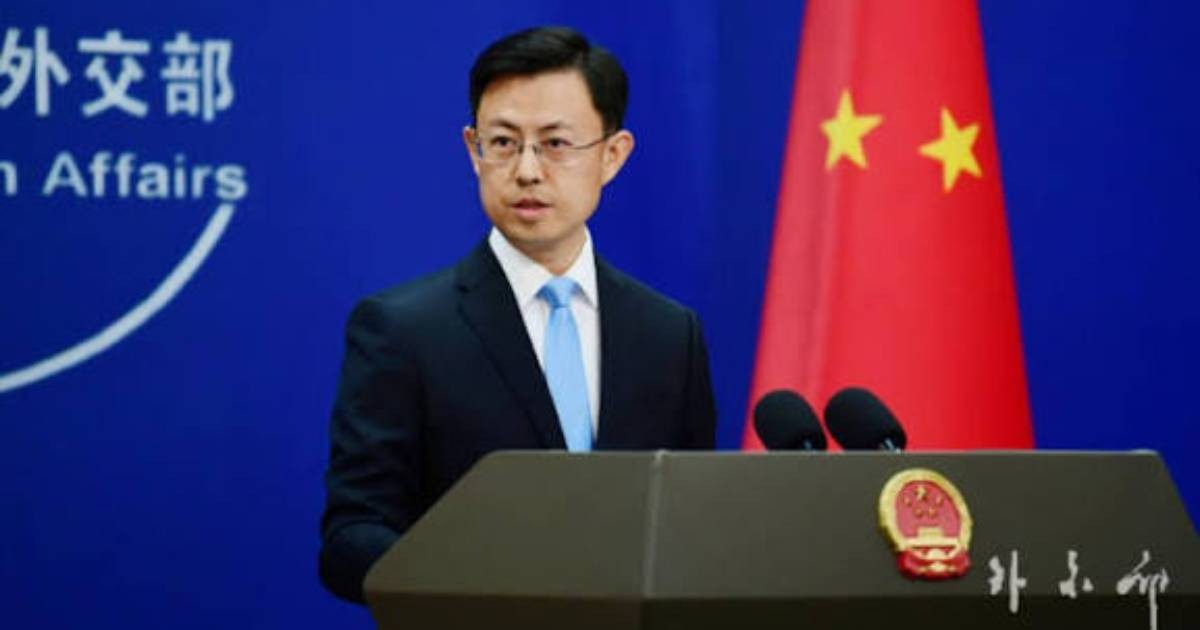
China's Foreign Ministry spokesperson, Guo Jiakun, called on Washington to swiftly lift its sanctions on Cuba, accusing the United States of deflecting blame onto others. This statement came in response to the recent measures imposed by the Trump administration targeting Cuban military-linked entities and officials.
The comments were made during a routine press briefing by China's Foreign Ministry after a Prensa Latina journalist inquired about Beijing's stance regarding the August 6 sanctions against five entities and eight individuals connected to Cuba's military apparatus and its ties with China and Russia.
"China has consistently communicated its position on this matter. We urge the U.S. to remove the sanctions and embargo against Cuba at once and refrain from blaming others," Guo stated, as reported by a tweet from Hua Xin, the Chinese ambassador in Havana.
Guo further defended the collaboration between Beijing and Havana amid Washington's criticisms. "The cooperation between China and Cuba is legitimate and transparent. China will steadfastly support Cuba in defending its national sovereignty and opposing foreign interference," he declared.
Beijing's response follows the U.S. State Department's announcement of a new round of sanctions under Executive Order 14404, signed by President Donald Trump on May 1, 2026. This order expanded Washington's authority to sanction individuals and entities supporting Cuba's security apparatus and its military relations with foreign powers.
The targeted individuals include the Minister of the Revolutionary Armed Forces, Álvaro López Miera, and the Chief of the General Staff, Roberto Legrá Sotolongo, both sanctioned for their connections with Moscow and Beijing.
The affected Cuban entities include Tecnoimport, Duna S.A., the Military Industry Union, and the Yuri Gagarin Military Industrial Enterprise. Washington specifically accused Duna S.A. of facilitating the entry of military equipment from China and Russia into Cuba.
However, Beijing's reaction wasn't confined to diplomatic channels. Just a day after the sanctions were announced, Ambassador Hua Xin revealed the dispatch of an additional 5,000 solar panels to Cuba, a critical aid as the island grapples with severe energy shortages and prolonged blackouts.
China's economic support for Cuba has been unwavering throughout 2026. Earlier this year, Beijing pledged $80 million in assistance and 60,000 tons of rice, which later increased to 90,000 tons, according to Hua Xin's statements.
This isn't the first time China's Foreign Ministry has publicly defended Havana against measures taken by Washington. Between January and August 2026, Beijing repeatedly criticized U.S. sanctions, reiterating that its cooperation with Cuba is "legitimate and transparent" and that it will continue to "firmly" back the Cuban government against what it perceives as foreign meddling.
This stance highlights the escalating tensions between Washington and Beijing over China's presence in Cuba, a matter that has gained significant importance in the Trump administration's policy toward the island.
U.S. pressure has steadily increased throughout the year. The military business conglomerate GAESA was designated in May, the Ministry of the Revolutionary Armed Forces in June, and the Ministry of Tourism in July. The latest measures add to the sanctions against Cuban entities and officials linked to foreign military cooperation.
Washington has prominently placed Havana's ties with Beijing and Moscow among its primary security concerns. The U.S. ambassador has explicitly linked the hardening stance toward Cuba with the presence of China and Russia on the island.
Understanding U.S.-Cuba-China Relations
Why has the U.S. imposed sanctions on Cuba?
The U.S. has imposed sanctions on Cuba primarily due to its military ties with foreign powers like China and Russia, which are seen as threats to U.S. national security interests.
What is China's stance on U.S. sanctions against Cuba?
China opposes U.S. sanctions on Cuba, urging Washington to lift them and asserting that its cooperation with Cuba is legitimate and transparent.
How has China supported Cuba economically in 2026?
In 2026, China has provided Cuba with $80 million in assistance, 90,000 tons of rice, and 5,000 solar panels to aid the island's energy crisis.