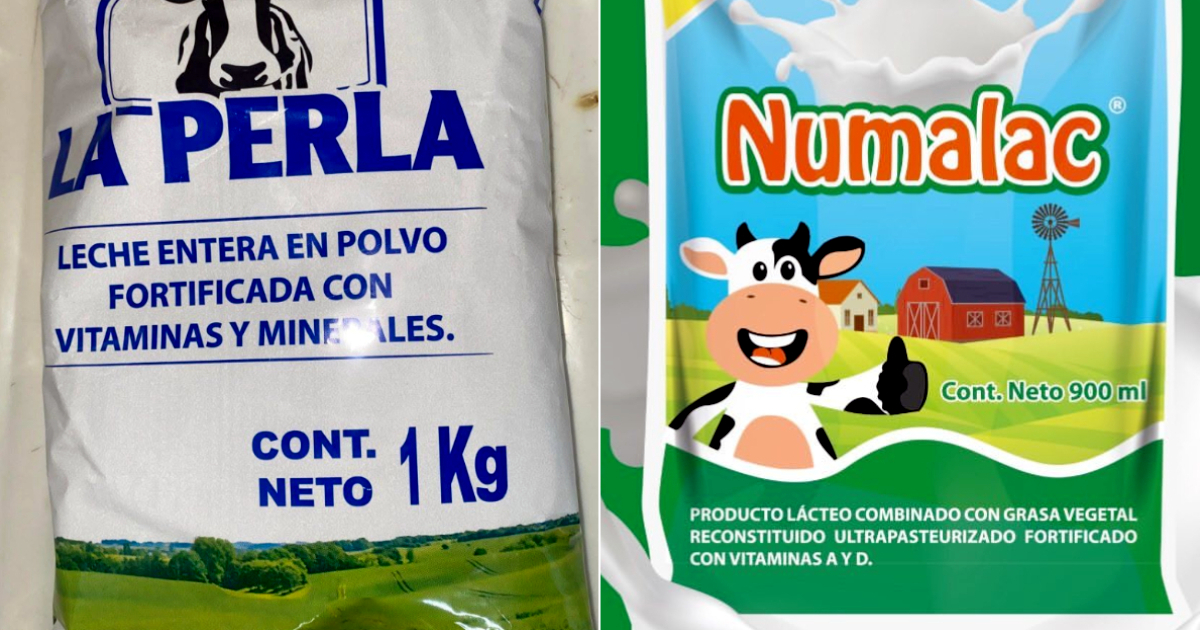
Amidst a crippling milk shortage impacting the Cuban populace, the military-run conglomerate GAESA is selling imported dairy mixes in U.S. dollars at prices significantly higher than their declared import values.
The investigative report titled 'From Mexico to Cuba: Routes of the Business Fueling the Shortage,' published by DIARIO DE CUBA, and authored by Annarella Grimal, Pablo Díaz Espí, and Mirta Fernández, delves into the import and sale of products like Numalac and La Perla on the island.
Price Discrepancies in Dairy Imports
One notable example is Numalac. According to foreign trade data reviewed by the journalists, a shipment of 59,400 200-gram packets had a declared value of $44,549.97.
This translates to roughly $0.75 per packet. Yet, the same product was sold through EnvíosCuba for about $2.39 each, over three times the import value.
The price hike results in a difference of approximately $1.64 per packet. However, this figure doesn't necessarily reflect net profit, as costs related to shipping, storage, and distribution must be deducted.
Nutritional Differences in Dairy Products
The report also highlights the composition of these dairy products. Numalac and La Perla contain vegetable fat and have significant nutritional differences compared to whole milk powder.
According to the report's data, whole milk powder typically contains between 25 and 27 grams of protein per 100 grams. Numalac reports 18.6 grams per 100 grams, and La Perla contains 12.3 grams.
Calcium content also varies. Numalac lists 381 milligrams per 100 grams, while whole milk powder can provide approximately 900-1,000 milligrams, as per the report.
Despite these differences, these products are sold at high prices. Numalac was priced at about $9.25 per kilogram in physical stores, and La Perla was around $8 per kilogram. Additionally, Tiendas Caribe promoted La Perla on social media as "milk powder with added vitamins and minerals," as documented by the authors.
GAESA's Market Influence
The investigation found these products available in Tiendas Caribe and CIMEX, major retail entities controlled by GAESA. The report also examines the role of EnvíosCuba, a platform used by Cuban expatriates to purchase goods in foreign currency, later delivered to their families on the island.
This situation means that the availability of basic foods often depends on the financial support from overseas relatives, rather than the income of those residing in Cuba.
Decline in Cuban Milk Imports
This scenario unfolds amid a drastic reduction in Cuban imports of powdered milk. Data from the National Office of Statistics and Information (ONEI), cited by DIARIO DE CUBA, indicate that milk powder imports fell by 74% from 2019 to 2023.
The value of these imports dropped from $158.1 million to $65.8 million, while the average import price escalated from $2,916 to $4,672 per ton. Domestic production has also failed to meet the country's demand.
Statistics from the investigation reveal a decline in non-state sector production from 411,800 tons in 2017 to 210,400 tons in 2022. This results in a tough situation for Cuban families: reduced local production, significant import cuts, and food sold in foreign currency at prices beyond the reach of many.
As shortages lead to reliance on international milk donations, GAESA-affiliated retail entities continue to sell imported dairy products in dollars, a currency that most Cuban workers do not earn.
Key Questions About Dairy Product Sales in Cuba
Why are dairy products being sold at such high prices in Cuba?
Dairy products are sold at high prices due to the markup by entities like GAESA, which sell them in dollars at prices much higher than their import value, amidst a severe milk shortage in Cuba.
How does the nutritional content of Numalac and La Perla compare to whole milk powder?
Numalac and La Perla contain less protein and calcium compared to whole milk powder, with Numalac having 18.6 grams of protein and 381 milligrams of calcium per 100 grams, whereas whole milk powder typically contains 25-27 grams of protein and 900-1,000 milligrams of calcium.
What role does EnvíosCuba play in the sale of dairy products?
EnvíosCuba facilitates the purchase of dairy products in foreign currencies by Cubans living abroad, who then send these products to their families in Cuba, thus playing a crucial role in the availability of these goods on the island.