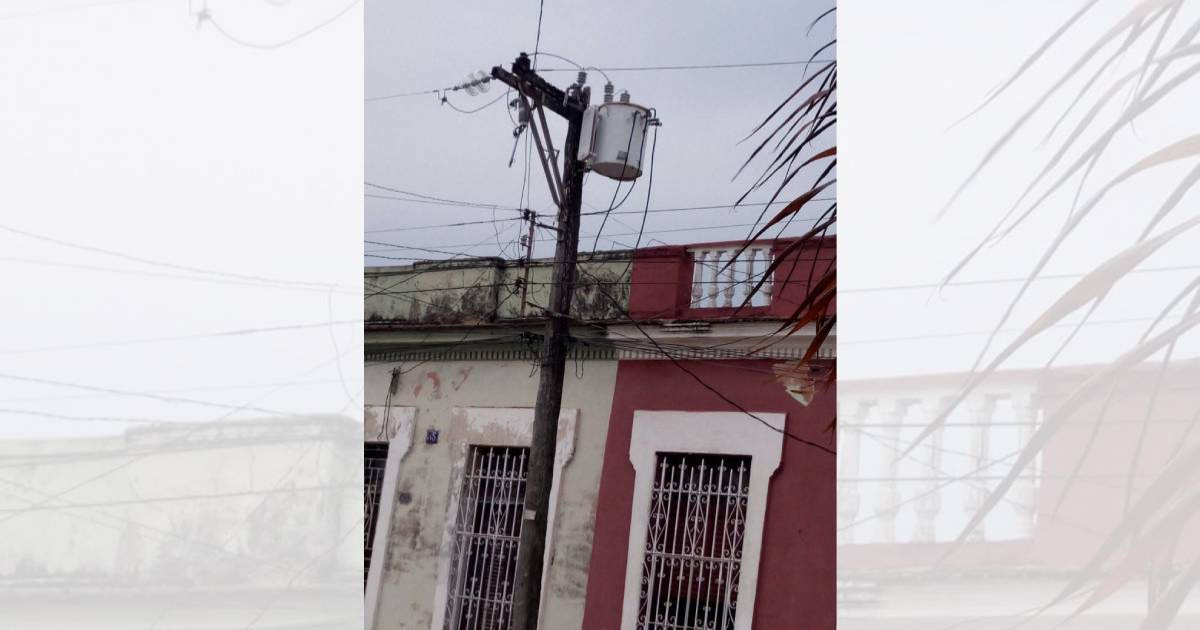
A neighborhood in Camagüey has been plunged into darkness for more than ten days due to a malfunctioning transformer that fails every time an attempt is made to reconnect it. This ongoing issue was highlighted on Sunday by writer and journalist María Antonia Borroto Trujillo.
Using her Facebook platform, Borroto detailed that it took local authorities five days to conclude that the equipment needed to be replaced with a higher-capacity unit. The official excuse provided is a lack of available transformers for the replacement.
As a doctor of Communication Sciences and a member of the Union of Writers and Artists of Cuba (Uneac), Borroto drew a stark comparison to Havana, where new poles and transformers have been installed to restore power to hospitals. "So, there's equipment for that, but not for Camagüey? And if there truly isn't any, are we to remain in perpetual darkness? Is that the plan? Are there no other solutions? Does anyone really care?" she questioned.
Public Outcry and Frustration
The public reaction to her post has been a mix of outrage and resignation. One comment noted, "If a family member of the electric company or government leaders lived here, it would have been resolved by now."
Another expressed collective exhaustion: "This country is like a ship adrift, abandoned to its fate... the path ahead is so disheartening."
A more pragmatic voice advised: "Stand firm, write letters, and request a meeting with the Party; sometimes that works. This has gone on for too long."
National Power Crisis and Scarcity
The power outage in this Camagüey neighborhood occurs amidst Cuba's most severe electrical crisis in decades, marked by frequent total disconnections from the National Electrical System and blackouts exceeding 24 hours in various areas.
The shortage of transformers is a nationwide issue. The Union Eléctrica admitted in June that no spare parts were physically available in any province across the country.
National production, allocated between plants in Havana, Santa Clara, and Manzanillo, barely reaches 70 units daily, far short of the replacement demand.
This structural scarcity is exacerbated by the systematic theft of dielectric oil. The Minister of Energy and Mines, Vicente de la O Levy, disclosed in late July to the National Assembly that "the amount of oil stolen is almost equal to what we produce in the same period."
He also revealed that some communities have been without power for up to 105 days due to damage to old voltage transformers, which are difficult to obtain.
In Caimito, Artemisa, several villages were without electricity for 21 days due to dielectric oil theft, and in Holguín, this crime accounts for more than half of the 42 electrical incidents recorded by the end of July.
The situation in the province worsens as Unit 5 of the Diez de Octubre thermoelectric plant in Nuevitas has been under maintenance throughout August, further decreasing the provincial generation capacity.
Voices of Protest on Social Media
Borroto's Facebook posts on Thursday and Friday quickly went viral. In the first, she sarcastically depicted daily life under the prolonged blackout, coining the phrase that sums up the crisis: "The Revolution has ended up being this: carrying everything that needs to be carried."
In the second post, she meticulously calculated the time without electricity in her home: "7 days. 172 hours - 10,320 minutes. 619,200 seconds without power."
Understanding the Power Crisis in Cuba
What is causing the power outages in Camagüey?
The ongoing power outages in Camagüey are primarily due to a malfunctioning transformer that continues to fail upon attempts to reconnect it. Additionally, there is a lack of replacement transformers available.
How does the transformer shortage affect Cuba?
The scarcity of transformers is a significant problem across Cuba, contributing to prolonged power outages. The local production of transformers falls short of meeting demand, and theft of dielectric oil exacerbates the situation.
What measures are being taken to resolve the power crisis?
Efforts to resolve the crisis include maintaining existing infrastructure and attempting to manage theft. However, the response has been inadequate, and the lack of resources hampers effective solutions.