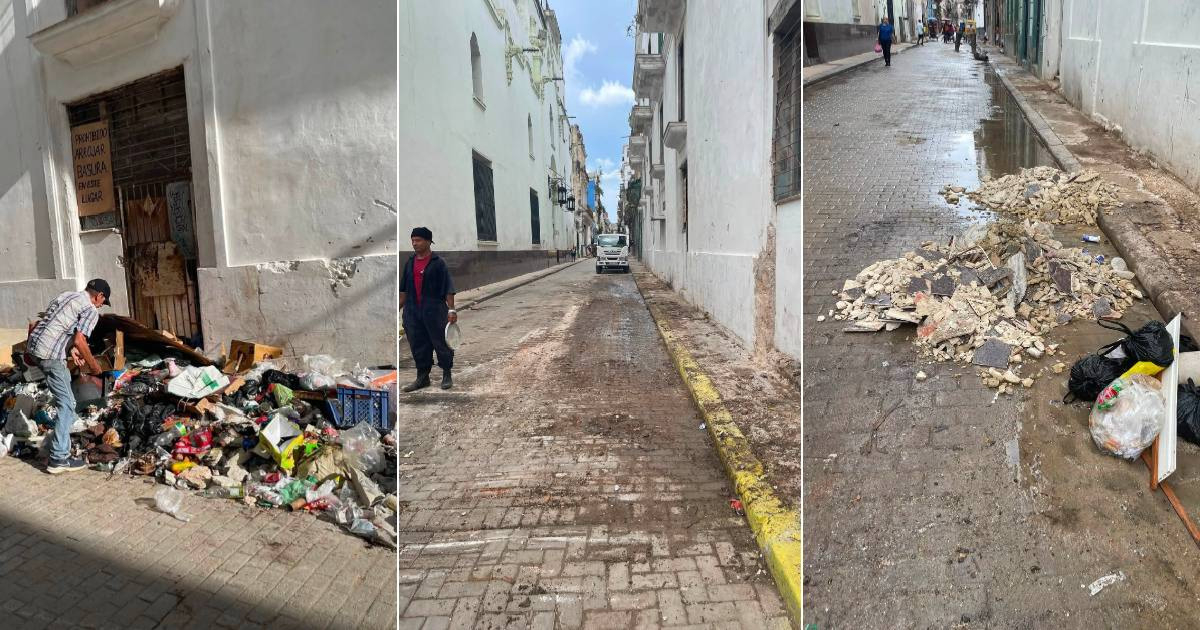
Despite regular cleaning efforts, Havana's Old Town is grappling with significant challenges in keeping its public spaces clean, acknowledged Perla Rosales Aguirreurreta, deputy director of the Havana Historian's Office, in a Facebook post on Thursday.
Rosales detailed how they spent hours assisting the president of the Plaza Vieja popular council in reorganizing the placement and collection methods for solid waste in an area home to a concert hall, the Supreme Court, and the Municipal Party headquarters.
Images shared by the official revealed Obrapía Street, between Aguiar and Habana, littered with waste as early as 9:00 a.m. In another scene, a worker from Aurora Company, under the Communal Services, is seen dumping collected trash back onto the street.
The post also praised Ratoncito Blanco, a small private company, for cleaning the space only for it to be littered again with rubble and waste two hours later.
Faced with the ongoing issue, Rosales declared their determination to continue efforts and called for inspectors to join the mission to ensure adherence to the adopted measures.
Comments from users suggested setting specific times and locations for waste disposal, preventing overaccumulation, and increasing inspector presence to enforce regulations.
Rosales responded, emphasizing that it's a "marathon" requiring both education and enforcement. She pointed out the need to provide conditions for the public to comply with waste management rules.
The situation in Plaza Vieja illustrates one of the broader challenges Havana faces in keeping its streets clean, even in areas recently tidied up, which quickly revert to being garbage-strewn.
This issue is neither new nor unique to this block. Official data indicates that Havana generates between 24,000 and 30,000 cubic meters of solid waste daily, yet only 44 out of 106 available garbage trucks are operational due to fuel shortages and mechanical issues, comprising merely 41% of the fleet.
The city also has about 10,000 trash containers, far fewer than the needed 20,000 to 30,000.
Recently, a video showed garbage overflowing from Trillo Park in Centro Habana, with cardboard boxes, plastic bags, clothing, and organic waste piled up uncollected.
In July, another video captured the corner of Ánimas and Monserrate in Old Havana as an open-air dump in front of colonial buildings.
Since November 2025, the Old Havana government has mandated residents and businesses to dispose of trash directly into collection trucks after 7:00 p.m. in several popular councils, including Plaza Vieja. This measure has not solved the underlying problem.
The health implications are severe. Cuba ended 2025 with at least 81,909 official dengue and chikungunya cases and 65 deaths, a crisis The New York Times attributed directly to the garbage issue.
In June of this year, the Ministry of Public Health activated epidemiological surveillance due to the risk of new outbreaks.
The decay starkly contrasts with the legacy of historian Eusebio Leal (1942-2020), who transformed the Historic Center into a global model of urban conservation over nearly four decades. Havana's Old Town was declared a UNESCO World Heritage Site in 1982.
"If Eusebio Leal were to come back to life, he'd die again," a user remarked after seeing images of the current decline weeks ago.
Historian Julio César González Pagés bluntly described the situation: "Havana, between garbage and feces, enters the summer with little water, hygiene, and medicine, reviving the worst of its colonial era."
Challenges and Solutions for Waste Management in Havana
What are the main challenges in waste management in Havana's Old Town?
Havana's Old Town faces challenges such as insufficient garbage trucks, a lack of trash containers, and inadequate enforcement of waste disposal regulations, leading to rapid reaccumulation of waste even after cleanup efforts.
How is the government addressing the waste problem in Old Havana?
The government has implemented measures such as mandating direct disposal into collection trucks after 7:00 p.m. and is encouraging inspector involvement to ensure compliance, although these have not resolved the structural issues.
What are the health implications of the waste management issues in Havana?
The waste management crisis is linked to health issues, with a significant number of dengue and chikungunya cases reported, attributed to the garbage situation, prompting the Ministry of Public Health to enhance epidemiological surveillance.