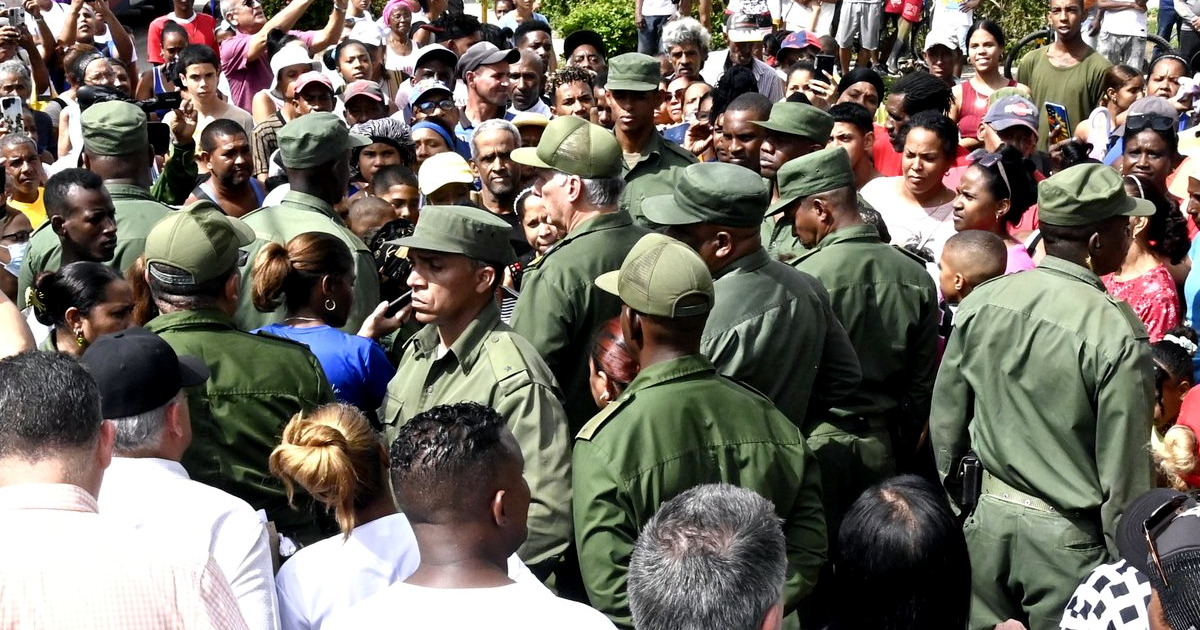
In recent months, the Cuban government has reportedly increased security measures around Raúl Castro and Miguel Díaz-Canel due to fears of a potential U.S. operation aimed at capturing or assassinating them. This information comes from The New York Times, which cited U.S. officials as sources.
The report emerges from an investigation into the strategies being considered by the Trump administration to push for changes within the Cuban leadership. This follows the military operation in January that led to the capture of Nicolás Maduro in Venezuela.
The newspaper highlights that, "in the months since the action against Maduro, Cuba has implemented defensive measures to complicate any U.S. attempts to capture or eliminate Castro or the current president, Miguel Díaz-Canel," attributing this to American officials. However, the Times does not specify what these measures entail nor confirm that Trump has ordered the preparation of such an operation.
The Role of U.S. Intelligence in the Heightened Tensions
The disclosure takes on a new dimension when combined with the significant increase in U.S. intelligence activities around Cuba. Recently, Washington elevated Cuba to a "Priority 1" status within its National Intelligence Priorities Framework (NIPF), equating it with China, Russia, and Iran.
According to another investigation by The New York Times, agencies like the NSA and the National Geospatial-Intelligence Agency have increased satellite and other resource allocations towards Cuba. This intelligence is intended, among other purposes, to help the U.S. military update its options for a potential military action against the island, following complaints from military and intelligence officials about outdated information regarding Cuban intentions, capabilities, and defenses.
Increased Reconnaissance Missions
The ramped-up activity is also evident in the skies. Since February, U.S. reconnaissance aircraft such as the P-8A Poseidon, the RC-135V Rivet Joint, and the high-altitude MQ-4C Triton drone have logged over 150 hours of missions around Cuba, as reported by Politico. These aircraft carry various capabilities for collecting electronic, maritime, and geospatial intelligence. The increase in their missions aligns with the Times-described effort to obtain a more accurate picture of Cuba's territory, communications, military capabilities, and defenses.
Background of U.S. Concerns
The Cuban regime's apprehension has an immediate precedent: Venezuela. The United States used a judicial indictment against Maduro as part of the legal basis for the Special Forces operation that led to his capture. Now, according to the Times, the Department of Justice has also filed charges against Raúl Castro. However, there is a crucial difference. Maduro was the sitting president of Venezuela, and his removal allowed Delcy Rodríguez, then vice president, to assume power temporarily. In contrast, Raúl Castro, at 95, holds no formal state position, though his influence over the Cuban system remains substantial. Therefore, capturing him would not automatically result in an institutional change.
The newspaper does not assert that there is currently a Trump directive to execute an operation against Raúl Castro or Díaz-Canel. In fact, the new CIA special group for Cuba is not presently authorized to facilitate lethal operations. Nevertheless, the Times adds a pertinent caveat: the authorities under which such a unit operates are flexible and can be altered at any moment by the president.
These revelations depict a scenario extending beyond economic pressure. The CIA has established a group specifically focused on Cuba; Washington has made the island a top intelligence priority; reconnaissance satellites and aircraft are gathering more data; and the Pentagon is using this intelligence to update potential military scenarios. Simultaneously, according to the Times, Havana is taking steps to protect its top leaders against the possibility of the U.S. attempting a similar operation to that carried out in Venezuela.
This does not indicate a decided incursion nor suggest one is imminent. However, it reveals that both Washington and Havana seem to be considering scenarios that, just a few months ago, would have appeared extraordinary: the U.S. updating its military options and the Cuban regime preparing to prevent its key figures from becoming the next targets.
Understanding U.S. Intelligence Priorities in Cuba
Why has the U.S. heightened its intelligence efforts in Cuba?
The U.S. has increased its intelligence activities in Cuba to update its understanding of the island's military capabilities and defenses, following concerns about outdated information. This is part of a broader strategy to assess potential military actions, similar to those executed in Venezuela.
What measures has Cuba reportedly taken to protect its leaders?
According to The New York Times, Cuba has implemented defensive measures to make it more difficult for U.S. forces to capture or neutralize Raúl Castro and Miguel Díaz-Canel. However, specific details of these measures have not been disclosed.
Is there a confirmed plan by the U.S. to target Cuban leaders?
There is no confirmed plan by the U.S. to target Cuban leaders. The New York Times reports that while Cuba has taken defensive steps, there is no evidence of an active U.S. operation to capture or kill Raúl Castro or Miguel Díaz-Canel at this time.