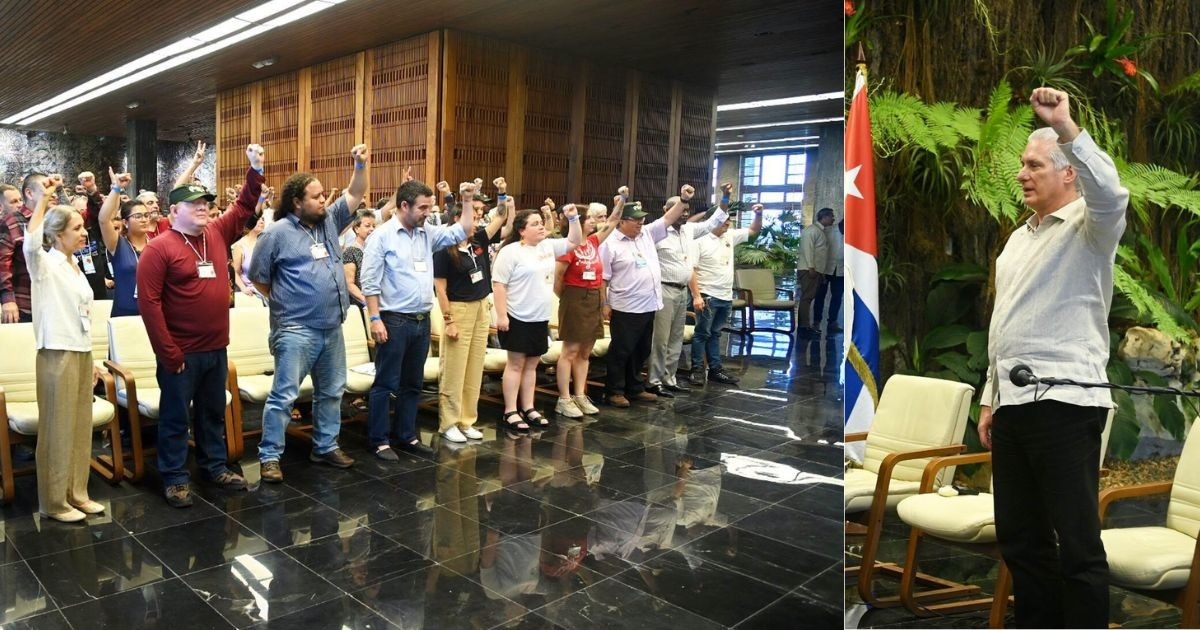
As countless Cubans struggle to survive without basic necessities like electricity, water, and food, Miguel Díaz-Canel welcomed delegates from the IV Continental Assembly of ALBA Movements at the Palace of the Revolution this past Saturday. The regime labeled the gathering as an exhibition of international "solidarity" with the Cuban Revolution.
This assembly, held from August 6th to 9th, brought together 188 delegates from 27 countries under the banner "For Socialism, One Hundred Years Walking with Fidel," leading up to the centennial of Fidel Castro's birth on August 13th.
Seizing the moment, Díaz-Canel employed his usual rhetoric to address the audience of foreign leftists. "While many around the world succumb to the dictates of Washington, to their criminal attempt to isolate us, you have chosen to be in Cuba during its most challenging hour," he declared, omitting the fact that it is the Cuban people, not him, who endure these hardships.
The President also used the metaphor of oxygen: "When the empire attempts to suffocate us by any means, you provide us with superior strength." However, he failed to acknowledge that the oxygen Cubans desperately need comes not from fist-pumping delegates but in the form of electricity, medicine, and food.
The event concluded with a declaration the regime deemed inspirational: "And above all, know that even in the toughest circumstances, Cuba will continue to fight, resist, and triumph. This is our commitment to Fidel's enduring legacy." Translated into daily life, this promise of resilience means more blackouts, shortages, and emigration.
This occasion is not an isolated event but part of a systematic pattern of ideological tourism the regime maintains with striking regularity. Just the previous Friday, Díaz-Canel opened the 24th International Meeting of Communist and Workers' Parties at the Palace of Conventions, hosting over 100 delegates from 48 organizations. From August 10th to 13th, the "Fidel: Legacy and Future" International Colloquium is scheduled. In May, an International Meeting of Solidarity with Cuba took place, with 766 delegates from 152 organizations across 36 countries. The official 2026 calendar lists over 280 institutional activities.
This parade of ideological visitors starkly contrasts with the real tourism collapse: the island welcomed 112,000 fewer visitors in 2026 compared to the previous year, marking the sector's worst decline since 2002.
While the regime organizes one ideological festivity after another, the Cuban economy has suffered a 15% decline since 2020, including a 5% drop in 2025 alone. The electrical system is experiencing historic deficits, with outages averaging between 15 and 24 hours daily in Havana and lasting up to 87 consecutive hours in Matanzas.
Cubans have expressed their outrage on social media. "There's fuel for this," one user commented under the official Presidential post. Another was more blunt: "Hypocrites all, why don't they stay and live in Cuba like ordinary Cubans?" A third remarked, "Let them walk through the neighborhoods... and see the reality and true support."
The most succinct, and perhaps the most poignant, response came from another citizen: "And on this side... Cuba is dying."
Understanding the Impact of Ideological Events in Cuba
What was the main purpose of the ALBA Movements' IV Assembly in Cuba?
The main purpose of the assembly was to demonstrate international solidarity with the Cuban Revolution, bringing together delegates from various countries under the theme of supporting socialism and commemorating Fidel Castro's legacy.
How has the Cuban economy been affected in recent years?
Since 2020, the Cuban economy has contracted by 15%, with a 5% decrease noted in 2025 alone. Furthermore, the electrical system is facing severe shortages, leading to frequent and extended blackouts.
What is the public's reaction to the regime's ideological events?
The public has reacted with indignation, criticizing the regime for prioritizing ideological events over addressing the critical needs of ordinary Cubans, such as electricity, food, and medicine.