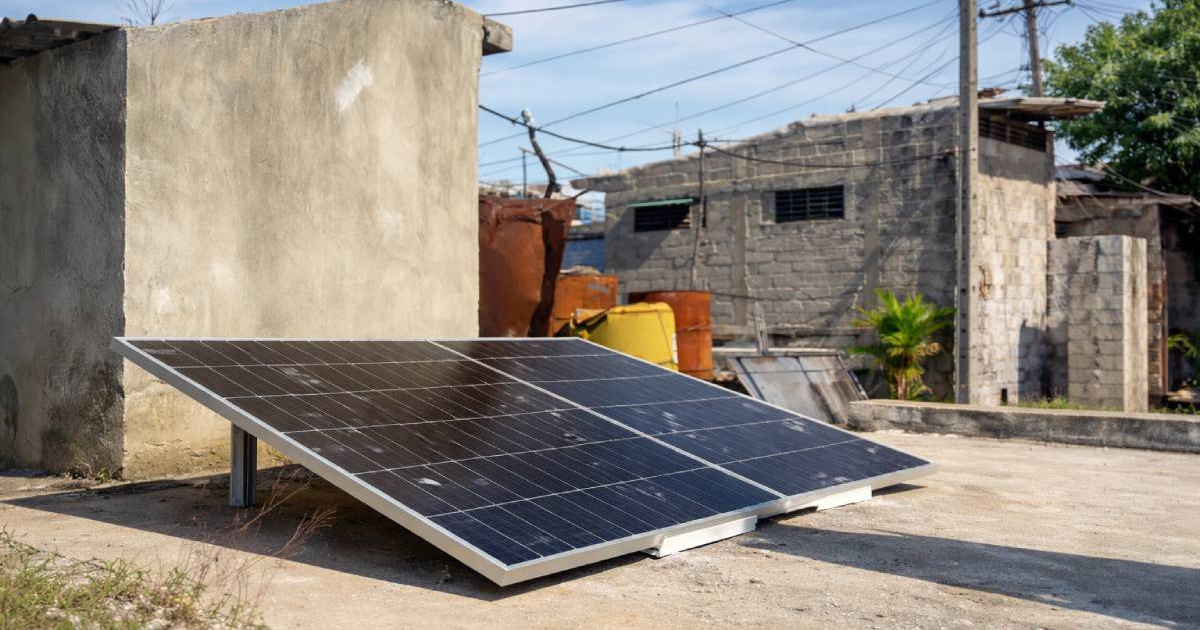
On Friday, Cuba's Ministry of Finance and Prices released Resolution 180/2026, a new regulation designed to expand and consolidate tax and customs benefits for individuals and businesses investing in renewable energy sources. This legislation took effect immediately upon its publication in the Official Gazette.
Signed by Minister Vladimir Regueiro Ale on August 5, this resolution repeals the previous Resolution 41/2026—issued in February—in order to gather all existing incentives into a single legal framework and prevent regulatory fragmentation.
Comprehensive Tax Exemptions for Renewable Energy Imports
The resolution's most notable incentive is the complete exemption from customs duties for importing photovoltaic solar systems and their components, solar heaters, photovoltaic pumps, small wind turbines, geomembrane biodigesters, biogas-powered water pumps, solar lighting, solar air conditioning systems, electric vehicle chargers operating on renewables, and biomass processing equipment.
Additionally, companies importing raw materials, parts, and machinery for renewable electricity generation projects are exempt from tariffs, regardless of whether they belong to the state sector or operate under non-state management forms.
Significant Tax Breaks for Private Economic Actors
Private sector economic actors stand to benefit substantially from exemptions from the Profit Tax and Personal Income Tax for those installing renewable sources intended for self-consumption or for supplying electricity to the national grid. The regulation specifies that this exemption covers "the amount of the investment value, during its recovery period, for up to eight years."
To qualify for this benefit, interested parties must secure an Energy Opinion from the National Office for the Control of Rational Energy Use and submit an application to the National Tax Administration Office. The tax authority has up to 60 days to establish the start date for the benefit.
Renewable Technology Pricing and Purchase Tariffs
The resolution also dictates that technologies related to renewables will be sold at non-revenue prices, formed from operational costs plus a profit margin of up to 25% over costs.
Published alongside this resolution in Official Gazette No. 66 was Resolution 179/2026, which extends the purchase tariff for surplus renewable electricity supplied to the National Power System to 90 Cuban pesos per kilowatt-hour, applicable at any time of day and to both residential and non-residential sectors.
These resolutions are part of a broader set of measures the regime has been implementing throughout 2026 to draw investment into renewable energies amid an unprecedented energy crisis. This crisis has left extensive areas of the country experiencing blackouts lasting over 20 hours daily, with generation deficits surpassing 2,000 MW during the most severe periods of 2025 and 2026.
However, these tax incentives face a significant access barrier that the government has yet to address: an 800-watt photovoltaic module is priced at over 75,000 Cuban pesos in Cuba, equivalent to more than twenty months' salary for an average state worker, while complete systems offered by Correos de Cuba start at 2,530,000 CUP for a five-kilowatt installation.
As of August 3, Cuba had already experienced six total collapses of its electrical system in 2026, underscoring the urgency with which the regime seeks to stimulate distributed generation through these tax benefits.
Understanding Cuba's Renewable Energy Incentives
What are the key benefits of Resolution 180/2026 for renewable energy investors in Cuba?
Resolution 180/2026 offers complete exemption from customs duties for importing renewable energy technologies and provides significant tax breaks for private sectors installing renewable sources for self-consumption or grid supply, covering investment value for up to eight years.
How does the new resolution impact the pricing of renewable technologies in Cuba?
The resolution mandates that renewable technologies be sold at non-revenue prices, based on operational costs plus a maximum profit margin of 25% over those costs, making them more affordable for investors.
What challenges do investors face despite the new incentives?
Despite the incentives, the high cost of photovoltaic modules and systems remains a barrier, as prices are significantly higher than the average state worker's salary, making access difficult for many potential investors.