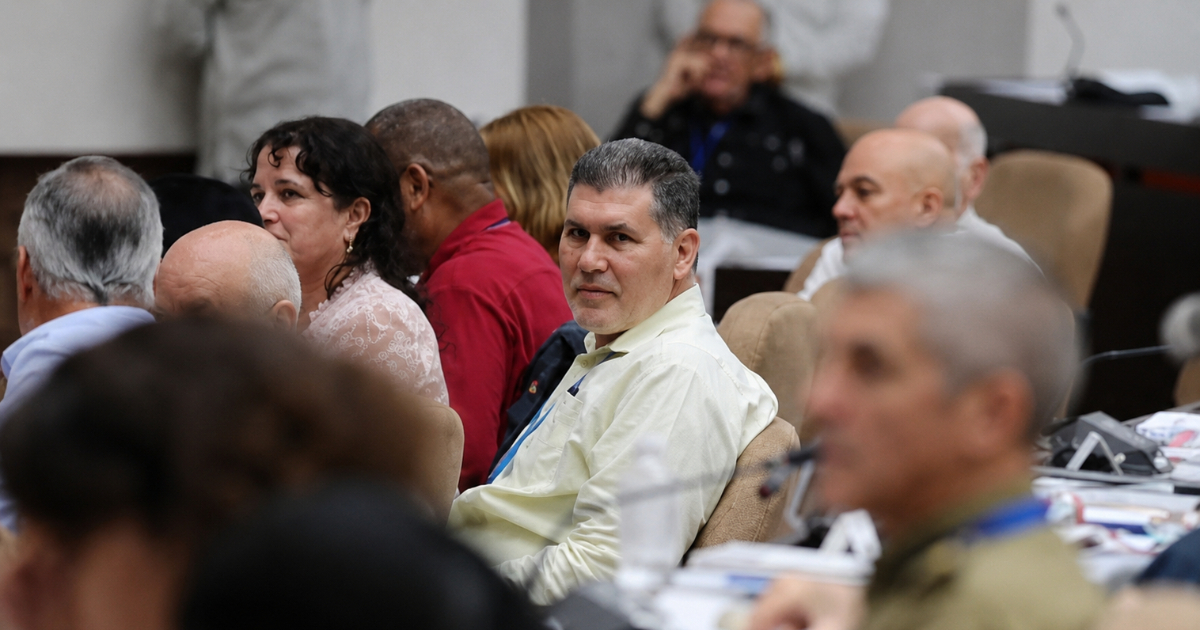
The Cuban regime seems to be promoting Óscar Pérez-Oliva Fraga as a potential successor within its power structure, according to a Friday report by The New York Times. This comes at a time when the Trump administration is looking for individuals capable of assuming governance responsibilities in a possible transition scenario on the island.
This report gains significance due to Pérez-Oliva's rapid rise in recent months and his increasing public exposure within Cuba. According to the Times, Pérez-Oliva, who is a great-nephew of the dictator Fidel Castro, has been making more frequent appearances on state television and in government announcements. He even gave a rare interview to international media outlets.
The Prospective Heir's Public Emergence
The newspaper interprets these developments as signs that the Cuban government might be supporting him as a possible successor. However, there is a significant hurdle in positioning him as a figure capable of negotiating a transition with Washington. The New York Times suggests that Pérez-Oliva would be "almost certainly unacceptable to the United States."
Pérez-Oliva's prominent role has not gone unnoticed. Over the past few months, CiberCuba has tracked his swift ascent within the governmental framework and the indications of a politically calculated promotion.
Balancing Tradition and Change
His recent trajectory is particularly notable due to his familial ties with the historical elite of the Castro regime, his experience in the economic apparatus, and a public image the regime has attempted to portray as more technical and modern than much of the old guard. His rising prominence has fueled questions about whether the regime aims to build around him a figure who could symbolize renewal without disrupting the system.
The new information from the Times takes this hypothesis further by stating directly that the Cuban government "appears to be endorsing" Pérez-Oliva as a potential successor.
Challenges in the Political Transition
Pérez-Oliva's rise occurs during a particularly delicate time for Cuban political succession. Despite not holding the presidency, Raúl Castro still wields enormous political influence, while Miguel Díaz-Canel leads a structure facing severe economic, energy, and social crises. Added to this is the increasing pressure from the United States and the regime's need to ensure the system's continuity as the historical generation that built and controlled its key institutions fades away.
In this context, a relatively young figure with government experience and familial ties to the Castros could offer the regime an appealing mix: generational renewal without breaking with the historical continuity of power. But that very continuity might present a problem for Washington.
Washington's Search for a Pragmatic Partner
The New York Times investigation reveals that the Trump administration is seeking something different. Washington has reportedly tasked its intelligence agencies with identifying current or former Cuban regime officials who could become pragmatic interlocutors and assume power responsibilities if U.S. pressure leads to a reconfiguration of the leadership.
Some officials envision a model similar to Delcy Rodríguez in Venezuela. After Nicolás Maduro's capture in January, Rodríguez became interim president and was seen by U.S. officials as a pragmatic figure capable of keeping the state apparatus functioning while collaborating with Washington. Trump is seeking someone in Cuba who could play a similar role. However, the candidate Havana seems intent on positioning is not the choice Washington desires.
The Times does not explain the specific reasons why Pérez-Oliva would be unacceptable to the United States nor identify the officials backing that assessment. The information is part of an investigation based largely on current and former U.S. officials and people familiar with intelligence assessments, whose identities were not disclosed.
This situation raises a deeper issue than a mere dispute over a name. Havana and Washington might both be searching for a figure for the post-current leadership scenario, but with vastly different criteria. For the Cuban regime, the primary goal would be to preserve the system's continuity and prevent a succession from leading to a loss of political control. For the United States, as described by the Times, the priority would be finding someone within the existing structures who is pragmatic enough to accept significant transformations and work with Washington.
In this U.S. search, other surprising names have emerged. The Times suggests that the Trump administration might be open to Raúl Guillermo Rodríguez Castro, "El Cangrejo," Raúl Castro's grandson, while the current Interior Minister, Lázaro Alberto Álvarez Casas, might also be deemed acceptable by U.S. officials.
The question remains whether this succession project can succeed in a scenario where the United States aims to have decisive influence over the direction of any transition.
FAQs on Cuba's Potential Political Transition
Who is Óscar Pérez-Oliva?
Óscar Pérez-Oliva is a Cuban official who has recently gained prominence within the regime's power structure. He is a great-nephew of Fidel Castro and has been suggested as a potential successor.
Why is Washington opposed to Pérez-Oliva?
While the exact reasons are not specified, Washington reportedly views Pérez-Oliva as "almost certainly unacceptable" due to his ties with the Castro regime and potential continuation of its policies.
What is the U.S. looking for in a Cuban successor?
The U.S. seeks a pragmatic figure within the Cuban regime who can facilitate significant transformations and collaborate with Washington in a transition scenario.