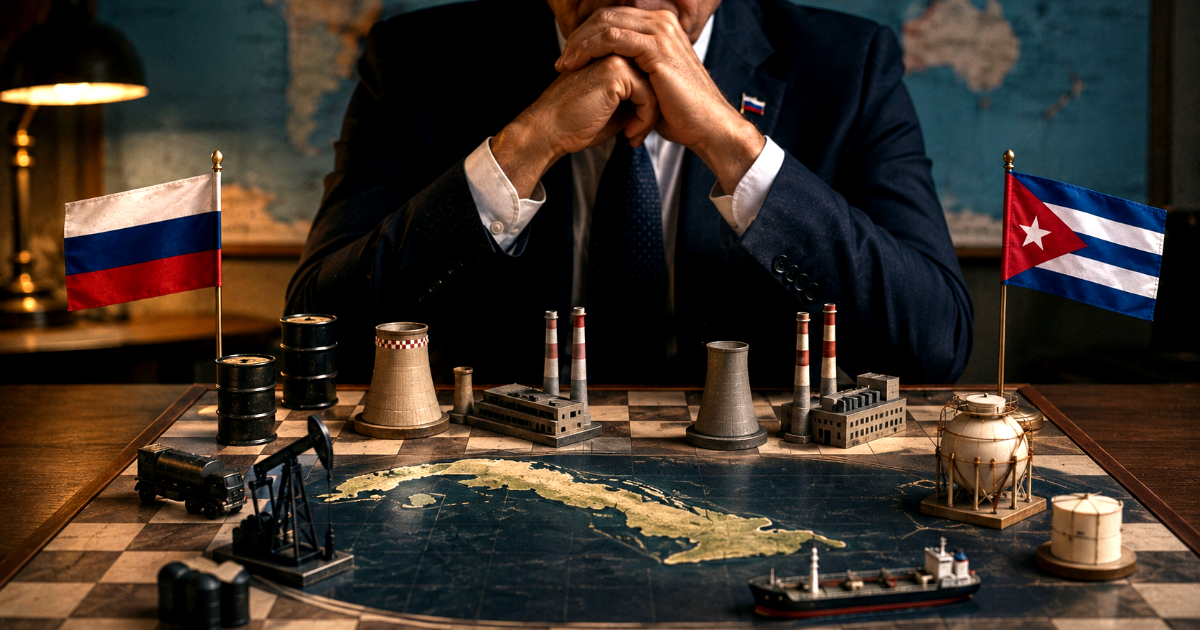
A Russian energy expert has stirred discussions by suggesting that Moscow's potential involvement in rebuilding Cuba's failing electrical grid goes beyond just the financial limitations of Havana.
Speaking to Finanzas Mail, and reported by Gazeta.Ru, Igor Yushkov addressed the critical issue of a possible political shift in Cuba that Russia must consider before committing to significant investments in the island.
Yushkov, who is affiliated with the Financial University under the Russian government, recently stated that Russian companies have the capability to construct power plants, supply gas or coal, and even explore nuclear power projects in Cuba. However, he raised concerns about the Cuban regime's ability to pay and introduced a political dimension to the discussion.
The expert emphasized that the current relationship between Havana and Washington poses a risk for Russian investments. If Cuba's political landscape changes, Moscow might not be able to recoup its investments.
This observation is particularly noteworthy in today's context: a Russian expert is openly considering a potential shift in Cuba's political direction as a factor that Russian businesses should evaluate before making long-term capital commitments in Cuba.
Yushkov did not claim to represent the Kremlin's expectations or speak on behalf of Vladimir Putin's government. Nevertheless, his remarks indicate that a change in regime is emerging as a possible scenario with tangible economic implications in Russian analyses.
His perspective contrasts with the public narrative Russia has been promoting in recent months regarding Cuba's situation and U.S. pressure. Moscow has consistently blamed Washington for many of Cuba’s challenges and publicly supported the continuation of the Cuban government.
In late January, Russian Foreign Ministry spokesperson Maria Zakharova accused the Trump administration of employing a strategy aimed at "economically strangling" Cuba through new sanctions.
Weeks later, Russian ambassador to Havana, Viktor Koronelli, assured that Moscow would continue to offer political and material support to Cuba, accusing Washington of trying to "strangle the Cuban revolution and change the government."
This rhetoric extended into the energy crisis discourse. In May, Koronelli denounced U.S. sanctions as a "totally unjust blockade" and "criminal blockade," highlighting the arrival of the Russian oil tanker Anatoly Kolodkin in Cuba as a defiance of the U.S.-imposed "energy fence."
During the same period, Russian Foreign Minister Sergei Lavrov reaffirmed to his Cuban counterpart, Bruno Rodríguez Parrilla, Russia's commitment to providing political, diplomatic, and material support to Havana against U.S. pressure.
In light of this, another aspect of Yushkov's statements is striking: while explaining the reasons for Cuba's frequent blackouts, he did not mention the embargo or U.S. sanctions.
Yushkov attributed the power outages to Cuba's severely deteriorated energy system, the growing demand for electricity without substantial upgrades, and a lack of new generation capacity.
His assessment highlights structural issues, such as outdated infrastructure, the absence of modernization, and insufficient new power generation capacity.
While Yushkov did not dismiss U.S. sanctions as a factor impacting Cuba's energy sector, he notably omitted them from the list of causes for the blackouts, a significant departure from the usual rhetoric of Russian and Cuban authorities.
This deviation is even more relevant since the expert was analyzing what Russia would need to do to address the problem. The change in perspective is remarkable.
While Russian diplomacy has framed its support for Cuba as a reaction to U.S. pressure, Yushkov takes a more pragmatic approach: evaluating the cost of rescuing Cuba's electrical system, who would finance the investment, and what would happen to that investment if Cuba's political direction changes.
"Cuba is currently insolvent. Let them first figure out how to pay us. Then we can discuss the matter," the expert stated.
His reasoning introduces two distinct risks for Moscow. The first is financial: Cuba currently lacks the resources to undertake large-scale energy projects. The second is political and potentially more significant: any Russian investment made today must endure potential future changes in Havana's political landscape.
Key Considerations for Russian Investments in Cuba
What did Igor Yushkov highlight as a risk for Russian investments in Cuba?
Igor Yushkov pointed out that a potential political shift in Cuba represents a significant risk for Russian investments, as it might prevent Moscow from recovering its investments.
How does Yushkov's perspective differ from Russia's public stance on Cuba?
While Russia has publicly blamed the U.S. for Cuba's issues and supported the Cuban government, Yushkov adopts a more pragmatic view, focusing on the financial and political risks of investing in Cuba's energy sector.
What structural problems did Yushkov identify in Cuba's energy system?
Yushkov identified the severe deterioration of Cuba's energy infrastructure, the lack of modernization, and insufficient new generation capacity as key issues causing frequent blackouts.