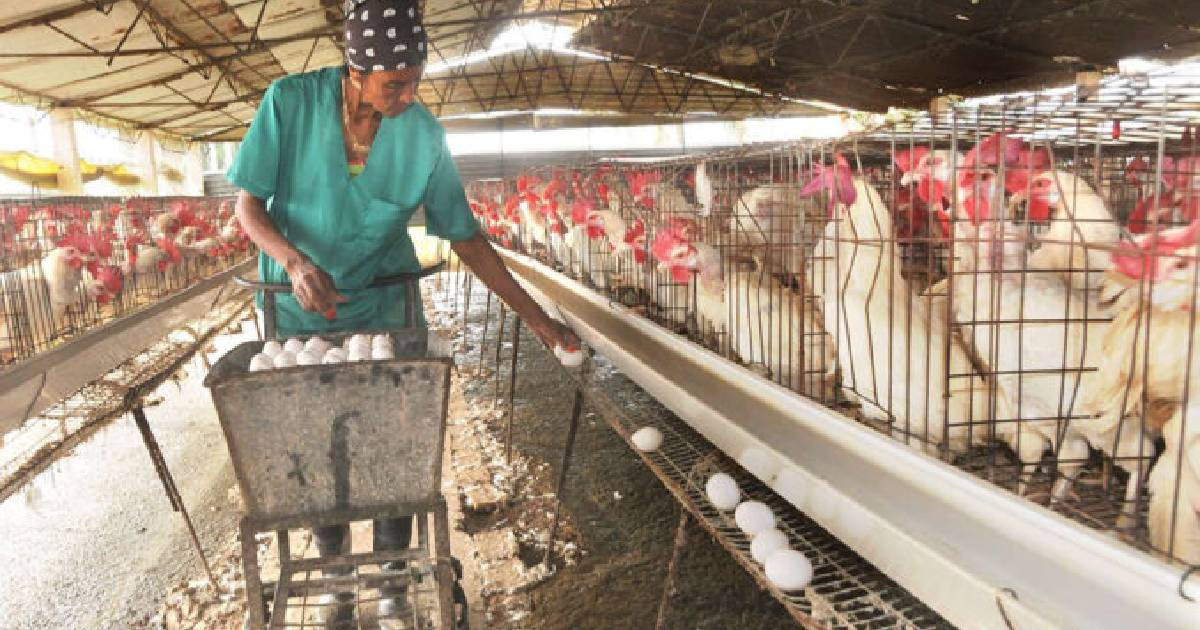
In the province of Granma, more than 460,000 hens are being raised, contributing to over 64 million eggs produced so far this year. Despite this impressive output, a portion is not reaching Cuban tables in local currency but is instead sold in foreign exchange.
"Eggs are allocated both for social consumption and sale in freely convertible currency, prioritizing the basic diet of the population and health programs," a report from Radio Bayamo's digital platform stated on Friday.
The report highlighted that Granma's poultry industry shows "signs of recovery through cooperative schemes involving state enterprises, small and medium-sized enterprises (SMEs), and private producers."
In July 2025, the official newspaper Granma reported that cooperative production included five agricultural producers, three private SMEs, and one state entity, with a production tally of 64,852,900 eggs at that time.
By the end of May 2025, "29,244,000 eggs had been sold in freely convertible currency, generating $4,919,385, which facilitated the purchase of 7,453.6 tons of feed through this scheme," emphasized the official organ of the Communist Party of Cuba.
The paradox is stark; while Granma churns out tens of millions of eggs, prices in the informal market within the province have surged to levels unaffordable for most Cubans.
In Guisa, a municipality in Granma, the price reported this week was 110 pesos per egg.
Consumers in various provinces confirmed prices nearing 200 pesos per egg, with some reports indicating costs as high as 300 to 320 pesos.
In Bayamo, the provincial capital, a carton of 30 eggs reached nearly 4,000 pesos in June, whereas pensions range between 2,000 and 3,000 pesos monthly.
The minimum wage for the budgeted sector was set at 3,210 pesos in July, meaning that purchasing a carton of eggs could consume nearly two full minimum salaries.
This collapse in egg accessibility is a direct result of the poultry crisis stemming from years of state mismanagement. Cuba's egg production dwindled from four to five million daily to a mere 1,200,000, as admitted by then-Minister of Agriculture Ydael Pérez Brito in October 2024.
Total production plummeted from 2,358.4 million units in 2022 to 415.3 million in 2024.
To bridge the gap, the government imports eggs from the Dominican Republic, Colombia, and the United States. The Dominican Republic resumed exports to Cuba on July 24 with an initial shipment of 12 containers and nearly four million units, subsidized by the Dominican government at a rate of $4,500 per container.
The Egg Crisis in Granma and Its Implications
Why are eggs in Granma being sold in foreign currency?
Eggs in Granma are sold in foreign currency to prioritize essential programs and generate revenue for purchasing necessary feed, despite their production being meant for local consumption.
What is the impact of the egg price surge in Granma?
The surge in egg prices has made them unaffordable for many residents, as prices in the informal market far exceed typical salaries and pensions, exacerbating food insecurity.
How has Cuba's egg production changed in recent years?
Cuba's egg production has drastically decreased from four to five million eggs daily to about 1.2 million, with total annual production dropping significantly between 2022 and 2024.