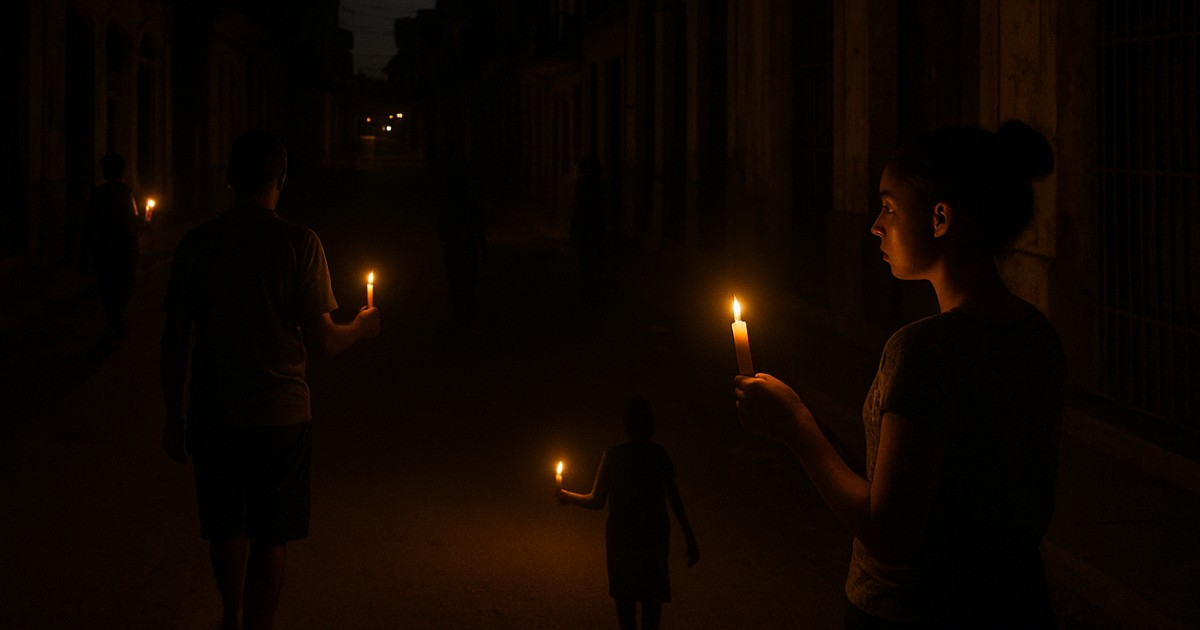
Camagüey writer and journalist María Antonia Borroto Trujillo took to Facebook on Thursday and Friday with two posts that quickly went viral. In one of them, she meticulously calculated the duration of her home's power outage: "7 days. 172 hours - 10,320 minutes. 619,200 seconds without electricity."
In her initial post, Borroto Trujillo—who holds a doctorate in Communication Sciences and is a member of the Union of Writers and Artists of Cuba (UNEAC)—used irony to depict daily life amid the prolonged blackout, coining a phrase that encapsulates the crisis: "The Revolution has become just that: charging everything that needs charging."
The immediate cause of the outage in her area was a faulty transformer that failed every time reconnection was attempted. As she explained in her post's comments, authorities took five days to respond: "The transformer gave out each time it was hooked up, and after five days, they 'discovered' it needed to be replaced with one of higher capacity."
Community Support in the Face of Crisis
Borroto Trujillo's account highlights a collective endurance that has become routine. She described how "neighbors from nearby blocks alert us when they have power, and that's where we charge cell phones, fans, power banks, Ecoflows... Basically, anything chargeable." Houses equipped with more robust solar panels have become community charging stations.
Compounded Hardships: Water and Cooking
The lack of electricity is exacerbated by water shortages—87% of Cuba's pumping stations rely on the electrical grid—and the inability to cook with gas. "Most homes have been cooking with charcoal for months. Yesterday, a neighbor shared some embers with another to make the most of them," she wrote. The price of a sack of charcoal, which was around 300 pesos in 2022, has skyrocketed to between 2,800 and 5,000 pesos in 2026, depending on the region.
Borroto Trujillo likened the situation to Hurricane Ike's onslaught in September 2008, one of Cuba's most devastating natural disasters, which left over 300,000 homes damaged and caused losses in the billions. "These days feel almost like after Ike," she noted. A commenter pointed out a key difference: "It's like a Category 5 hurricane, or worse, because back then, line crews from across the country would help with repairs."
Public Outcry and Lingering Questions
Comments ranged from outrage to despair. While one user claimed to have been without power for two weeks, relying on solar panels and batteries, another reported 35 consecutive days without electricity. "It's criminal, torturous. I'd love to see high officials in this situation," one commenter lamented. Another summed up the grim reality: "It's about getting used to living poorly for the rest of our lives."
This episode is part of the most severe electrical crisis Cuba has faced in decades. The National Electric System experienced at least six total collapses in 2026, according to Bloomberg Línea, the latest occurred on the night of August 2. The generation deficit exceeded 2,305 MW during peak nighttime hours on August 6, with blackouts lasting 20 to 24 hours daily in many areas. Some areas in Matanzas suffered outages lasting up to 87 consecutive hours between July and August.
It is not the first time Borroto Trujillo has publicly criticized the energy collapse. On August 1, she published a satirical piece titled "Basic Manual for Communicating with the Cuban Electric Company Without Having a Heart Attack," which also circulated widely on social media. Her latest posts concluded with a question that remains unanswered by officials: "Today is another day. Life continues, it must go on, and it must be different. Until when?"
Understanding Cuba's Power Crisis
What caused the power outage in Maria Antonia Borroto Trujillo's area?
The power outage was caused by a faulty transformer that failed each time reconnection was attempted. It took authorities five days to identify the need for a more powerful replacement.
How are communities coping with the prolonged power outages?
Communities are relying on solidarity, with neighbors informing each other when they have power so they can charge essential devices. Some homes with stronger solar panels serve as community charging points.
How has the cost of living changed due to the crisis?
The cost of essentials like charcoal has risen dramatically, with prices increasing from 300 pesos in 2022 to between 2,800 and 5,000 pesos in 2026, depending on the region.