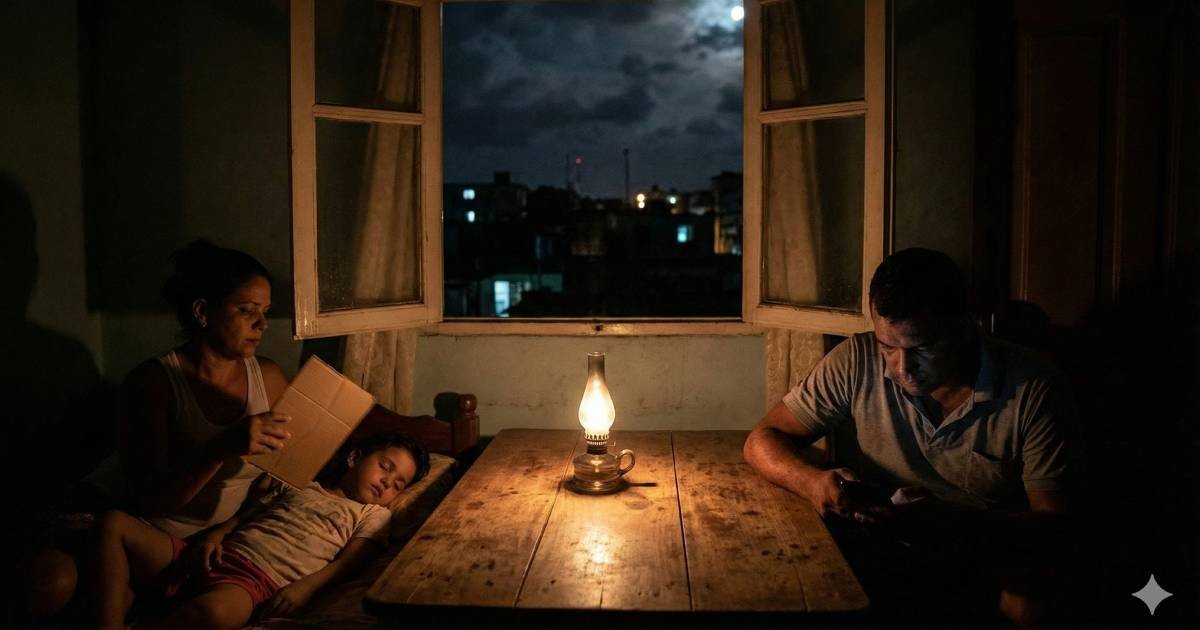
This Friday, Cuba is bracing for another intense wave of power outages. According to a report from the Electric Union, the evening peak could see shortages reaching 2,340 MW, with only 940 MW available against an anticipated demand of 3,250 MW.
Yesterday offered no respite; the electrical service was compromised around the clock, with the maximum real impact reaching 2,240 MW at 11:20 PM.
The Struggle of Power Plants
Several thermoelectric units remain offline. The Máximo Gómez plant's Unit 6, Ernesto Guevara De La Serna's Units 1 and 2, Carlos Manuel de Céspedes' Unit 4, and Lidio Ramón Pérez's Unit 2 are all out of operation due to malfunctions.
In addition, maintenance work is underway for Ernesto Guevara De La Serna's Unit 3, Antonio Maceo's Units 5 and 6, and Diez de Octubre's Unit 5.
Adding to the crisis, 106 distributed generation plants are non-operational due to fuel shortages, along with the Regla and Melones barges, the Mariel Fuel Plant, and the Moa Fuel Plant.
The Role of Renewable Energy
On Thursday, the 54 solar photovoltaic parks managed to produce 3,697 MW/hour, achieving a peak output of 575 MW. However, this contribution falls short of covering the nighttime deficit, when electricity demand is at its highest.
This Friday's challenges are part of a week marked by unprecedented figures. On Tuesday, Cuba shattered its own blackout record with a real impact of 2,411 MW at 10:30 PM, surpassing the previous high of 2,380 MW recorded on July 29.
A Nation in Crisis
Between August 3 and 4, the National Electric System experienced two total disconnections in less than 48 hours, marking the sixth and seventh nationwide blackouts of the year.
The root causes are deep-seated and chronic: shortages of fuel oil and diesel, severe deterioration of thermoelectric plants, and a lack of spare parts.
Energy and Mines Minister Vicente de la O Levy confessed to the National Assembly that some Cuban communities have endured up to 105 days without electricity.
The impact on the populace is severe: daily outages lasting 20 to 24 hours, disruption of water pumping, inability to preserve food, and unbearable heat in homes.
Some Cubans have resorted to sleeping on Havana's Malecón to escape the stifling temperatures.
Desperation has spilled into the streets. On Wednesday, protests erupted in Marianao, La Lisa, El Cerro, San José de Mayabeque, and Santiago de Cuba, all directly linked to the blackouts.
In July, the Cuban Conflict Observatory recorded 1,415 protests and critical expressions, the highest monthly figure in its history, including 72 in-person demonstrations.
Faced with this scenario, the regime's response has been limited to statements. Following the latest total disconnection, Minister De la O Levy claimed authorities are working with "dedication and commitment," yet no immediate viable solutions were announced.
Understanding Cuba's Power Crisis
What is causing the power outages in Cuba?
The outages are primarily due to structural issues such as fuel shortages, deterioration of thermoelectric plants, and a lack of spare parts.
How are the blackouts affecting Cuban citizens?
The blackouts lead to prolonged power cuts, disrupt water supply, make food preservation difficult, and increase discomfort due to heat.
What measures is the Cuban government taking to address the crisis?
The government's response has largely been limited to declarations without announcing immediate, viable solutions to the crisis.