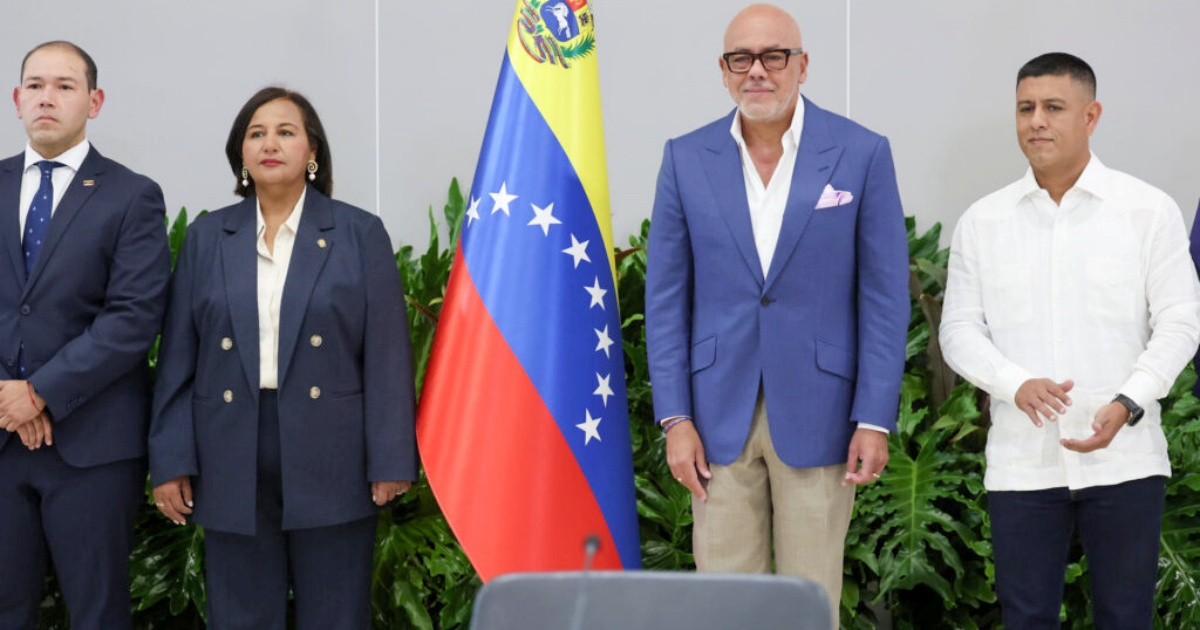
Venezuelan government representatives and a faction of the opposition formally initiated their negotiation table on Thursday at the La Carlota airbase in Caracas. This marks the first in-person meeting between the two sides since the U.S. spearheaded a transition process for Venezuela, occurring seven months following Nicolás Maduro's capture by U.S. forces.
The parties have agreed to engage in an initial work cycle in continuous session until Wednesday, August 12, at which point they will assess the continuation of the plenary sessions.
The joint statement reads, "During the first work cycle, we will remain in continuous session until Wednesday, August 12, and will decide on the continuation of the plenary, considering the significance of this process for the well-being of Venezuelans."
The Delegations Face-to-Face
Leading the opposition side is Dinorah Figuera, president of the National Assembly elected in 2015. She returned to Venezuela from Spain the day before to head the discussions.
Figuera was joined by former deputies Marco Aurelio Quiñones, Ramón López, Jorge Millán, Juan Miguel Matheus, Sergio Vergara, and Desiree Barboza.
On the government side, led by acting president Delcy Rodríguez, the delegation is spearheaded by Jorge Rodríguez—brother of the acting leader and president of the Parliament—accompanied by the Minister of Higher Education Ana María Sanjuán, first vice president of Parliament Pedro Infante, and deputies América Pérez, Génesis Garvett, and Jorge Arreaza.
Rodríguez provided a brief statement on the commencement: "National dialogue begins with former opposition deputies of the 2015 National Assembly."
Figuera emphasized on X: "We have launched the process that will pave the way towards democracy and the reinstitutionalization of Venezuela among deputies from the 2015 National Assembly and representatives of the interim government. We are steadfastly working for freedom and democracy for Venezuelans."
Principles and Agenda of the Negotiations
The joint statement outlines principles guiding the discussions: good faith negotiation, peaceful and constitutional political solutions, mutual recognition, political equality, verifiable compliance with commitments, and protection of the human rights of "all forces."
The agenda is centered on three main themes: addressing victims of the June 24 double earthquake—which resulted in at least 6,125 deaths and left nearly 18,000 homeless—strengthening democratic institutions, and ensuring political and civil rights.
This process is anticipated to extend until December 2026, at which point the work's outcomes will be formally presented.
U.S. Support and Internal Divisions
The United States described the start of the talks as a "unique opportunity" for Venezuelan reconciliation, according to a State Department statement reaffirming its commitment to Secretary Marco Rubio's three-phase plan: stabilization, economic recovery, and democratic transition.
Despite this, the process faces opposition from both sides. Hardline sectors of the chavismo, such as the Anti-Imperialist Popular Front, protested last week in Caracas against the dialogue, labeling it an "imposition by the U.S. government."
On the opposition front, the Democratic Unity Platform (PUD) is not participating in the talks. María Corina Machado and Edmundo González Urrutia are excluded for not being members of the 2015 National Assembly.
The PUD issued a statement on Thursday expressing hope for "real progress" and demanding an end to political persecution and the restoration of civil rights as "indispensable conditions for advancing towards genuine national reconstruction."
A Ninth Attempt with Unprecedented Support
This dialogue marks the ninth attempt between chavismo and the opposition, but it is the first with explicit and active backing from Washington. The process was formally relaunched on August 1 through a phone call between Rodríguez and Figuera, following initial contact in June that was disrupted by the earthquakes.
Even from his detention in Brooklyn, awaiting trial set for June 2027, Maduro issued a message supporting "any dialogue path that helps consolidate peace, coexistence, and unity among Venezuelans."
Key Questions on the Venezuelan Negotiation Process
What is the main goal of the Venezuelan negotiations?
The primary aim is to initiate a peaceful and constitutional political transition, focusing on democracy, civil rights, and addressing humanitarian issues.
Who are the key figures in the negotiation process?
Dinorah Figuera represents the opposition, while Jorge Rodríguez leads the government delegation. Both play crucial roles in facilitating dialogue.
How long is the negotiation process expected to last?
The negotiations are planned to continue until December 2026, when the results of the discussions will be formally presented.