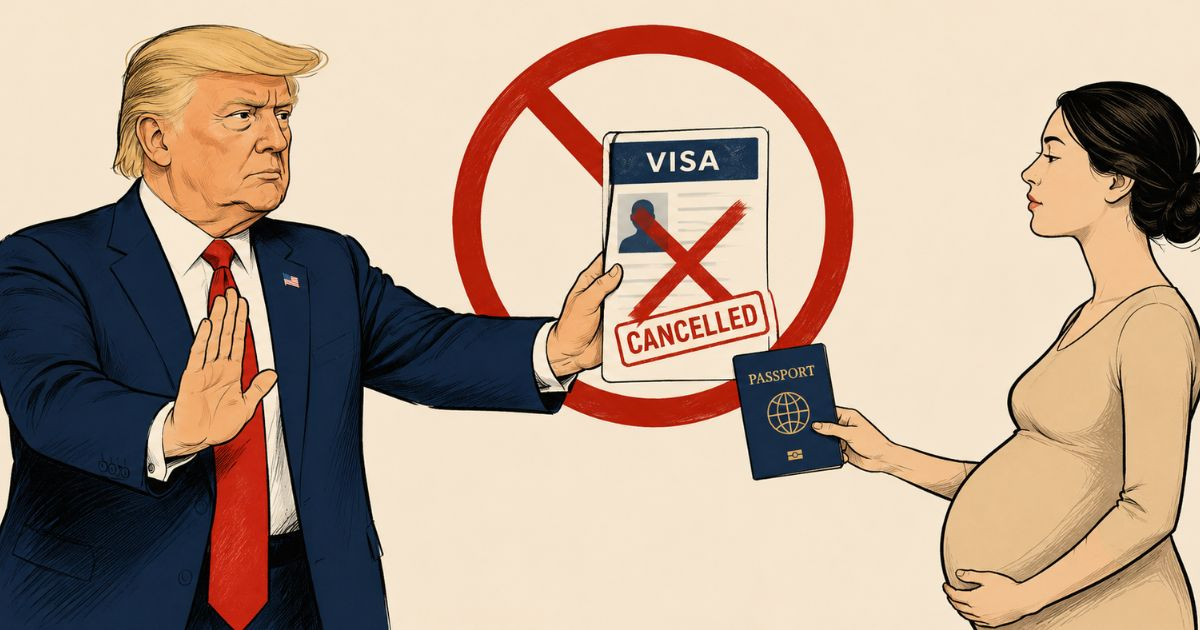
On Thursday, President Donald Trump enacted an executive order titled "Ending Birth Tourism," empowering the Department of State and the Department of Homeland Security to crack down on foreign nationals entering or attempting to enter the United States on non-immigrant visas with the intent of giving birth on American soil.
The new directive allows the government to refuse visas, revoke travel authorizations, impose permanent entry bans, and expel individuals linked to what's known as maternity tourism.
The executive order, made public by the White House, emphasizes that "citizenship is not a commodity to be acquired through calculated exploitation and evasion of immigration laws, as is the case when entering the country on a non-immigrant visa to give birth within its borders."
This measure also targets those facilitating the scheme: operators, organizations, and individuals—both inside and outside the U.S.—involved in arranging these trips.
According to the document, these operators "use deceptive advertising and incentives to lure foreigners to travel to the U.S. for the purpose of giving birth," promising citizenship, access to public benefits, and stays in specialized facilities, claims often left unfulfilled.
Furthermore, the order reveals that operators "advise their clients to misrepresent the purpose and duration of their stay to consular and border officials" to secure entry visas.
White House officials clarified that tourist visas "can and will be denied" when the declared intent is birth tourism.
The order includes humanitarian or national interest exceptions, at the discretion of the secretaries of State and Homeland Security, granting them presidential authority under section 215(a) of the Immigration and Nationality Act to implement the order.
This approach marks a shift from Trump's January 2025 attempt, when he signed Executive Order 14160 to reinterpret the 14th Amendment and deny automatic citizenship to children of non-citizens.
That order was blocked by a federal judge shortly after its introduction, and the Ninth Circuit Court of Appeals upheld the block months later. The final blow came on June 30, 2026, when the Supreme Court nullified the order by a six-to-three vote, reaffirming constitutionally guaranteed birthright citizenship.
Following this judicial setback, Trump's new strategy doesn't target birthright citizenship directly but rather focuses on the entry mechanism: by addressing non-immigrant visas, the executive branch exercises broader discretion, making it harder to challenge in court.
The State Department had already warned in June 2026 that it might refuse visas to pregnant women primarily intending to give birth in the U.S. In early August, the country also tightened general tourist visa access with stricter requirements for certain nations.
The birth tourism industry predominantly serves clients from China, Russia, Nigeria, and Latin American countries, including Cuba.
Estimates presented to the U.S. Senate suggest the annual number of cases ranges between 50,000 and 150,000 solely among Chinese nationals, while the Center for Immigration Studies estimates around 36,000 global cases each year.
This order coincided with the signing of a second executive order related to birthright citizenship, both presented by the White House as efforts to "safeguard the meaning and value of American citizenship."
Understanding Birth Tourism and U.S. Immigration Policies
What is birth tourism?
Birth tourism refers to the practice of traveling to another country, such as the United States, primarily to give birth so that the child can obtain citizenship in that country.
Why is the U.S. targeting birth tourism?
The U.S. government views birth tourism as a form of exploitation of immigration laws, where individuals use non-immigrant visas for purposes not originally intended, aiming to grant citizenship to their children through birthright.
How does birth tourism impact U.S. immigration policy?
By exploiting loopholes in visa policies, birth tourism challenges the integrity of U.S. immigration laws and places additional administrative burdens on the immigration system.