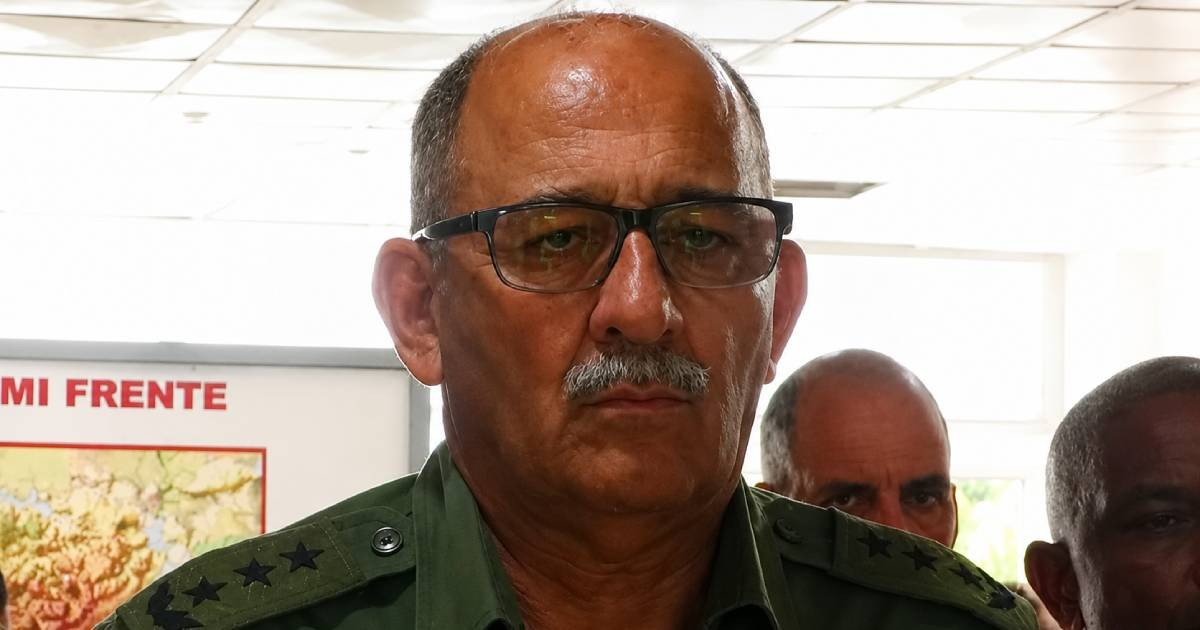
The United States government has once again imposed sanctions on General Roberto Legrá Sotolongo, the Chief of the General Staff of the Revolutionary Armed Forces (FAR) and First Deputy Minister of the Ministry of the Revolutionary Armed Forces (MINFAR). He has been identified as a central figure in acquiring Russian weaponry and bolstering Cuba's military alliances with nations deemed adversarial by Washington.
This is part of a fresh wave of sanctions unveiled by the State Department, extending to five organizations and seven additional officials connected to Cuba's military apparatus. These actions are implemented under Executive Order 14404, signed by President Donald Trump on May 1, 2026, aimed at penalizing individuals and entities that aid in enhancing the military and repressive capabilities of the Cuban regime.
The State Department highlights Legrá Sotolongo's significant involvement in procuring Russian-manufactured weapon systems and fostering military cooperation between Havana and governments hostile to the United States.
Previous Sanctions and Expanding Measures
This isn't the first instance of Washington targeting the Cuban military leadership with sanctions. On August 19, 2021, the Office of Foreign Assets Control (OFAC) of the Treasury Department had already listed him in the Specially Designated Nationals (SDN) list under the Global Magnitsky Act, citing his involvement in the repression of the historic protests on July 11, 2021.
The latest designation does not replace the previous one but rather enhances it. This development intensifies restrictions on any assets or interests Legrá Sotolongo may have within U.S. jurisdiction, further tightening the pressure on one of the regime's most influential military figures.
Legrá Sotolongo officially became the Chief of the General Staff in 2021 and joined the Political Bureau of the Communist Party of Cuba in December 2025, solidifying his role within the highest echelons of power.
Targeting Cuba’s Military Leadership
Alongside Legrá Sotolongo, the State Department has renewed sanctions against FAR Minister Álvaro López Miera, who was previously sanctioned by the Treasury Department in July 2021 following the crackdown on the July 11 protests.
The updated list also includes José Antonio Remón Rodríguez, head of the MINFAR's Directorate of External Relations; Óscar Enrique Biosca Gallego, head of the Economic Directorate; Mónica Milián Gómez, Cuba's military attaché in Russia; Waldo Pérez Cortés, military attaché in China; Roberto Jesús Viciana Mousset, director general of the Military Industry Union and brigadier general, and Heriberto Sánchez Alleyne, general director of TECNOIMPORT.
Sanctioned Enterprises Supporting Cuba’s Military
The U.S. has also targeted five companies accused of bolstering the regime's military capabilities. The sanctioned entities include TECNOIMPORT, DUNA S.A., the Military Industry Union (UIM), the Yuri Gagarin Industrial Military Company, and TECNOTEX, all associated, according to Washington, with importing, producing, repairing, or modernizing armaments for the FAR.
The State Department asserts that these companies have facilitated the integration of Russian and Chinese military equipment into Cuba's arsenal. TECNOTEX, in particular, is noted for its history of collaboration with North Korea on defense-related projects.
Intensifying Pressure on the Cuban Regime
These sanctions are backed by the State Department's report "Cuba: The Capital of 21st Century Communism," released on July 20, which accuses the regime of tightening military cooperation with Russia and China, receiving arms and surveillance technology, and serving as a base for intelligence operations targeting the United States.
This move is part of the Trump administration's maximum pressure strategy initiated in May 2026. In recent months, Washington has sanctioned GAESA, MINFAR, MININT, President Miguel Díaz-Canel, the Mariel Container Terminal, and now the network managing arms acquisitions for Cuba's Armed Forces.
In announcing the new measures, Secretary of State Marco Rubio reiterated the White House's stance toward the Cuban regime: "President Trump's resolve is unwavering: The United States will not tolerate a rogue state hosting military, intelligence, and terrorist operations just ninety miles from American soil."
Understanding U.S. Sanctions on Cuban Military Figures
What prompted the new sanctions on Roberto Legrá Sotolongo?
The U.S. imposed new sanctions on Roberto Legrá Sotolongo due to his central role in acquiring Russian arms and enhancing military cooperation with countries considered adversaries to the U.S.
How do these sanctions affect the Cuban military?
The sanctions intensify restrictions on Cuban military leaders, aiming to curb their ability to strengthen and modernize the regime's military capabilities.
Which other Cuban officials are affected by the sanctions?
Sanctions were also renewed against Álvaro López Miera and extended to José Antonio Remón Rodríguez, Óscar Enrique Biosca Gallego, Mónica Milián Gómez, Waldo Pérez Cortés, Roberto Jesús Viciana Mousset, and Heriberto Sánchez Alleyne.