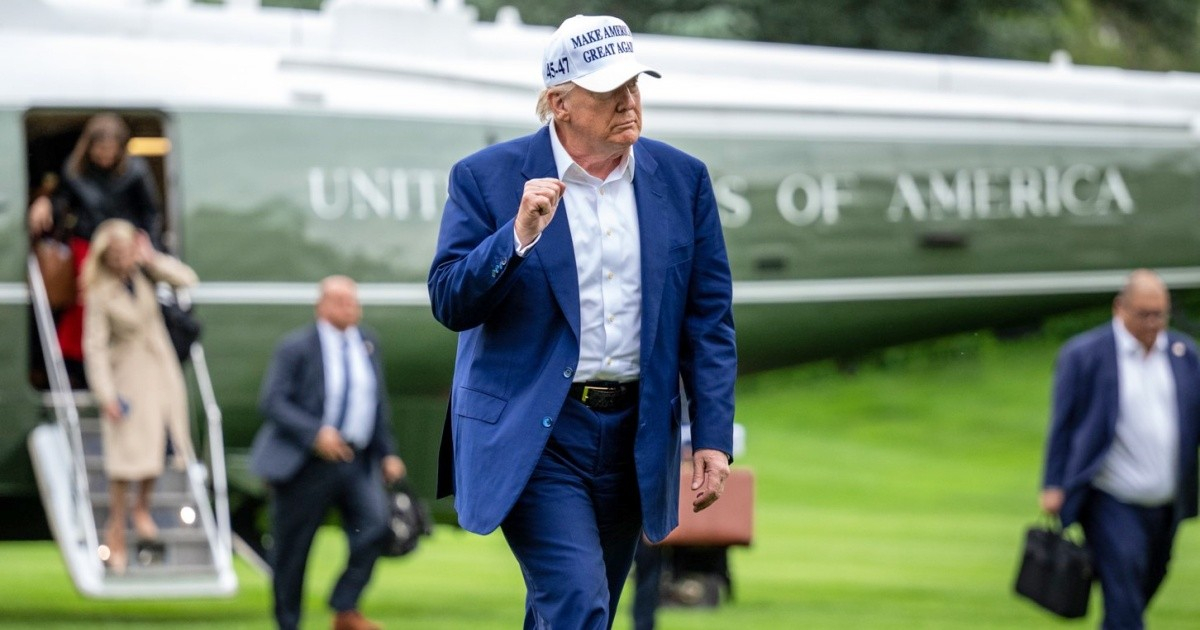
The National Transportation Safety Board (NTSB) has initiated a formal inquiry following reports that the presidential helicopter, Marine One, carrying President Donald Trump, came alarmingly close to a commercial aircraft in Washington's airspace. This potential breach of security protocols has been a cause of concern, as reported by agency EFE.
The incident took place around 2:33 PM Eastern Time when Marine One departed from the Ellipse near the White House, heading towards Joint Base Andrews, where President Trump was scheduled to board his plane for a trip to California.
The Close Call
Just a minute after Marine One took off, Envoy Air Flight 3742—an Embraer E-170 operating for American Airlines bound for Pensacola, Florida—departed from Ronald Reagan National Airport.
According to sources cited by the New York Times, the two aircraft were less than a mile apart, violating the regulatory minimums of 2.4 kilometers for horizontal separation and 150 meters for vertical separation, as noted by the Wall Street Journal.
The Federal Aviation Administration (FAA) cautiously confirmed the incident, stating that its "preliminary safety analysis indicated a temporary loss of separation, after which both aircraft distanced themselves from each other."
The FAA added that the air traffic controller maintained communication with both the commercial and Marine One pilots during the separation lapse, emphasizing that the aircraft were not on a collision course.
White House Downplays the Risk
Kush Desai, a spokesperson for the White House, responded to the reports by minimizing the threat, asserting to AFP, "Marine One flights are piloted by some of the world’s best aviators."
Desai assured, "At no point was the president in any danger."
Despite these assurances, the NTSB declared it is investigating "the reported event of loss of separation between Marine One and a commercial aircraft" departing from Reagan, withholding further details in their initial statement.
Protocol Issues Under Investigation
The central question of the investigation is whether established protocols were followed. These protocols were set after the January 29, 2025, air tragedy over the Potomac River, where an Army Black Hawk helicopter collided with an American Airlines regional flight near the same airport, resulting in the deaths of all 67 people aboard both aircraft.
Following that accident, the FAA implemented a policy mandating a complete halt in commercial traffic at Reagan whenever Marine One is operating nearby, with very limited exceptions.
According to sources from Reuters and CNN, this protocol might not have been timely applied on Tuesday. Air traffic control audio captured a "three minutes to departure" announcement before Marine One took off, suggesting commercial flights were still active when the presidential helicopter initiated its maneuver.
Complex Airspace Under Constant Review
Ronald Reagan National Airport is one of the most challenging airspaces in the United States due to its close proximity to downtown Washington, the White House, and presidential flight zones.
After the January 2025 accident, the FAA reduced the number of hourly arrivals at Reagan from 36 to 26 and indefinitely closed the nearby helicopter corridor.
This Tuesday's incident occurred in the same scrutinized airspace, highlighting issues in coordinating commercial traffic with presidential transport, especially as President Trump recently declared a national emergency at airports due to an air security crisis.
Despite the scare, commercial flights at Reagan continued without disruption following the episode, with no additional suspensions reported, as confirmed by the FAA.
Understanding Airspace Protocols and Safety Concerns
What is the role of the NTSB in airspace safety?
The NTSB is responsible for conducting investigations into transportation accidents, including airspace incidents, to determine the causes and make safety recommendations.
How does the FAA ensure aircraft separation?
The FAA enforces regulatory minimums for horizontal and vertical separation between aircraft to prevent collisions. Controllers monitor and manage air traffic to maintain these safe distances.
Why is Reagan National's airspace considered complex?
Reagan National's airspace is considered complex due to its location near the nation's capital, the White House, and the airspace reserved for presidential flights, requiring stringent coordination and management.