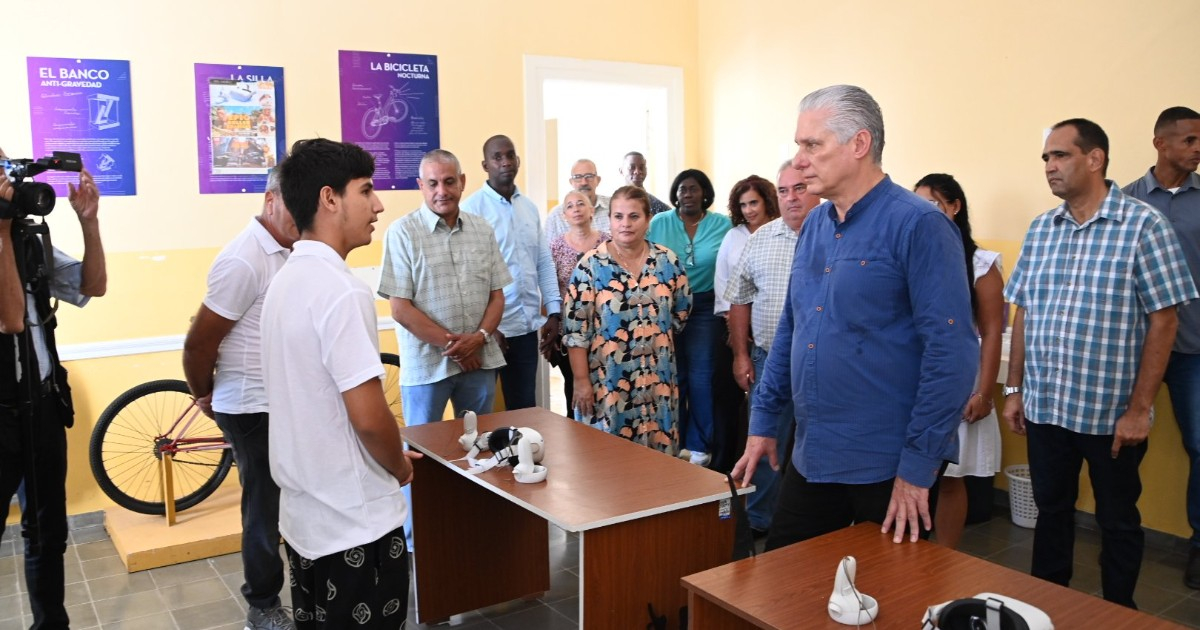
While millions of Cubans endure a summer plagued by power outages lasting up to 25 hours a day and failing services, Miguel Díaz-Canel took a tour around Havana on Wednesday. This excursion, portrayed by the official Cuban presidency website as a working visit, was focused on "recreation and the economy."
The itinerary covered the Great Metropolitan Park of Havana, the Sports Complex of 23 and B in Plaza municipality, the Technological Palace "Finca de los Monos", the "Río Cristal" recreational center on Rancho Boyeros Avenue, and the Suchel Cetro Basic Business Unit, a soap factory situated in the eastern part of the capital.
At each location, official rhetoric emphasized themes such as business autonomy, integration with economic actors, and artificial intelligence.
During his visit to the soap factory, Díaz-Canel engaged with director Alexander Puig Varona about expansion strategies, renewable energy sources, and electric mobility. "Attention must be paid to how these transformative contexts can be leveraged to enhance an industry that directly impacts the lives of Cubans," the leader stated, as reported by the official portal.
Accompanying him were Liván Izquierdo Alonso, first secretary of the Communist Party's Provincial Committee in Havana, and Yanet Hernández Pérez, the capital's governor.
The tour is part of a broader campaign that Díaz-Canel initiated on June 30, spanning all 15 municipalities of the capital. It is framed within the so-called "Year of Preparation for Defense 2026" and aligns with the 176 economic and social transformations approved in June. By the end of July, he had visited 11 of the 15 municipalities, persistently urging local authorities to "better organize the blackouts" and appoint "the most capable individuals" to lead the structures.
The stark contrast between the official tour and the harsh reality faced by Cubans is undeniable. In early August, Cuba experienced two complete power system failures in less than 48 hours, marking the sixth and seventh nationwide blackouts of the year, just before Díaz-Canel's visit.
Reports from Infobae highlight that the island faces an electrical deficit of up to 2,000 MW during peak consumption periods, with outages lasting 20 to 25 hours daily in some areas.
The tourism sector, touted by the regime as a pillar of economic recovery, is also experiencing its worst phase in years. Between January and April 2026, Cuba welcomed only 328,608 international tourists, a 55.8% decrease compared to the same period in 2025. By the end of July, 73% of hotel facilities were closed, and approximately 25,000 industry workers were "available."
In this context, a Cuban doctor went viral on TikTok sharing her experience in Varadero: a $315 vacation she described as "the worst vacation of my life," featuring poor air conditioning, no hot water, and subpar food.
Independent analysts and media have criticized Díaz-Canel's municipal tours for yielding minimal or merely declarative results, as the regime continues to organize visits to parks and factories as a show of management amidst an ever-deepening crisis.
Understanding Cuba's Current Challenges
What are the main issues facing Cubans this summer?
Cubans are dealing with prolonged power outages, lasting up to 25 hours a day, and collapsing services, making daily life extremely challenging.
Why is the tourism sector struggling in Cuba?
The tourism industry in Cuba is facing a significant decline, with a 55.8% drop in international visitors in early 2026 compared to the previous year, compounded by the closure of most hotel facilities and workforce reductions.
How are Díaz-Canel's tours perceived?
The tours have been criticized for producing limited tangible results, with many viewing them as symbolic gestures rather than effective management actions amid ongoing crises.