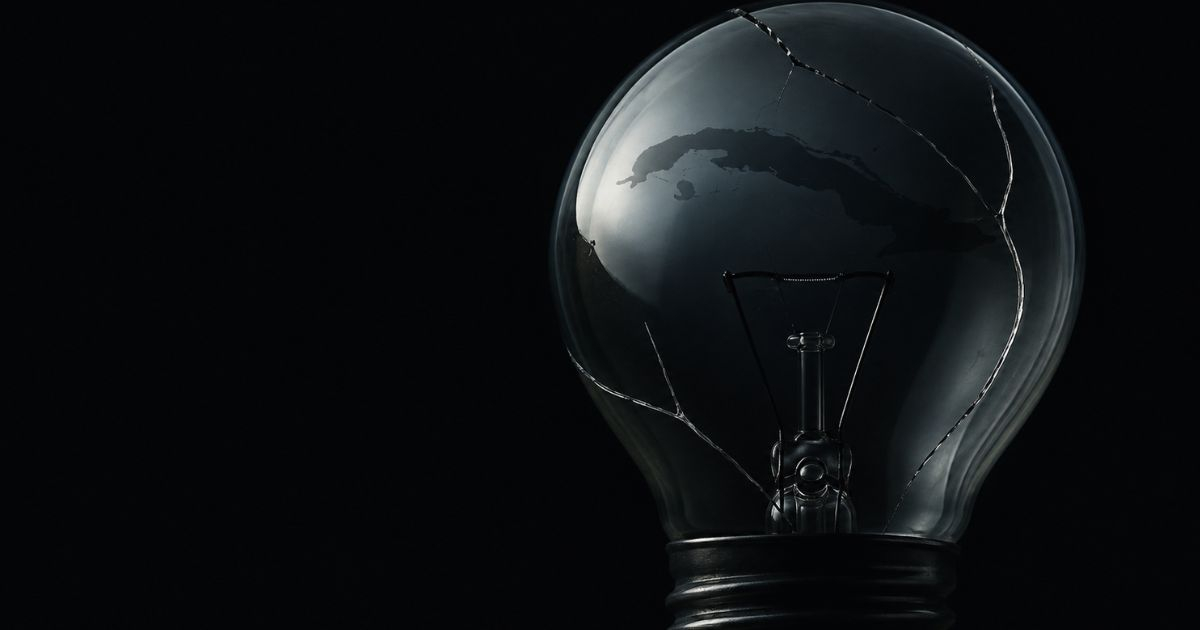
On Tuesday, Cuba hit a new peak in its ongoing energy crisis, experiencing a power shortage of 2,411 megawatts (MW) due to insufficient generation capacity. This unprecedented deficit left a significant portion of the island without electricity and surpassed the previous record set just a week earlier.
The state-run Union Electrica (UNE) reported that the highest level of power outage occurred at 10:30 PM on Tuesday, with the electricity service remaining unstable due to inadequate capacity for a full 24 hours, affecting the entire night into Wednesday morning.
The specific figure of 2,411 MW represents the impact on service caused by the generation shortfall, according to the terminology used by the state enterprise.
This figure breaks the previous record of 2,380 MW from July 29, when the grid could only provide 850 MW against a demand calculated at 3,200 MW.
The critical situation persisted as of 6:00 AM Tuesday, with only 970 MW available to meet a demand of 2,815 MW.
UNE reported that at that point, 1,840 MW were affected and predicted that outages could hit 1,700 MW during midday.
The published figures for availability and demand showed a mathematical discrepancy of 1,845 MW, which is five MW more than the reported impact.
For peak demand times, the company forecasted an availability of 970 MW against a demand of 3,150 MW, indicating a shortfall of 2,180 MW. Due to the operational conditions of the system, the expected impact was even greater, reaching 2,210 MW.
Four thermal power blocks remain out of operation: unit 6 at the Maximo Gomez plant in Mariel, unit 4 at Carlos Manuel de Céspedes, unit 2 at Felton, and unit 3 at Renté. These thermal generation limitations account for another 547 MW being unavailable.
Additionally, units 3 of Santa Cruz, unit 5 of Nuevitas, and units 5 and 6 of Renté are currently offline for maintenance.
In total, eight thermal power plant blocks are out of service due to breakdowns or scheduled work, amidst a crisis exacerbated by fuel shortages, deteriorating facilities, and a lack of spare parts.
Solar photovoltaic parks generated 3,148 megawatt-hours (MWh) during the previous day, delivering a peak power output of 490 MW during periods of maximum sunlight.
This new record comes on the same day that UNE declared the National Electroenergy System restored, following two complete disconnections within 48 hours.
In response to these latest disconnections, Energy and Mines Minister Vicente de la O Levy simply stated that authorities continue to work with "dedication and commitment," resorting to rhetoric instead of offering an immediate solution for the system.
The minister acknowledged days earlier that some Cuban communities have endured up to 105 days without electricity. He also noted that the country is not receiving the necessary fuel volumes and that "there is no energy to distribute."
The repercussions extend beyond mere inconvenience, as some Cubans have resorted to sleeping on the Malecón in Havana to escape the heat in homes without fans. Additionally, the lack of electricity disrupts water pumping and hampers food preservation.
Understanding Cuba's Energy Crisis
What caused Cuba's recent blackout record?
Cuba's recent blackout record was caused by a power shortage of 2,411 MW due to insufficient generation capacity, exacerbated by fuel shortages, deteriorating facilities, and a lack of spare parts.
How are Cubans coping with the power outages?
Many Cubans have been sleeping on the Malecón in Havana to escape the heat, while the lack of electricity also disrupts water supply and food preservation efforts.
What are the key challenges facing Cuba's power system?
Key challenges include ongoing breakdowns in thermal power plants, fuel shortages, outdated infrastructure, and insufficient spare parts.