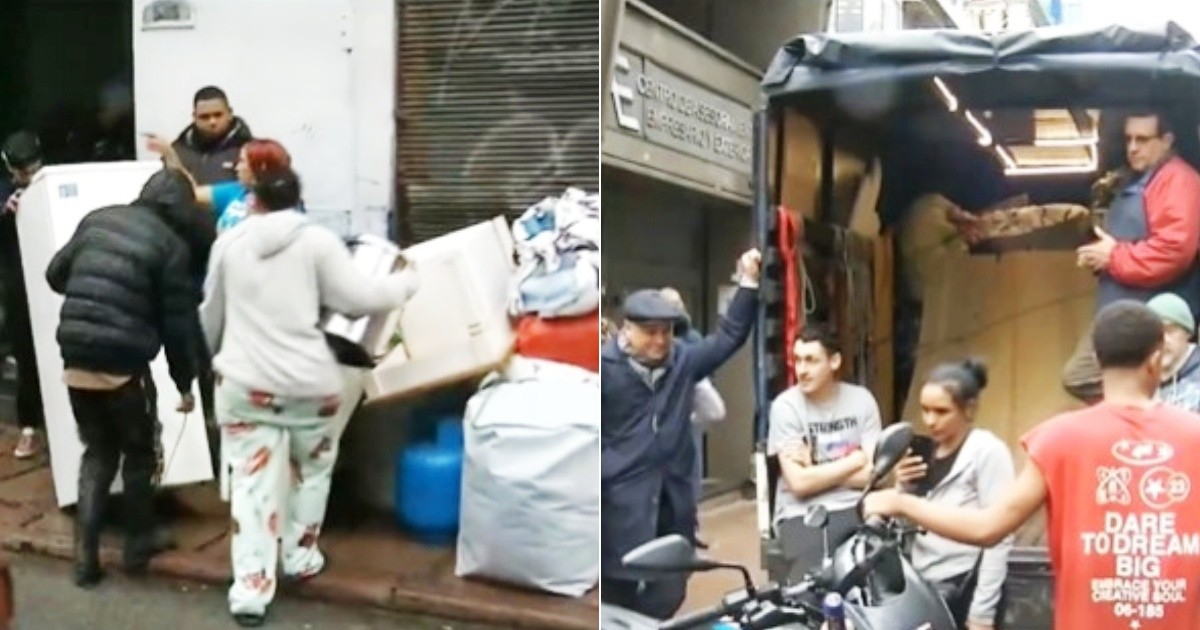
On Tuesday, numerous families, including Cuban, Dominican, and Uruguayan migrants, found themselves homeless following the eviction of a five-story building in Montevideo's Ciudad Vieja neighborhood. The eviction occurred at the intersection of 25 de Mayo and Ituzaingó, enforced by police under a court order at the property owner's request.
The Eviction's Background
According to a report by Uruguay's Subrayado, the legal proceedings that led to the eviction began six years ago. The property owner initiated the case in court to reclaim their building.
The police operation commenced Tuesday morning, extending into the afternoon. Displaced families waited on the sidewalks, surrounded by mattresses, washing machines, water heaters, and refrigerators, hoping for a response from the Ministry of Social Development (Mides).
Police sources revealed to Subrayado that the building had been raided multiple times, as a drug-selling operation was previously conducted on its ground floor.
Impact on Cuban Families
The exact number of affected Cuban families remains uncertain. Residents suggest at least 15 families lived in the building, but officials have not specified how many were Cuban.
The only confirmed information is that the evicted included Uruguayans, Dominicans, and Cubans, without detailed numbers by nationality. Many migrants declined to speak on camera to avoid exposing their situation to family back home.
Voices of Distress and Demand for Action
Anthony, a Uruguayan resident of the building for over nine years with approximately 20 family members, including nearly 11 children, claimed the agreed-upon deadline was ignored. "They gave us only 30 minutes to leave. The extension was supposed to be three months, but they cut it short," he stated.
Anthony urged for government intervention, saying, "We'll stay here until we find a way for someone to tell us or for the government to show compassion and lend a hand because it's for the children." He emphasized that they did not intend to confront authorities: "We aren't marginalized families, nor do we blame the police for doing their job, but they should offer more to families with children."
Bella, a Dominican woman residing in the building for four months with two undocumented children, recounted that Mides collected her information without providing an immediate solution: "They took my details, my children's names and documents, and my phone number, telling me to check back if I hadn't heard in two days."
In the meantime, a friend agreed to temporarily house her for two days. "Something needs to be done for us; it's not fair," she summarized.
Mides' Response
Daniel Gerhard, the national director of Social Protection, was present on-site but did not comment to the press. The ministry assessed each family's situation to determine who required state assistance, considering factors like children or pregnant women to decide on temporary shelter.
Some families managed to contact acquaintances and left with their belongings on moving trucks, while others remained on the street with no immediate destination.
Challenges Facing Cuban Migrants
This eviction occurs amid a growing Cuban presence in Uruguay. In 2025, over 22,000 Cubans entered the country—a historical record—and 13,852 obtained Uruguayan ID cards for the first time, the highest among all foreign nationalities.
Many of these migrants face severe housing challenges, with rents ranging from 9,000 to 18,000 Uruguayan pesos monthly and significant barriers to accessing the formal housing market.
The Ciudad Vieja eviction adds to a series of incidents affecting the Cuban community in Montevideo recently: a 28-year-old Cuban was fatally stabbed by a Venezuelan national in a Paso de la Arena hostel on Monday, and in April, delivery man José Eduardo Cuéllar Arteaga, 31, was killed during a robbery attempt in Carrasco Norte.
Mides continued assessing each family's needs on Tuesday to determine assistance measures, with the total number of individuals requiring emergency shelter yet to be specified.
FAQs on Cuban Migrant Evictions in Uruguay
How many Cuban families were evicted in Montevideo?
The exact number of Cuban families evicted remains unclear. Residents estimate at least 15 families lived in the building, but authorities haven't specified how many were Cuban.
What was the reason for the building's eviction?
The eviction resulted from a court order initiated six years ago when the property owner sought to reclaim their building. The building had also been raided due to illegal drug activities.
What assistance is available for the evicted families?
The Ministry of Social Development (Mides) is evaluating each family's situation to provide assistance, considering factors like children or pregnant women for temporary shelter arrangements.