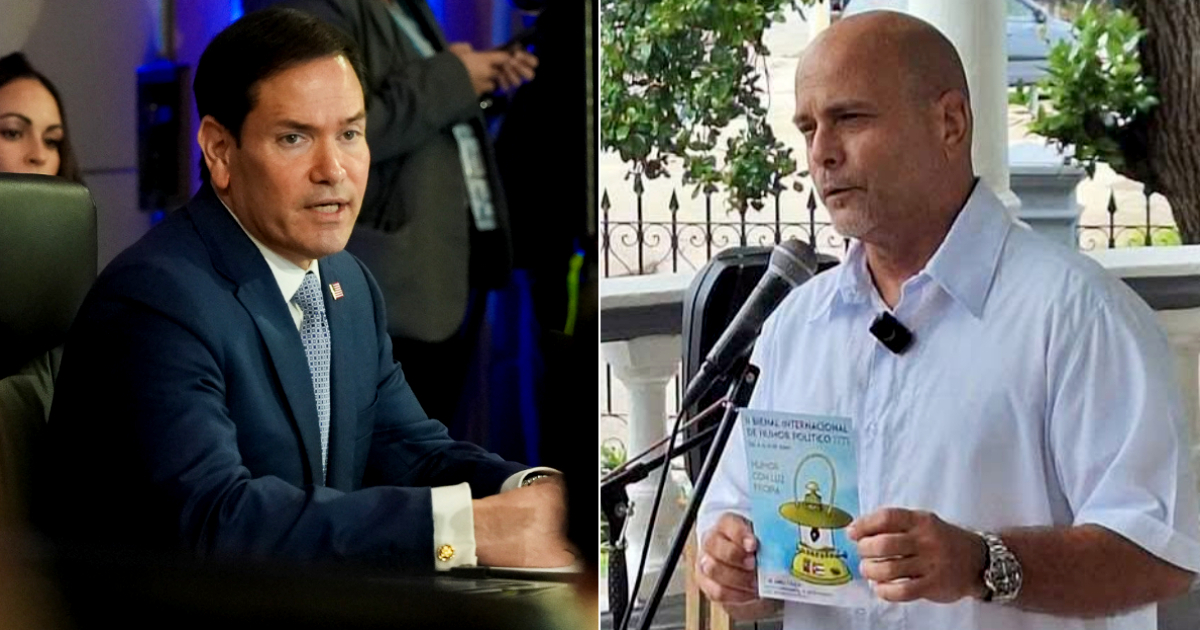
Gerardo Hernández's latest Facebook post, where he attempted to discredit U.S. Secretary of State Marco Rubio's statements about Cuba, sparked a flood of responses highlighting more than just a political disagreement.
Hundreds of comments under the post reveal a growing frustration with one of the most prominent figures of the Cuban power structure and an increasing rejection of the official narrative.
The central argument of the convicted spy from the Wasp Network was simple: if Cuba poses a threat to the United States, it cannot simultaneously be labeled a failed state. However, this reasoning was precisely what many users challenged.
Contradictions in the Argument
"One does not exclude the other," summarized one of the most supported comments. Others delved deeper, explaining that a state can maintain control over its territory while failing to provide economic stability, basic rights, and well-being for its citizens.
Participants went further, noting that failed states often become sources of regional and international instability.
They argued that institutional collapse, humanitarian crises, mass migrations, organized crime, drug trafficking, terrorism, or human trafficking often make these countries threats to the security of other states.
"Failed states are a problem for everyone," wrote one user. "They generate migration, violence, and destabilization," added another.
The Cuban Context
Some comments shifted the debate to Cuba's specific situation.
"Cuba can be both: a state unable to provide dignified living conditions for its citizens and a security problem due to its alliances with hostile governments, its role in intelligence operations, or the migratory waves it causes," summarized one internet user.
Others insisted that the concept of a "failed state" doesn't solely depend on losing territorial control. "Government control doesn't mean functionality," wrote one commenter. "What's collapsed is the economy, public services, and quality of life," added another.
This argument sparked one of the longest discussions of the conversation. Some argued that Cuba cannot be considered a failed state because the regime maintains control over institutions, the military, and the national territory, comparing Cuba's reality to countries like Somalia, Libya, or Haiti to highlight clear differences.
Criticism of Leadership
The debate eventually turned into a broader critique of Hernández's role within the system.
Many comments questioned why a leading regime figure spends time on propaganda posts while millions of Cubans face a daily crisis marked by inflation, blackouts, and shortages. The dominant perception was of a leader disconnected from the reality of most citizens, enjoying the privileges of power.
"They don't live in the same country as the average Cuban," summarized one participant. Others claimed that the political elite "clings to power while the people pay the price."
Although there were personal attacks—including references to Hernández's private life episodes circulating on social media for years—the volume of these comments reflects the level of animosity toward figures associated with the regime's political apparatus.
Public Image Decline
Beyond the tone used, the conversation indicates a decline in the public image of leaders who were previously shielded from open criticism.
This is not the first occurrence. In recent months, nearly every one of Hernández's social media posts has become a space for citizen counter-speech.
Whether attempting to mock U.S. military deployment, sharing photos in a pedicab, enjoying a local stew, or provoking critics with questions, the result has been consistently the same: hundreds of responses using his posts to challenge the regime and denounce the country's situation.
This dynamic seems intentional. In recent years, Hernández has cultivated a social media profile based on confrontation and political provocation, a strategy that often backfires, making each post a barometer of public discontent.
There were also voices supporting Hernández's stance. Some argued the U.S. deliberately exaggerates Cuba's situation to justify a more aggressive policy towards the island and defended that Cuba's institutions and sovereignty remain intact.
Others contended that U.S. sanctions largely explain the economic crisis and rejected the label of a failed state.
However, these arguments were met with equally strong rebuttals. Many participants countered that the economic and social decline preceded many of Washington's recent measures and that blaming the crisis solely on external factors ignores decades of inefficiency, political control, and lack of structural reforms.
For these commenters, the real issue isn't Marco Rubio's rhetoric but the Cuban government's inability to provide solutions to a population enduring blackouts, shortages, and unprecedented emigration for years.
The conversation yields a clear conclusion: rather than debating an academic definition of a failed state, many Cubans used Hernández's post to express accumulated frustration with those they hold responsible for the country's plight.
And this fatigue, increasingly visible on social media, overshadows any attempt by official propaganda to control the narrative.
Understanding the Cuban Political Discontent
Why are Cubans criticizing Gerardo Hernández's post?
Cubans are criticizing Hernández's post because they see it as disconnected from their reality and an attempt to deny the country's struggles, which include economic instability, lack of basic rights, and government failure to address these issues.
Can a state be a failed state and a threat simultaneously?
Yes, a state can exhibit characteristics of both a failed state and a threat. While maintaining control over its borders, it can still fail to provide for its citizens, leading to regional instability and security threats through migration, crime, or alliances with hostile entities.