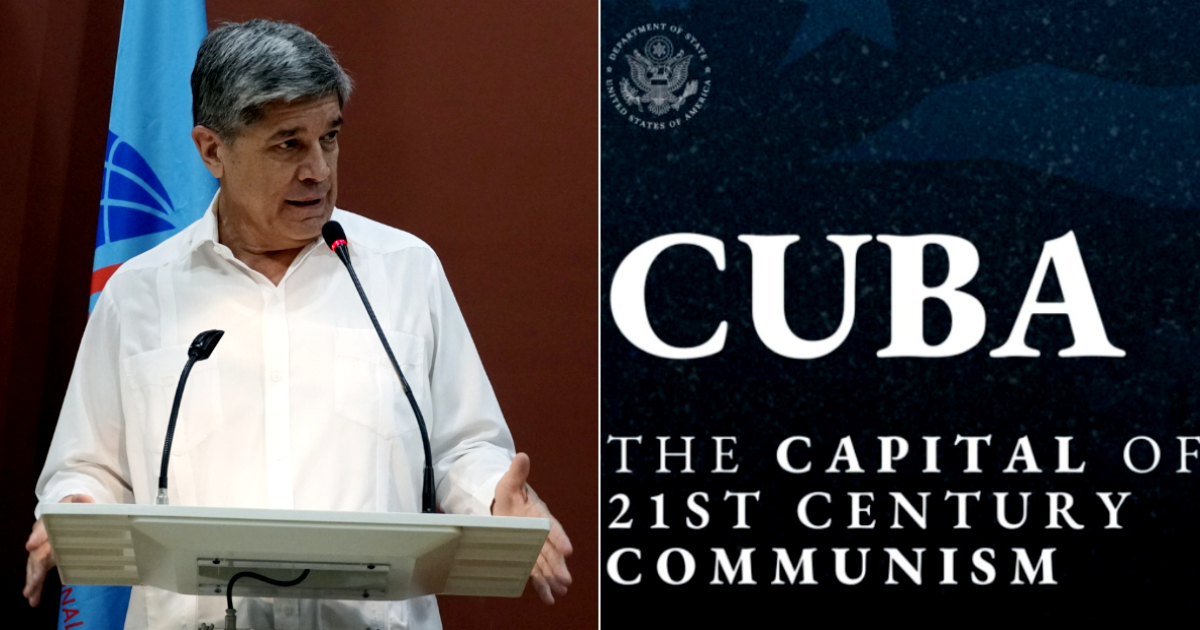
On Monday, Cuban Deputy Foreign Minister Carlos Fernández de Cossío took to social media to issue a response to a U.S. State Department report titled "Cuba: the Capital of 21st Century Communism," dismissing it as "voluminous and deceitful."
In an extensive Facebook post, the diplomat accused Washington of attempting to instill fear among American citizens by portraying Cuba as a potential threat.
The report, released on July 20 under the leadership of Secretary of State Marco Rubio, charges the Cuban regime with establishing espionage networks, ideological subversion, and influence operations against the United States over more than six decades. It highlights connections with Russia, China, and Iran, and cites specific cases like those of Ana Belén Montes, Víctor Manuel Rocha, and the Avispa network.
Fernández de Cossío did not dispute these cases or provide evidence to counter the accusations. Instead, he argued that the report failed to acknowledge historical context.
Historical Context and Omitted Details
The deputy minister pointed out that while the report mentions American civil rights activists' admiration for Cuba, it neglects to address the severe injustices within the U.S. that motivated many individuals to engage in a national political and civil struggle.
Regarding Cuba's support for armed movements in Africa, he claimed the report ignores the colonial oppression and the disgrace of the racist regimes in South Africa and former Rhodesia, whose survival was tied to political, economic, and military backing from the U.S. and other major powers.
Double Standards and Ignored Issues
Fernández de Cossío also criticized what he called a "double standard": the report condemns Cuban intelligence activities in the U.S. without mentioning American operations against Cuba or acknowledging Cuba's right to self-defense against ongoing aggression from the world's largest military and nuclear power.
This argument overlooks the fact that documented cases of Cuban espionage—such as Ana Belén Montes, who spent years leaking intelligence secrets to Havana—were not defensive measures but offensive operations against a sovereign state.
The omissions in the deputy minister's response are as telling as his statements: there is no mention of the more than 700 political prisoners whose release Rubio demanded on July 18, no reference to the humanitarian crisis on the island, and no acknowledgment of the systematic human rights violations documented in the report.
Additional Responses from Cuban Officials
On Sunday, Foreign Minister Bruno Rodríguez Parrilla also weighed in, dismissing the notion that Cuba poses a threat to the U.S. as a "ridiculous and clumsy lie," and accusing Rubio of using it as a pretext to justify sanctions and potential military aggression.
Rodríguez Parrilla went so far as to label the sanctions as an "ongoing genocide" against the Cuban people, a term the regime consistently uses to deflect its own responsibility for the island's economic collapse.
The response from Fernández de Cossío is part of a sustained pattern of verbal confrontation with Rubio throughout 2026: in May, he accused Rubio of "repeatedly" lying, and in June, he described the sanctions as "collective punishment."
However, in a surprising rhetorical shift, the deputy minister recently told the New York Times that the Cuban regime does not exclude Trump or his organization from doing business on the island.
Rubio introduced the report by stating that Cuba has been, for more than six decades, "the main sponsor of left-wing radicalism and third-worldism" in the U.S. and the hemisphere, as part of a maximum pressure policy that includes over 240 sanctions and Cuba's re-listing as a state sponsor of terrorism.
Frequently Asked Questions on U.S.-Cuba Relations
What are the main accusations against Cuba in the U.S. State Department report?
The report accuses Cuba of establishing espionage networks, ideological subversion, and influence operations against the United States, with ties to Russia, China, and Iran.
How did the Cuban Deputy Foreign Minister respond to the report?
Deputy Foreign Minister Carlos Fernández de Cossío dismissed the report as deceitful and accused the U.S. of attempting to instill fear among its citizens, without addressing the specific allegations.
What is Cuba's stance on its intelligence activities in the U.S.?
Cuba claims its intelligence activities are a form of legitimate self-defense against U.S. aggression, although specific cases like Ana Belén Montes are seen as offensive operations.