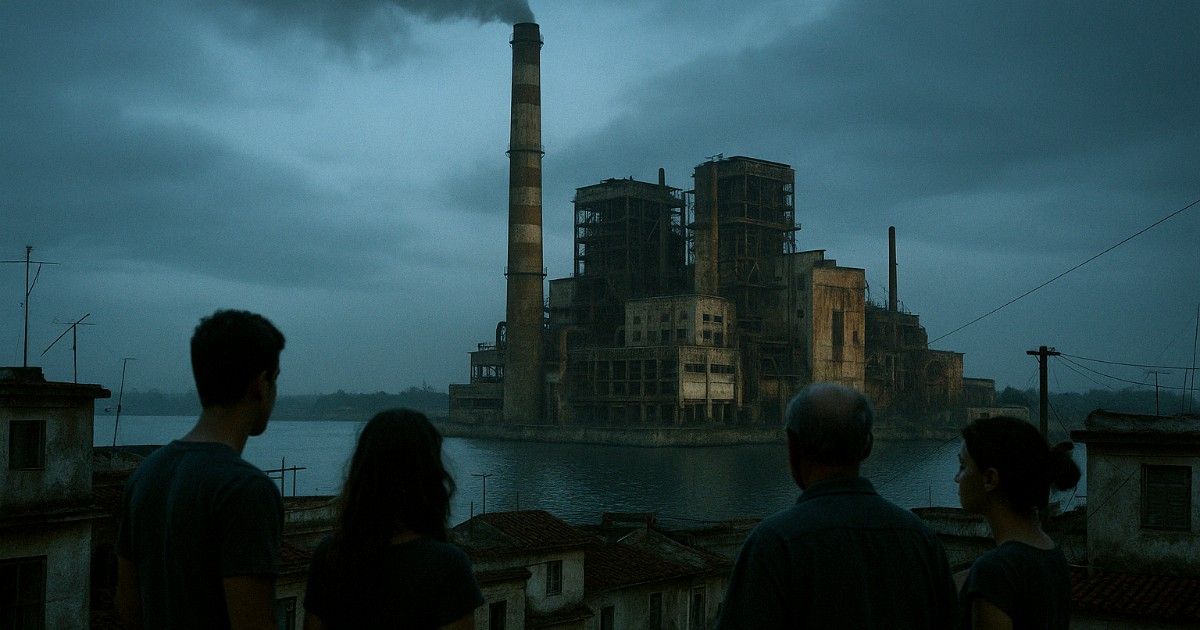
The Cuban Electrical Union (UNE) announced on Monday that efforts are underway to gradually restore the National Electric System (SEN) following a complete blackout that occurred Sunday night. This marks the sixth major power outage in Cuba this year.
According to an official statement posted by the UNE on Facebook, by 8:41 AM, several power units were in the process of restarting. These included Units 1 and 2 at the Ernesto Guevara de la Serna Thermoelectric Plant, Units 5 and 8 at the Máximo Gómez Plant, and Unit 3 at the Carlos Manuel de Céspedes Plant.
Additionally, three more facilities were preparing to join the grid: Unit 6 of the Diez de Octubre Plant, Unit 1 of the Lidio Ramón Pérez “Felton” Plant, and the Antonio Guiteras Plant, the largest thermoelectric facility in the country, located in Matanzas.
State media outlet Canal Caribe reported that at the same time, two units of Energás Boca de Jaruco in Mayabeque were synchronizing with the electric system, allowing for the creation of micro-systems to help reactivate larger plants.
From Cienfuegos, there was partial recovery reported as the provincial electric company managed to create a generation island with the Junco Sur Electric Plant from 2:30 AM, providing power to the Provincial Hospital, Pediatric Hospital, and ETECSA, while also working to include the CEA Specialty Hospital.
In Camagüey, as of 8:20 AM, electricity was limited to essential services: water pumping and several hospitals, including Provincial, Maternal, Oncology, Amalia Simoni, Pediatric, and Military, along with the television section, as shared by the province's Electric Company on social media.
In Havana, progress in restoring power was slow, with only 14% of the electricity supply restored by early morning. This equates to 87,480 customers and 78.51 MW, with 12 substations and 29 circuits energized, including 19 hospitals and two water supply boosters.
Sunday's collapse happened just 24 hours after a partial disconnection in the western part of the country on Saturday, caused by a simultaneous fault in the 220 kV lines between Matanzas-Cienfuegos and Matanzas-Santa Clara, leaving approximately 4.5 million people without electricity in five western provinces.
The system had not fully recovered from that incident when the total blackout occurred, confirmed by the UNE at 10:43 PM on Sunday.
Throughout 2026, the SEN has experienced at least six total collapses, with a recurring structural deficit exceeding 2,000 MW, compounded by a deteriorating thermoelectric infrastructure and a chronic fuel shortage.
The crisis has sparked widespread protests across the nation, with the Cuban Conflict Observatory reporting 107 in-person demonstrations in June alone, with Havana being the focal point.
The UNE stated that the recovery process would continue "gradually as SEN conditions allow," a phrase that has become all too familiar to Cubans after months of repeated blackouts.
Understanding Cuba's Power Crisis
What caused the recent nationwide blackout in Cuba?
The blackout was due to failures in key power lines and an overall struggling electrical infrastructure, exacerbated by fuel shortages and outdated equipment.
How is the Cuban government responding to the power outages?
The government is working on a gradual restoration of power, prioritizing essential services and attempting to stabilize the electric grid with available resources.
What impact have these blackouts had on the Cuban population?
The blackouts have led to widespread frustration, resulting in numerous protests across the country, highlighting the growing discontent with the government's handling of the crisis.