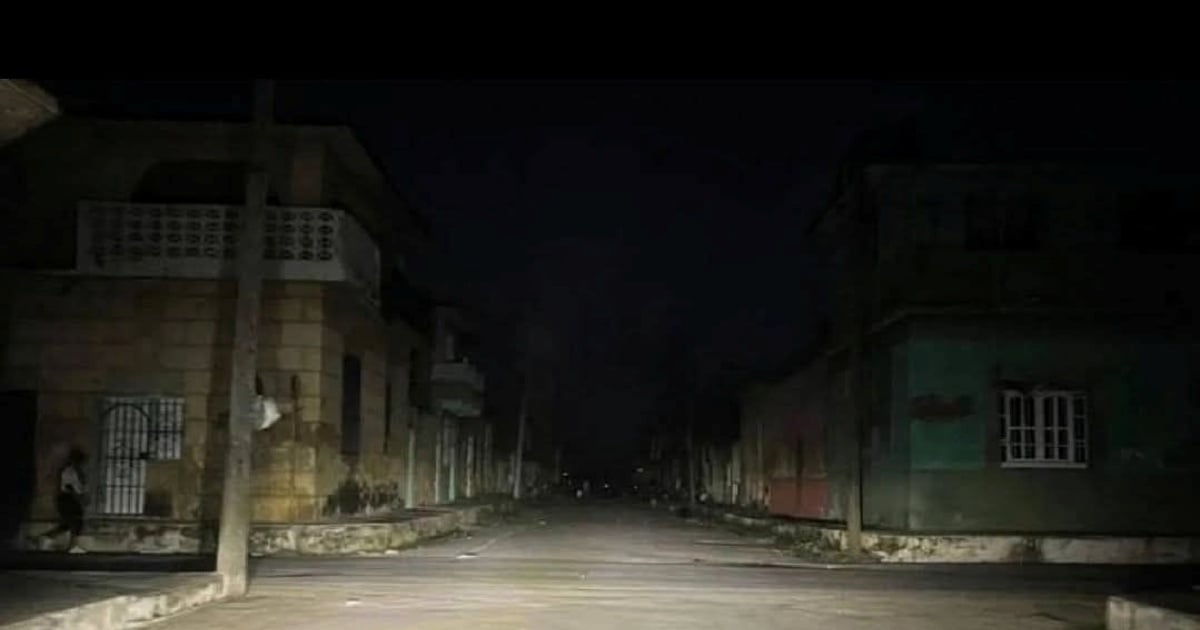
On Sunday night, Cuba was once again plunged into complete darkness as the National Electric System (SEN) experienced another total shutdown. At precisely 10:43 PM, the Unión Eléctrica (UNE) issued a brief statement: "A total disconnection of the National Electric System has occurred. Further updates will follow."
This marks the sixth nationwide blackout in Cuba this year, 2026, a frequency that has made these power failures a distressingly common occurrence for the Cuban populace.
The latest blackout occurred just a day after a partial outage on Saturday, August 1, affected the western region of the island, from Pinar del Río to Matanzas, leaving roughly 4.5 million Cubans across seven provinces without electricity. This incident was triggered by simultaneous faults on the 220 kV lines connecting Matanzas-Cienfuegos and Matanzas-Santa Clara.
Following a partial restoration of power in the west, the UNE had already anticipated a deficit of 2,195 MW for Sunday, with only 1,035 MW available to meet a demand of 3,200 MW, making another collapse almost unavoidable.
Public Reaction: Sarcasm and Frustration
Cubans took to social media to express their frustration with the UNE's announcement on Facebook, often with a dose of sarcasm. Nuri Benítez quipped, "It came, said hello, and went back to sleep." Sofía Del Toro Domgz was more direct: "The question is, when is it ever connected?"
Becky Pereira Infante compared the SEN to a medical condition: "The SEN is worse than someone with Alzheimer's; it doesn't know if it's coming or going." Yoa Pzm added, "The SEN sits, stands, and acts like a stubborn donkey. It's breaking its own record."
Barber Pineda mixed political irony with a nod to the Antonio Guiteras thermoelectric plant, the country's largest and a critical component of the system: "Utopia collided with Guiteras and disintegrated on the horizon."
Gladys V. Fernández's comment bordered on open criticism of the regime: "What should fall doesn't. Of course, it's up to us as a people to bring it down."
The Impact of Recurrent Outages
Several users shared personal experiences that underscore the severity of the ongoing energy crisis. Maydelin Redondo noted, "This is nothing new; they just restored my power after almost 24 hours. Such disregard." Evelyn Cabrera encapsulated the absurdity in a single sentence: "I haven't had power since yesterday, and it was only on for three hours, so I didn't even notice." Rauli Velázquez summed it all up with one word: "Blackoutland."
The deterioration has been escalating throughout the week. On July 29, the UNE projected a record-setting shortfall of 2,380 MW, with a mere 850 MW available to meet a demand of 3,200 MW. By July 31, the deficit had already reached 2,042 MW.
Historical Context of Blackouts in 2026
The history of total outages in 2026 includes the March 16 blackout — the longest, lasting 29 hours and 29 minutes — as well as others on March 22, July 6, when nearly 9.6 million people were without power, July 10, and July 14, attributed to the unexpected shutdown of Unit 1 at the Felton plant in Holguín.
Each collapse can be traced back to unresolved structural issues that the regime has failed to address for decades: thermoelectric plants operating for over 30 years — many with outdated Soviet technology — insufficient maintenance, chronic fuel shortages, and a complete dependency on imported fuel oil and diesel that the system itself cannot guarantee.
Understanding Cuba's Energy Crisis
What caused the recent total blackout in Cuba?
The recent total blackout in Cuba was due to a failure in the National Electric System, exacerbated by structural issues and insufficient power supply to meet demand.
How have Cubans reacted to the frequent power outages?
Cubans have reacted with frustration and sarcasm on social media, often criticizing the government's inability to resolve ongoing energy issues.
What are the underlying issues causing Cuba's energy problems?
Cuba's energy problems stem from outdated infrastructure, lack of maintenance, chronic fuel shortages, and dependency on imported fuels.