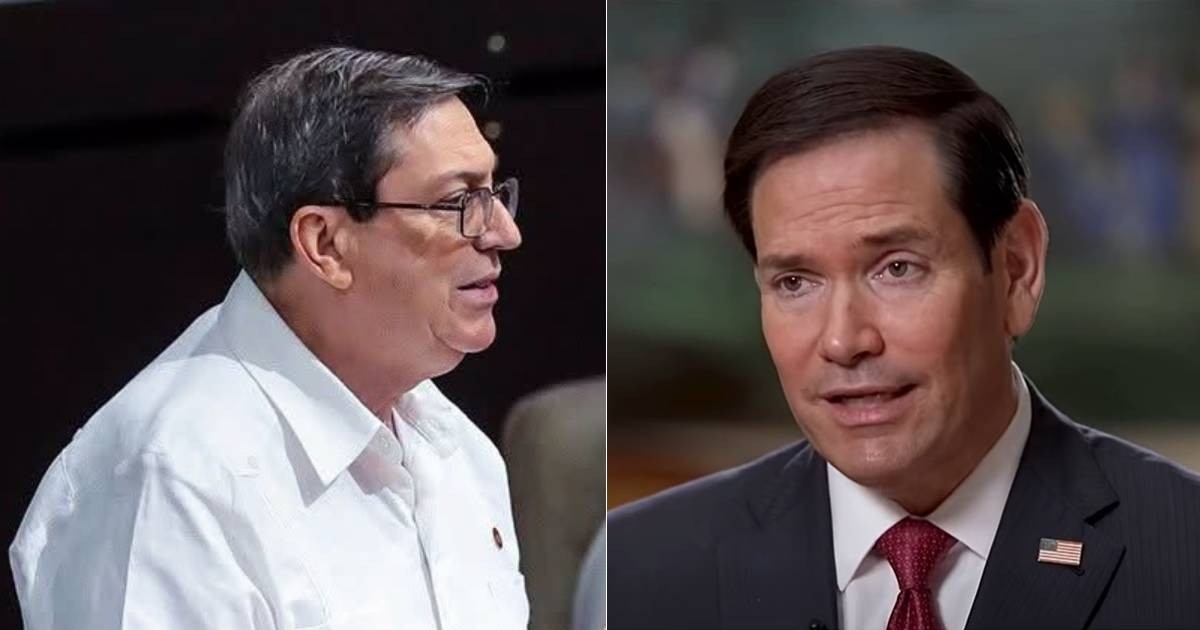
Cuba's Foreign Minister, Bruno Rodríguez Parrilla, issued a stern response on Sunday to U.S. Secretary of State, Marco Rubio, dismissing his assertion that Cuba poses a danger to Washington as a "ridiculous and clumsy lie."
In a post on the social media platform X, the Cuban diplomat argued that Rubio is attempting to formulate a rationale for intensifying U.S. policy against Havana.
"The Secretary of State insists on the absurd and inept falsehood, which neither he nor his corrupt colleagues believe, that #Cuba could pose a threat to the world's leading nuclear power," Rodríguez stated.
Rodríguez further accused Rubio of leveraging this narrative to justify the U.S. sanctions policy against the island.
"It is a desperate attempt to defend the current genocide against the Cuban people through collective punishment and a fanciful excuse for military aggression, which would result in a bloodbath for both Cuban and American citizens," he added.
Rodríguez's remarks follow Rubio's defense on Fox News, during the segment "My View with Lara Trump," of a Department of State report titled "Cuba: The Capital of 21st Century Communism," released on July 20.
In the interview, Rubio claimed that Cuba has developed an advanced espionage capability against the United States over decades.
"It is the only country that has systematically placed and concealed spies within the U.S. system without even paying them," the Secretary of State declared, portraying the island as an "espionage and influence operation superpower," despite its small size and proximity to U.S. territory.
The report, approximately 100 pages long, alleges that Cuban intelligence services have infiltrated U.S. institutions such as the Department of State, the National Security Council, and the Department of Defense. It also attributes to Cuba the operation of 18 signals intelligence facilities involving China and Russia.
To support these findings, Rubio referenced the cases of Ana Belén Montes, a former Defense Intelligence Agency analyst convicted of espionage for Cuba, and former U.S. ambassador Víctor Manuel Rocha, sentenced in 2024 after admitting to decades of work as an agent for the Cuban regime.
Rubio also dismissed criticism that the report aims to justify military intervention against Cuba.
"Everything in that report is factual, and frankly, I don't think they can refute it," he asserted.
This exchange adds to a series of public disputes between the two officials. Since the State Department's report was published, Rodríguez has denounced the document as a "fallacy" and a "slanderous pamphlet," repeatedly accusing Rubio of advocating for confrontation between the two nations.
During the interview, Rubio also criticized sectors of the U.S. press and academia for allegedly downplaying the Cuban regime's intelligence activities due to ideological motivations. He further linked Havana to influence operations related to the 2020 protests in the United States and political activism movements in American universities.
Understanding the Tensions Between Cuba and the United States
Why did Bruno Rodríguez criticize Marco Rubio?
Bruno Rodríguez criticized Marco Rubio for claiming that Cuba poses a threat to the United States, labeling it a "ridiculous and clumsy lie." Rodríguez argued that Rubio uses this narrative to justify harsher U.S. policies against Cuba.
What was the content of the Department of State's report on Cuba?
The report titled "Cuba: The Capital of 21st Century Communism" claims that Cuban intelligence services have infiltrated U.S. institutions, detailing operations involving China and Russia. It describes Cuba as an espionage superpower despite its small size.
How did Rubio defend the report against criticism?
Marco Rubio defended the report by stating that its contents are factual and expressed skepticism that critics could refute its claims. He dismissed allegations that the report serves to justify military intervention in Cuba.