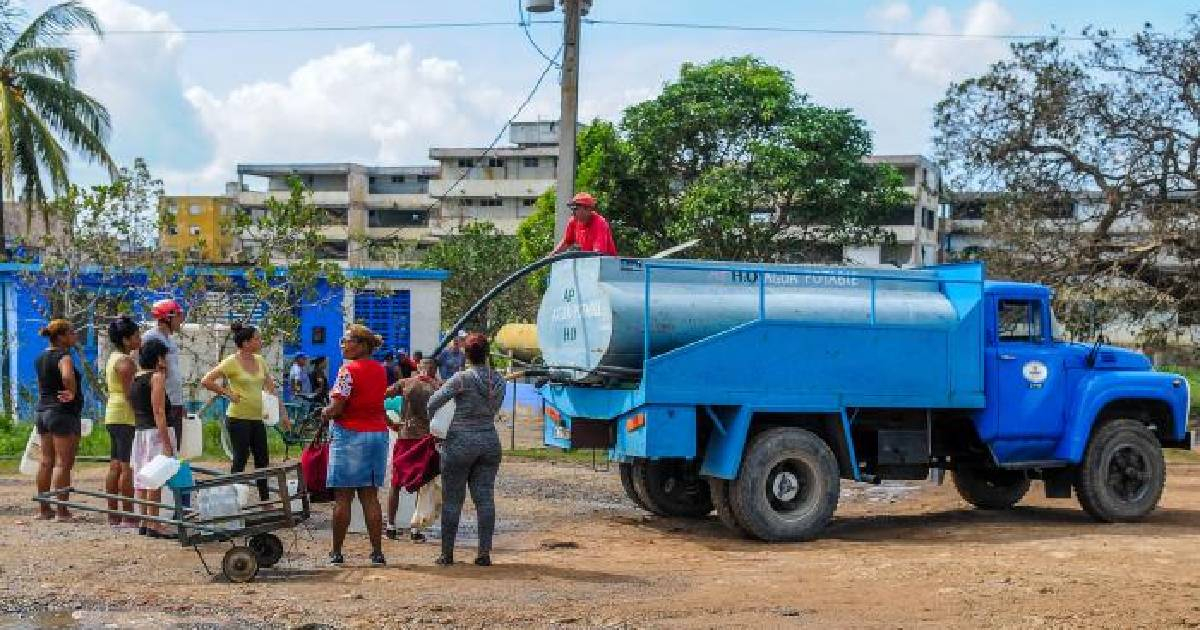
This past Sunday, Pinar del Río playwright and theater director Irán Capote took to his Facebook profile to share a satirical "poem" about the Cuban water system. His words quickly resonated with many Cubans, reflecting their collective frustration over the unreliable access to potable water.
Capote cleverly used the metaphor of the horizon—popularized due to President Miguel Díaz-Canel's misquoted reference to Eduardo Galeano—to illustrate the broken promises of water supply: "Aqueduct is on the horizon. And as thirst takes two steps forward, Aqueduct takes ten steps back. What is the purpose of an Aqueduct? To keep us thirsty...."
The post sparked a torrent of comments as Cubans recognized their own daily struggles, blending humor with bitterness.
Theater Figures Respond with Irony
Fellow Cuban theater figure Norge Espinosa Mendoza chimed in sarcastically: "Always 26!" This was a nod to the National Electrical System—since every power outage also cuts off water supply, worsening the water crisis—and a reference to the old revolutionary slogan that every day of the calendar is July 26, the date of Fidel Castro's 1953 attack on the Moncada Barracks.
In the face of overwhelming reactions, Capote simply remarked, "Everything has its philosophical explanation."
Public Outcry and Personal Accounts
Social media comments painted a stark picture of the situation. One user lamented, "Aqueduct serves to keep us up at night waiting for the precious liquid, pay exorbitant prices for water trucks, haul water like beasts, and ultimately for nothing." Another added, "Aqueduct is there to enrich a few who sell water trucks for 10,000 pesos while no one stops them. They've quickly grasped what socialist mafia is."
Some highlighted the energy issue: "And suddenly... when it's your turn for the little cup of water... boom... the electrical system fails." Others questioned, "Does Aqueduct even exist?" or confessed, "We laugh so we don't cry."
A Deepening Water Crisis
Capote's ironic take on the situation underscores a supply crisis that reached alarming proportions in 2026. According to the National Institute of Hydraulic Resources, as of May 2026, around 2.7 million Cubans faced severe difficulties in accessing clean water, with millions more receiving it intermittently.
The pumping system operates with just 37% of the required fuel, and 87% of aqueducts rely on the National Electrical System, making every blackout an unavoidable water crisis.
Regional Impacts and Economic Strain
In Capote's home province of Pinar del Río, the situation is dire. Residents in Entronque de Herradura have gone over two years without regular water service, paying exorbitant prices for water trucks. In Viñales, the water shortage had lasted more than six months as of May 2026.
The informal market for water trucks has thrived amidst the collapse of the state service: prices have surged from around 3,000 or 4,000 pesos in 2025 to over 10,000 pesos by July 2026, depending on the area—amounts unaffordable for most Cubans.
Capote, a graduate in Theatrical Arts from the Instituto Superior de Arte, was the recipient of the 2019 Calendar Award for Dramaturgy and the 2025 Villanueva Critics Award. In November 2022, the UNEAC in Pinar del Río barred him from a teaching position due to ideological reasons, a turning point in his public relationship with the regime's cultural institutions.
One social media user summed up the shared sentiment from Capote's post: "Your muse captures the historical moment perfectly. I laugh, but truthfully, I want to cry."
Cuban Water Crisis: Key Questions and Answers
Why is the water supply unreliable in Cuba?
The water supply in Cuba is unreliable due to a combination of insufficient fuel for the pumping system and heavy reliance on the failing National Electrical System. This infrastructure issue leads to frequent and prolonged water outages.
How are Cubans coping with the water shortage?
Cubans cope with water shortages by relying on informal markets for water trucks, paying high prices for limited access to water. Many endure long waits and unpredictable schedules for water delivery.
What impact does the electrical system have on water supply?
The National Electrical System's frequent outages directly affect the water supply, as the majority of aqueducts depend on electricity to function. Each blackout results in concurrent water shortages.