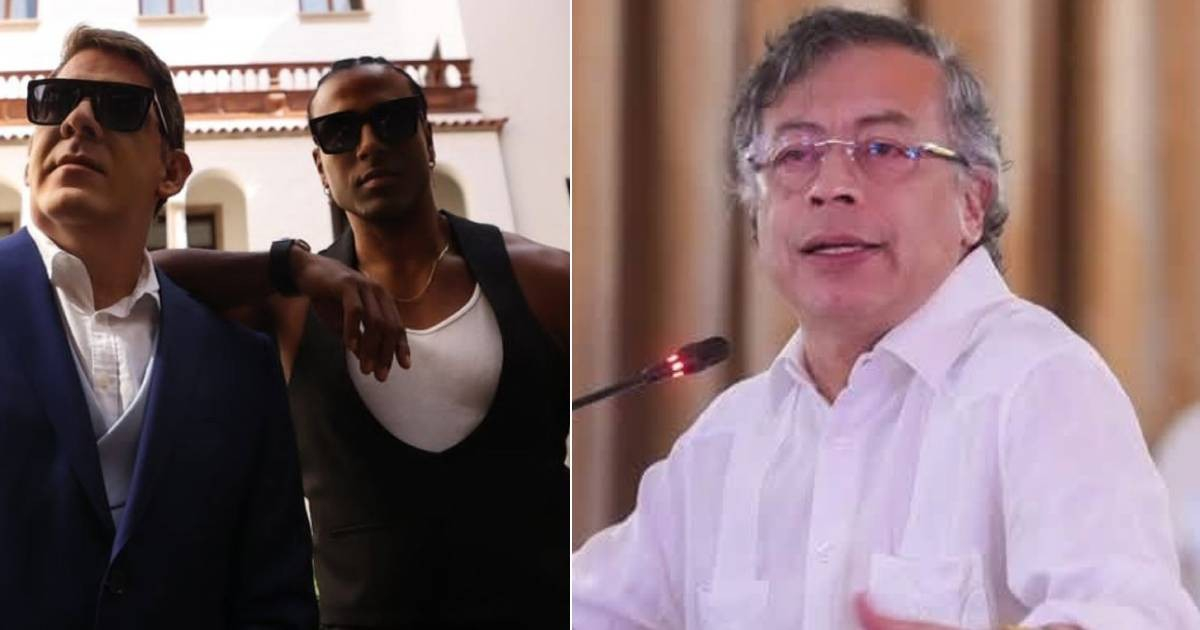
Colombian President Gustavo Petro expressed his regret on the social media platform X this Saturday for not being able to attend the seventh edition of the Concert of Hope, held at Plaza de Bolívar in Bogotá. The Cuban group Orishas was among the main attractions of this free event organized by RTVC.
“I wanted to go to the concert but I am running late. I would have loved to hear Orishas, as they offer a great exploration of contemporary Caribbean music. The Caribbean will experience a second renaissance if art can escape greed and obscurantism, and if the Caribbean people are free,” Petro wrote, responding to a post from the educational and cultural public channel Señal Colombia.
The message was notable given that Yotuel Romero, one of Orishas' most prominent members, has been a vocal critic of the Cuban regime. Meanwhile, Petro has consistently shown support for Havana during his time in office.
The Impact of "Patria y Vida"
Yotuel co-wrote the anthem "Patria y Vida" with Gente de Zona, Descemer Bueno, Maykel Osorbo, and El Funky. Released in February 2021, the song became emblematic of the historic July 11 protests that year in Cuba.
Since then, Yotuel has labeled the Cuban political system as a "dictatorship" and "totalitarian." In February 2021, he asserted that "the Cuban regime has taken everything from us, even our fear," and by May 2026, he reiterated that "Patria y Vida" stands "for the Cuban people and against the dictatorship." He also criticized a speech by Miguel Díaz-Canel, claiming there is no future project for Cubans under the current system.
Petro's Stance on Cuba
Petro's perspective has diverged. In May 2026, he argued that Cuba "should be applauded and aided," condemning the U.S. embargo as a "genocide affecting the Cuban people."
Moreover, just two days before the concert, on July 31, he made his third official visit to Havana since becoming president, meeting with Miguel Díaz-Canel at the Palace of the Revolution. His foreign minister described the meeting as a gesture of "solidarity" with the Cuban government. Throughout his presidency, Petro has also frequently expressed admiration for Fidel Castro.
Orishas Shines in Bogotá
Meanwhile, thousands attended the Concert of Hope VII, singing along to Orishas' hits, including "Atrevido," a track that delves into ambition and the personal consequences of one's choices.
Founded in the late 1990s between Havana and Paris, Orishas revolutionized Latin music by blending hip hop with son, rumba, and other traditional Cuban rhythms. Since releasing "A lo Cubano" in 1999, the group has earned Latin Grammy awards and multiple Grammy nominations.
The Concert of Hope VII came with a price tag of approximately 4.437 billion Colombian pesos, drawing criticism from opposition sectors. During the event, RTVC Manager Hollman Morris publicly thanked Petro for his support of public media.
Understanding the Dynamics of the Orishas Concert and Political Reactions
Why did Gustavo Petro not attend the Orishas concert?
Gustavo Petro mentioned on social media that he could not attend the Orishas concert because he was running late, but he expressed his interest in the event and appreciation for the band's music.
What is the significance of "Patria y Vida" in Cuban protests?
"Patria y Vida" is a song that became a symbol of the July 11 protests in Cuba. It was co-written by Yotuel and others, advocating for freedom and opposing the Cuban regime.
How has Petro's support for Cuba been perceived?
Petro's support for Cuba, including his criticism of the U.S. embargo and admiration for Fidel Castro, has been seen as a contrasting stance to Yotuel's criticism of the Cuban regime.