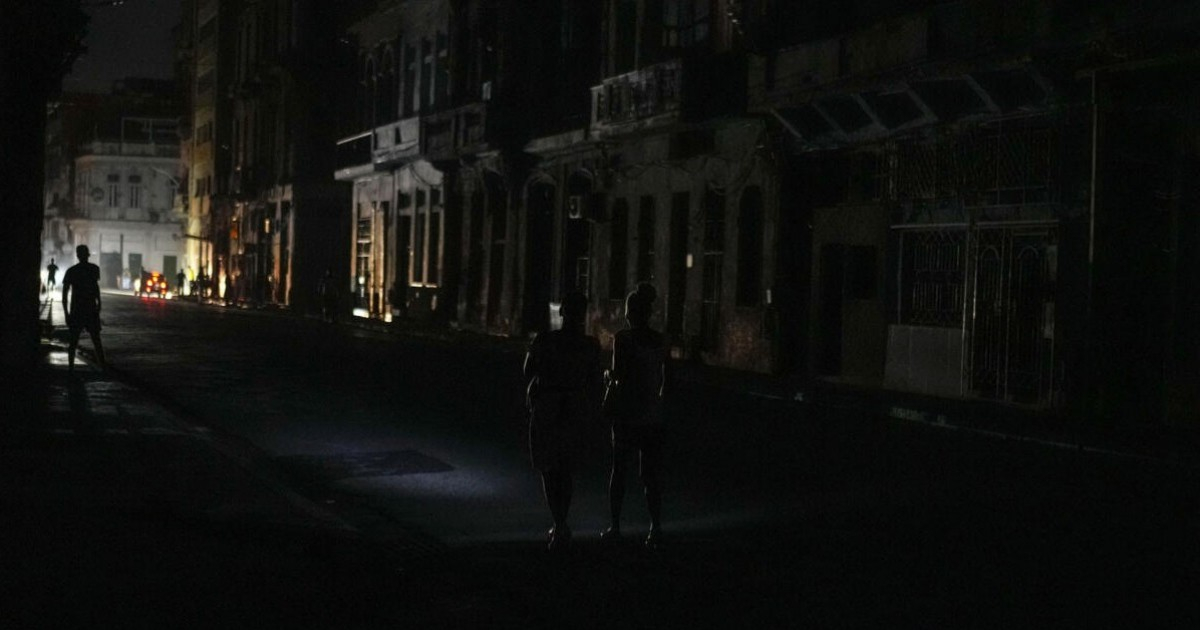
Just hours after the National Electric System (SEN) was reconnected in western Cuba, the Electric Union (UNE) forecasted a severe power shortage for Sunday evening's peak demand: a shortfall of 2,195 MW, with only 1,035 MW available to meet an expected demand of 3,200 MW.
This gap represents roughly 68% of the total demand, suggesting widespread blackouts across much of Cuba during the high-consumption period on Sunday.
System Breakdown: A Recurring Issue
The crisis began on Saturday at 6:07 PM when, according to UNE, a simultaneous fault occurred on the 220 kV lines from Matanzas to Cienfuegos and Matanzas to Santa Clara. This incident split the SEN and left five provinces—Pinar del Río, Artemisa, Mayabeque, Havana, and Matanzas—in darkness.
The restoration process was gradual, lasting nearly seven hours. Early Sunday morning, UNE reported, "Restoration efforts are ongoing as per established procedures. Hospitals and essential facilities are now online. Power plants in the western region are being prepared for gradual reintegration into the SEN." At 1:10 AM on Sunday, they declared, "The electric system in the western region has been restored."
Public Frustration and Discontent
However, this official statement did not reflect the reality experienced by many Cubans. Comments on UNE's page from residents in Havana, Matanzas, Artemisa, and Cienfuegos indicated that many remained without power. One user remarked, "I have no electricity. It's like I'm on another planet." Another pointed out, "Only the privileged circuits are back on." A third commented bluntly, "They are completely misleading the public."
Persistent Power Challenges
This incident marks the fifth major collapse of the SEN in 2026, following total disconnections on March 16, July 6, and July 10 and 14. The record for simultaneous power disruption—without a complete SEN failure—was set on July 29 with 2,380 MW affected.
The thermal power generation capacity is indicative of the system's structural decay. Outages this Sunday include units 6 and 8 of the Máximo Gómez Thermoelectric Plant (Mariel), unit 1 of the Ernesto Guevara De La Serna Thermoelectric Plant, unit 1 of the Antonio Guiteras Thermoelectric Plant in Matanzas—the largest in the country with at least 17 unscheduled outages in 2026—and unit 2 of the Lidio Ramón Pérez Thermoelectric Plant in Felton. Units under maintenance include unit 3 of the CTE Ernesto Guevara De La Serna, units 5 and 6 of the CTE Antonio Maceo in Renté, and unit 5 of the CTE Diez de Octubre in Nuevitas.
Efforts to Mitigate the Deficit
In an attempt to lessen the deficit during peak hours, UNE plans to bring unit 8 of the CTE Mariel online with 60 MW and unit 1 of the CTE Santa Cruz with 45 MW, a minimal contribution compared to the over 2,000 MW shortfall that remains.
On the renewable energy front, the 54 solar photovoltaic parks generated 4,867 MWh on Saturday, with a peak output of 756 MW. However, solar energy does not cover nighttime hours, which is when demand peaks and shortages are most acute. Additionally, 106 distributed generation plants are offline due to fuel unavailability, along with the Regla and Melones barges, the Mariel Fuel Center, and the Moa Fuel Center.
Fuel scarcity, exacerbated by reduced supplies from Venezuela, Mexico, and Russia, is the most immediate constraint on thermal power generation. Energy and Mines Minister Vicente de la O Levy acknowledged on July 30 that some communities have gone up to 105 days without electricity, admitting that there is "no short-term solution" to the energy crisis and that "the path ahead is long."
Understanding Cuba's Electricity Shortage
What caused the recent power outage in western Cuba?
The outage was triggered by a simultaneous fault on the 220 kV lines from Matanzas to Cienfuegos and Matanzas to Santa Clara, splitting the National Electric System and affecting several provinces.
How severe is the expected power deficit in Cuba?
The Electric Union has forecasted a deficit of 2,195 MW during peak demand, with only 1,035 MW available against a demand of 3,200 MW, indicating widespread blackouts.
What efforts are being made to address the power shortage?
UNE plans to activate additional generating units, though the contributions are minimal compared to the shortfall. Renewable energy sources and distributed generation plants are also being considered, but fuel shortages limit their availability.