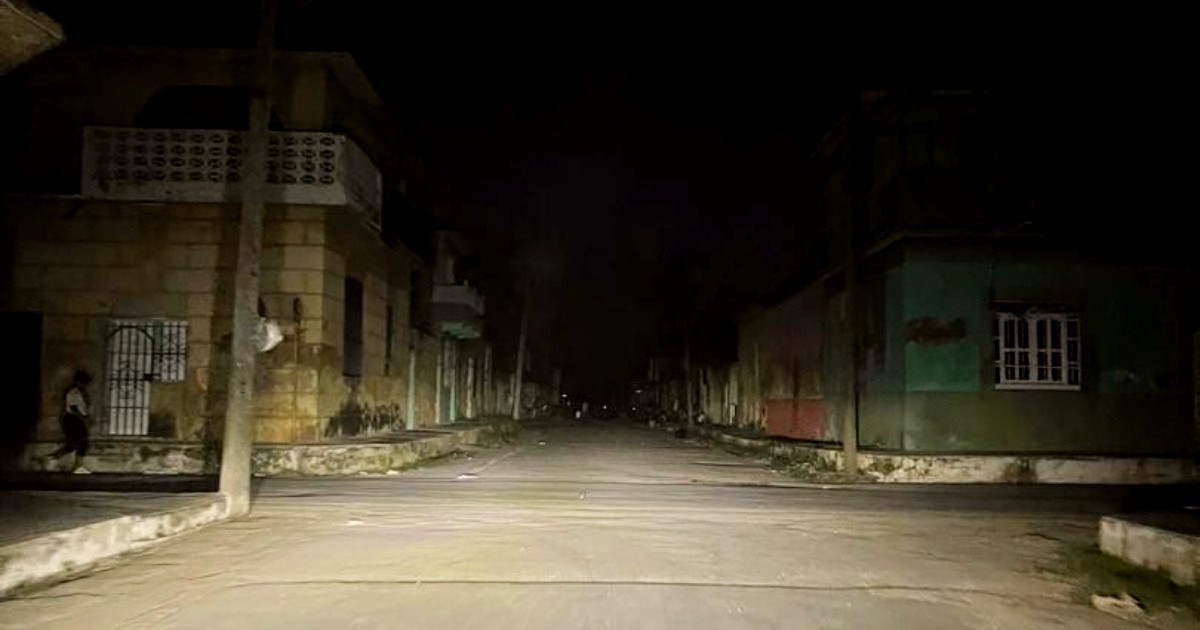
The Electric Company of Matanzas announced on Saturday that efforts are underway to gradually restore electricity to the province. This comes after the collapse of the National Electroenergetic System (SEN) left the entire western region of Cuba in darkness, according to a post by the entity on Facebook.
The breakdown occurred at 6:07 PM when a simultaneous outage affected the 220 kV lines connecting Matanzas with Cienfuegos and Santa Clara. This technical failure split the SEN, causing power outages in the provinces of Pinar del Río, Artemisa, Mayabeque, Havana, and Matanzas, as reported by the Electric Union.
In their statement, the state-run company indicated that plans are being prepared to restore the system gradually as conditions allow.
As a concrete initial step, the company reported that the Faustino Pérez Hospital, the primary healthcare facility in the province, and the 4955 water pumping circuit in Bello have already had their power restored. This aligns with the protocol to prioritize health facilities and critical water infrastructure during recovery efforts.
The recovery strategy in Matanzas includes starting the 110 kV Guanábana substation groups and linking them with other system points to advance towards overall synchronization, with particular priority given to the Eliseo Noel Caamaño hospital, as per local media reports.
Chronic Issues Underlying the Crisis
The collapse occurred at a particularly inopportune time for a system already stretched to its limits. At 6:00 AM on Saturday, the SEN's availability was a mere 895 MW against a demand of 2,825 MW, with 1,930 MW affected even before the evening breakdown.
The total disconnection of the SEN in western Cuba happened on a network that was already operating under critical conditions.
This event is not an isolated incident. Throughout 2026, Cuba has experienced multiple total collapses of the SEN: the complete blackout on March 16, 2026, which lasted for 29 hours and 29 minutes, and the outages on July 6—nearly 24 hours without electricity—and on July 11 and 14.
Just on July 29, the Electric Union had forecasted a record deficit of 2,380 MW during peak hours, equivalent to leaving almost three-quarters of the country without power.
The underlying causes are structural: aging thermoelectric plants without adequate maintenance, chronic fuel shortages, and decades of underinvestment in the grid.
The western region, including Havana, has the highest population density in Cuba and relies on high-voltage transmission lines originating from Matanzas, making it the most vulnerable to any failure in this electrical corridor.
Understanding the Power Crisis in Cuba
What caused the power outage in western Cuba?
The outage was caused by a simultaneous failure in the 220 kV lines connecting Matanzas with Cienfuegos and Santa Clara, which split the National Electroenergetic System and led to widespread power loss in several provinces.
How is the power being restored in Matanzas?
The restoration is being carried out gradually, with priority given to critical infrastructure such as hospitals and water pumping stations. Efforts include starting the 110 kV Guanábana substation and linking with other system points.
Why is Cuba's power grid so vulnerable?
Cuba's power grid is vulnerable due to aging thermoelectric plants lacking proper maintenance, chronic fuel shortages, and decades of insufficient investment in infrastructure.