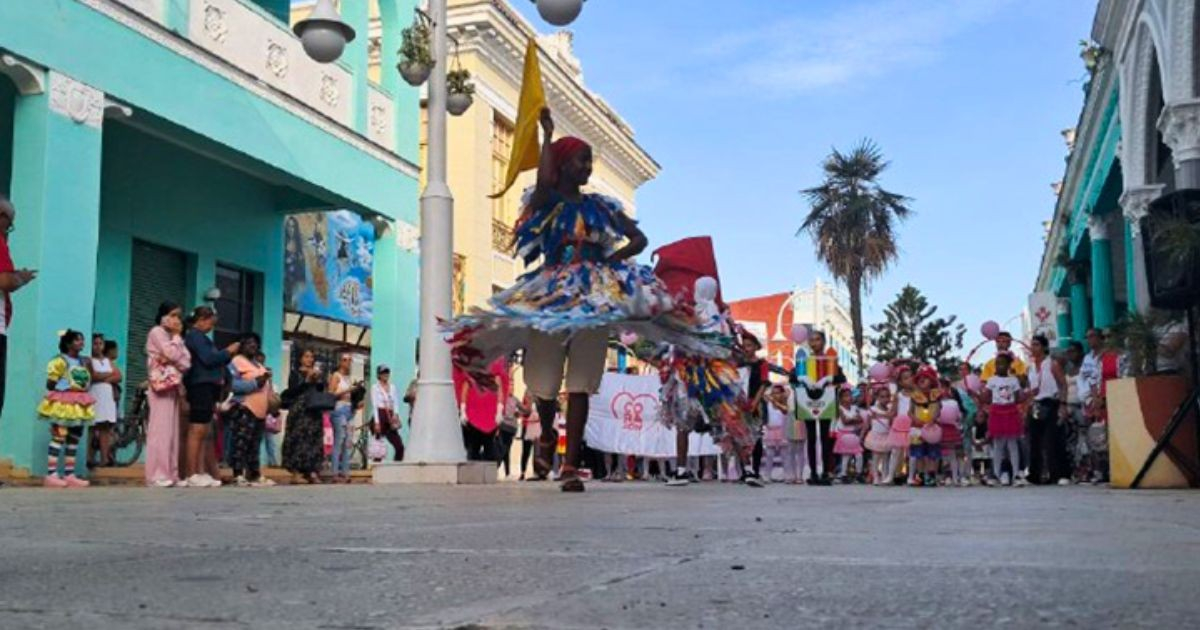
In Cuba, even the circus performers, including acrobats, jugglers, and the Caribbean Gagá, are not exempt from the state's compulsory ideological branding. The 10th edition of the Circus Arts Festival, Circávila 2026, kicked off on Friday in Ciego de Ávila with a parade through the city's boulevard. The state-run agency, ACN, boldly declared that the festival is "framed within the centenary of the birth of the Commander in Chief, Fidel Castro Ruz (1926-2016)."
The circus, it seems, also belongs to Fidel.
The opening parade traveled the stretch from Hotel Rueda to Teatro Principal with three stops: acrobatics by the Haliom company at the Casa del Joven Creador, a Gagá performance—a popular Caribbean expression with Haitian and Dominican roots—at the Casa de Cultura José Inda Hernández, and a show by Guiñol Polichinela at Sala Abdala, according to the source.
This year, the festival brings together Haliom, the National Circus School, the Amateur Artists Movement, the Corazón project, and Polichinela itself, aiming to surpass previous editions in reach. Additionally, eight students from the National Circus School who trained in the 2025-2026 course are participating. For the first time in the festival's history, the Osokpuan Irawo Folkloric Ballet joins with performances featuring fire-eaters and machete skills, the report expands.
The schedule includes performances of "People with Swing" and "Circus Varieties" at Teatro Principal this Saturday, with the finale on Sunday, August 2, featuring a Varieties show at 10:00 a.m. Admission is 200 pesos, a significant amount in a Cuba plagued by blackouts and shortages.
However, the real circus isn't on stage; it's in the propaganda machine surrounding the event. On December 20, 2025, the National Assembly declared this year as the "Year of the Commander's Centennial," and since then, virtually no event on the island escapes the mandatory "framing."
The list of events now bearing Fidel's mark in 2026 is as lengthy as it is surreal: the 34th International Book Fair, the 1st International Colloquium "Fidel: Legacy and Future," the Havana Poetry Festival, the #ArteFiel campaign by UNEAC, blood donations as a "revolutionary commitment" in Holguín, tourist trips from Chile at $2,000 per person to attend official acts, and the military mobilized to plant one hundred cedars spelling "Fidel" in military units across several provinces.
Now it’s the circus's turn. The official motto of the year is "Fidel is a country," and the regime seems determined to prove it show by show.
Many Cubans have reacted with irony and frustration on social media in response to such "framing." Some call the year "the centennial of Cuba's misfortune"; others, simply "the year of the eternal blackout," referencing the ongoing blackouts that continue to paralyze the island, also burdened by chronic shortages of medicine and food, while the regime invests energy in glorifying its founder.
Cuban priest Alberto Reyes precisely described the model that produced this cult: "a State and a Party that had only one point of reference, one leader, one owner, one unquestionable voice: his own." Analyst Jorge L. León summarized it from another perspective: "Democracies are built on institutions; dictatorships on men."
The central event of the centennial is scheduled for August 13 in Birán, Holguín, the birthplace of Fidel Castro. Until then, the regime will continue seeking events to "frame." The circus has already done its part.
Key Aspects of Fidel Castro's Centennial in Cuba
What is Circávila 2026?
Circávila 2026 is the 10th edition of the Circus Arts Festival held in Ciego de Ávila, Cuba. It features performances by acrobats, jugglers, and other acts, and is notably "framed" within the centenary of Fidel Castro's birth.
How is Fidel Castro's centenary influencing events in Cuba?
The centenary of Fidel Castro is being used as a propaganda tool, with many events across Cuba being "framed" in his honor. This includes cultural festivals, blood donation campaigns, and even tourism packages, all highlighting his legacy.
What has been the public reaction to Fidel Castro's centennial celebrations?
Many Cubans have responded with irony and frustration, criticizing the regime's focus on glorifying Fidel Castro amid ongoing economic hardships, including blackouts and shortages of essential goods.
When and where is the main event for Fidel Castro's centenary?
The main event for Fidel Castro's centenary is scheduled to take place on August 13 in Birán, Holguín, which is the birthplace of Fidel Castro.