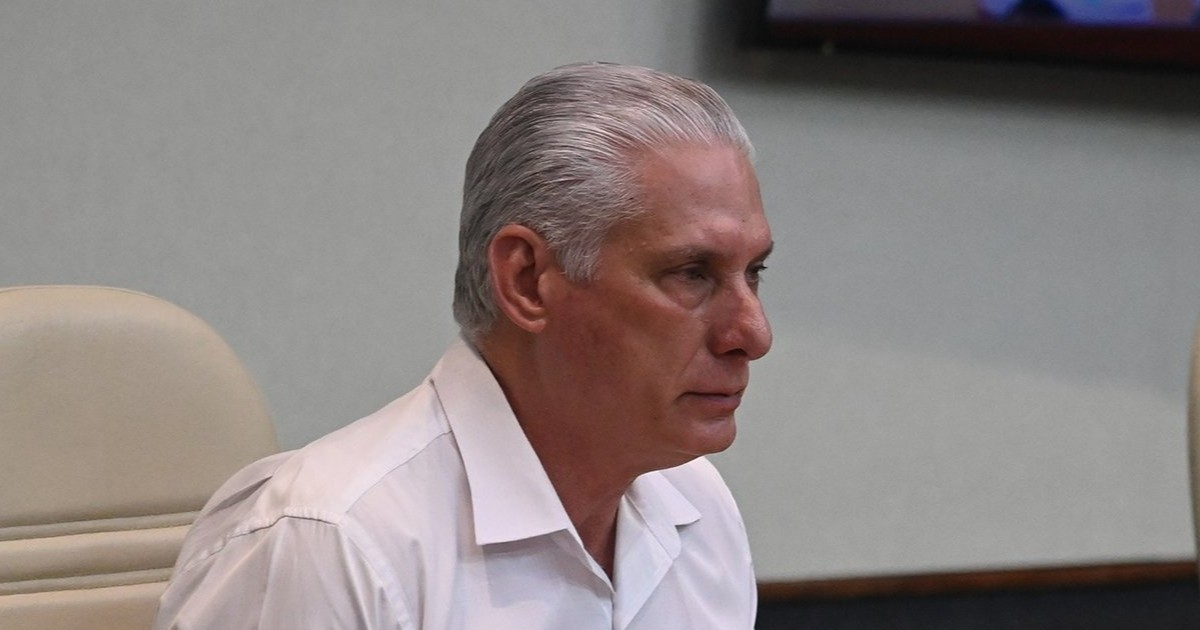
Miguel Díaz-Canel took to his Facebook profile on Thursday, asserting that the Cuban regime's changes are carried out "collectively and democratically, in consultation with the people." Cubans responded swiftly, flooding the comments with mockery, sarcasm, and outrage.
The statement, shared from the official profile of the president during the closing of the VII Ordinary Period of Sessions of the X Legislature of the National Assembly of People's Power, read: "We have aimed to undertake the transformations demanded by the moment, under the leadership of the Party, collectively and democratically, in consultation with the people, without compromising independence, national sovereignty, or the social achievements of the Revolution."
On July 21, the same Díaz-Canel who clarified that all reforms would be "under the Party's control," stood before the National Assembly discussing democracy and popular consultation in a nation where the Constitution recognizes the Communist Party as the superior force and the sole legal political organization, with no multi-party elections.
The contradiction was glaring. "What country is he living in?" questioned a user with a laughing emoji. Another was more straightforward: "Excuse me, but I am the people, and no one consulted me, so if something goes wrong, it’s not my fault." A third summed up the general mood with biting irony: "Let's eat willpower, then."
Questions about the supposed "social achievements of the Revolution" also surfaced. "Can someone clarify what the social achievements of the Revolution are?" wrote a user. "Social achievements... what a joke," added another. One more pointed to the historical absurdity with sharp precision: "67 years of transformations, are they trying to create dinosaurs?"
The context in which Díaz-Canel delivers these words makes them even harder to swallow. Since 2020, Cuba has experienced an economic contraction approaching 20%, with additional declines projected between 6.5% and 7.2% by 2026, according to CEPAL and independent economists. Power outages last over 20 hours daily in many areas, inflation is rampant, and shortages of food, medicine, and fuel are chronic.
Amid this backdrop, the National Assembly approved five new laws: a Labor Code incorporating telework and multi-employment, a Housing Law recognizing up to two primary properties and expanding the private sector's role in construction, an Agricultural and Forestry Land Law, a Law on the Organization of the Central State Administration — reducing central bodies from 27 to 21 — and a Personal Identity and Domicile System Law.
Díaz-Canel also announced that 120 of the 176 transformations in the economic and social package were ready for implementation, and out of the 121 measures planned for June and July, 110 had been approved, constituting 90.9% of the total. In the same speech, he labeled the U.S. government as a "neofascist regime" and urged Cuban leaders to maintain "high ethical conduct" amid the crisis.
One commenter reminded that homes in the Guamá municipality remain roofless after Cyclone Melisa, while the president speaks of transformations from a podium. Another summarized decades of unfulfilled promises with a question left unanswered: "In the 60s, in the 70s, in the 80s, in the 90s... and so on, decade after decade for almost 70 years. How many more? As many as we can endure?"
This isn't the first time Cubans have mocked Díaz-Canel on social media following a grandiose declaration: in July, when he spoke of a "resounding VICTORY" at the UN, the comments were filled with sarcasm; when he called for the people's "creativity and joy" during July 26, the response was similarly ironic. This time, the word "democratic" was enough to unleash the same storm. "The only measures to escape this misery are true democracy and freedom of thought," concluded a user, with clarity that no official speech has managed to counter.
Understanding the Cuban Regime's Claims of Democracy
What is Díaz-Canel's stance on Cuban reforms?
Díaz-Canel asserts that the Cuban regime's transformations are conducted collectively and democratically, in consultation with the people, despite the Communist Party's control over all reforms.
How have Cubans reacted to Díaz-Canel's statements?
Cubans have responded with mockery, sarcasm, and outrage, questioning the reality of the democratic process and the achievements of the Revolution.
What are the economic challenges currently facing Cuba?
Cuba faces a significant economic contraction, projected further declines, frequent power outages, rampant inflation, and chronic shortages of essentials like food, medicine, and fuel.