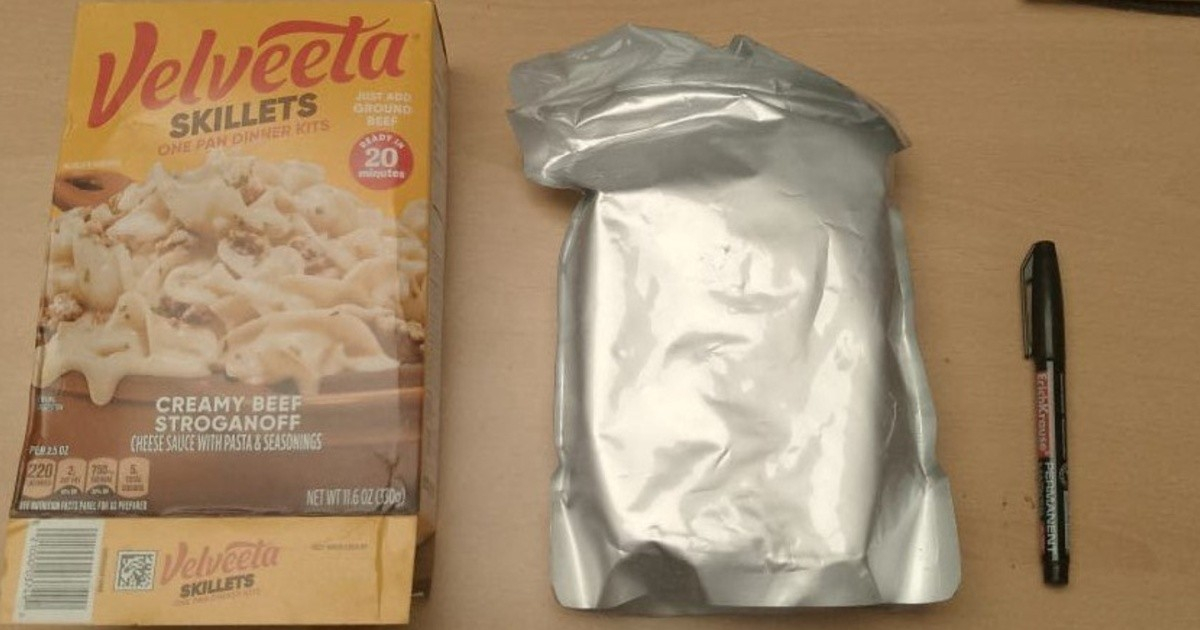
On Friday, Cuban Customs officials intercepted a shipment of synthetic cannabinoids originating from the United States, cleverly disguised within a package of Velveeta Skillets—a popular pasta and cream mix—delivered to the island by air.
Wiliam Pérez González, the First Deputy Chief of the General Customs of the Republic, disclosed the discovery via his official account on X: "Another shipment from the U.S. with synthetic cannabinoids hidden in a food package detected, arriving by air with the drug in cream form. The anti-drug unit is continuing investigations, showcasing the strength of our collaboration with Cuban Customs."
The substance was cleverly concealed in a silver metallic pouch inside the box, mimicking one of the ingredients of the meal kit.
Photos shared by the official depict the Velveeta Skillets box alongside the bag containing the drug, as well as a sniffer dog—equipped with a working harness—examining the package.
Ongoing Efforts to Combat Drug Smuggling
This latest seizure is part of a series of operations highlighting a troubling trend: the use of well-known American food brand packages to smuggle synthetic cannabinoids into Cuba, exploiting the food remittance flow from the Cuban community in the U.S.
On July 18, authorities discovered "chemical" substances hidden in two food boxes from the U.S., including a Pillsbury brownie mix.
Back in April, 19 sheets soaked with synthetic cannabinoids were found within a Cocoa Puffs cereal box sent from the U.S., with an estimated potential to yield 22,800 doses. In March 2025, the drug was found concealed in disposable diapers.
Health Impacts and Legal Measures
Known in Cuba as "the chemical" or "papelillo," synthetic cannabinoids are 50 to 100 times more potent than marijuana and can cause seizures, psychosis, organ failure, and even death.
At least 40 variants of these substances circulate in Cuba, out of the 245 identified globally.
The health implications are concerning. According to Dr. Tania Adriana Peón Valdés, head of Mental Health and Addictions in Havana, as reported by AP, medical emergencies due to these substances in the capital rose from 467 cases in 2024 to 886 in 2025. The average age of first use is between 13 and 14 years.
Since May 2025, a more lethal version of the "chemical" has been in circulation, possibly containing fentanyl, formaldehyde, benzodiazepines, phenobarbital, and veterinary anesthetics.
In response, the Decree-Law 108 "On Customs" and Decree 134 were enacted in April 2026, classifying drug importation as a "very serious" offense, subject to confiscation and fines up to three times the value of the merchandise.
The José Martí International Airport in Havana accounts for 77% of drug trafficking cases detected at Cuban borders. The regions with the highest incidence of synthetic cannabinoid use are Holguín and Havana.
Key Questions on Synthetic Cannabinoid Trafficking in Cuba
What are synthetic cannabinoids?
Synthetic cannabinoids are human-made chemicals that mimic the effects of THC, the main active ingredient in marijuana, but are much more potent and dangerous.
How are synthetic cannabinoids smuggled into Cuba?
Smugglers have been using packages of American food brands to conceal synthetic cannabinoids, taking advantage of the food remittance flows from the Cuban diaspora in the United States.
What measures has Cuba implemented against drug smuggling?
Cuban authorities have enacted Decree-Law 108 and Decree 134 to classify drug importation as a very serious offense, leading to confiscation and heavy fines.