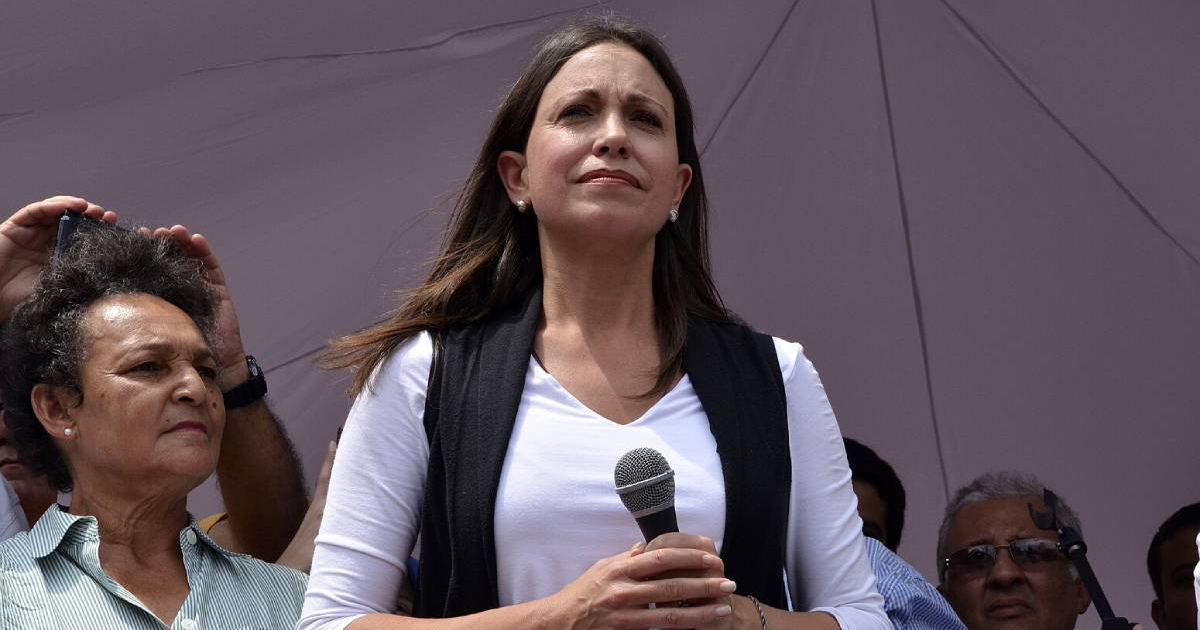
Political transition discussions in Venezuela, supported by the United States, began on Saturday without the presence of María Corina Machado, the nation's most prominent opposition leader and Nobel Peace Prize laureate of 2025.
According to Reuters, the opposition delegation participating in the negotiations is led by Dinorah Figuera, head of the 2015 National Assembly, the last democratically elected legislative body in Venezuela, which Washington recognizes as the legitimate opposition representative.
Meanwhile, the Chavista regime's representation is held by Jorge Rodríguez, brother of the interim president, Delcy Rodríguez.
Three sources cited by Reuters revealed that Machado was not invited to join the delegation because she is not part of the 2015 National Assembly, the formal channel chosen by Washington for negotiation.
The same sources indicated that Machado was unaware of the conversations' commencement until mid-June.
Machado has remained outside of Venezuela since December 2025, following her trip to Oslo to receive the Nobel Peace Prize, and she has claimed that Delcy Rodríguez's government blocked commercial airspace to prevent her return.
On July 26, Machado and Edmundo González Urrutia released a joint statement, conditionally supporting the process while clarifying that they did not partake in its "design, construction, and functioning."
The leaders set conditions for evaluating the dialogue: restoring democratic institutions, releasing all political prisoners, ensuring guarantees for all political actors, establishing a presidential election timetable, and fully respecting popular sovereignty.
In this statement, Machado and González insisted they would not "obstruct any initiative that yields real progress," but demanded that Figuera and Rodríguez inform the nation about "their objectives, methods, and timeline."
On Tuesday, July 28, during a rally organized by her party Vente Venezuela in Caracas—the first in the capital in 2026—Machado reiterated her stance with a direct message: "Rise up, Venezuela. Transition is coming, and it's with the people, for the people, and by our own hands."
The negotiation process follows a meeting on June 18 at Caracas's Federal Legislative Palace between Figuera and Jorge Rodríguez, marking the first significant contact between the government and the opposition in nearly three years.
The dialogue faced a temporary halt due to the devastating earthquakes on June 24—measuring 7.2 and 7.5 magnitudes—that resulted in over 5,500 fatalities and left tens of thousands homeless.
Secretary of State Marco Rubio confirmed the formal start of the process on July 20, describing the agreement as a "very significant proposal," and assured that Washington would be "very actively" involved.
The roadmap includes an equal technical and political table for institutional reforms, such as renewing the National Electoral Council and restructuring the Supreme Court of Justice.
However, President Donald Trump stated on July 24 that Venezuela is "not really ready" for elections, which directly contrasts with Machado's demand for a presidential election timetable as a condition for supporting the process.
Figuera, who returned to Venezuela after eight years in exile in Spain at the invitation of the State Department, acknowledged that Machado is "very important in this process," yet her absence from the table highlights a visible fracture in the opposition bloc from the outset.
Insights into Venezuela's Political Negotiations
Why was María Corina Machado excluded from the negotiations?
Machado was not included because she is not a member of the 2015 National Assembly, which is the formal channel chosen by Washington for the negotiations.
What conditions did María Corina Machado set for supporting the dialogue?
Machado's conditions include the restoration of democratic institutions, the release of all political prisoners, guarantees for all political actors, a presidential election timeline, and full respect for popular sovereignty.
What is the role of Dinorah Figuera in the negotiations?
Dinorah Figuera leads the opposition delegation in the negotiations, representing the 2015 National Assembly, which is recognized by Washington as the legitimate opposition body in Venezuela.