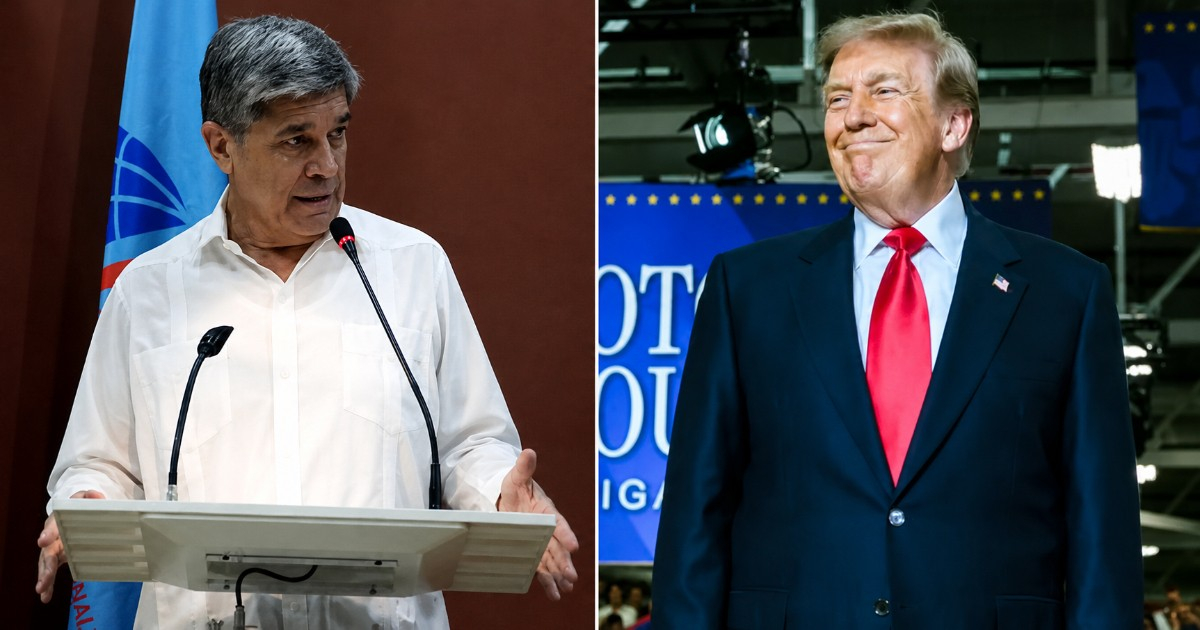
In a surprising move, Cuba's Deputy Foreign Minister, Carlos Fernández de Cossío, told the New York Times that the Cuban regime is open to business ventures from President Donald Trump and his organization.
The interview, conducted in Havana and published on Thursday, highlights a stark contrast between the Cuban government's ideological rhetoric and its pressing economic challenges.
"If he wishes to proceed peacefully, we see no specific reason to exclude him," Fernández de Cossío stated when questioned about the possibility of Trump investing on the island.
Remarkably, the same official who once likened Trump’s foreign policy to Hitler’s fascism in January 2025 and labeled the U.S. administration as "criminal" in May 2026, is now offering a handshake to Trump as a potential investor through the pages of the New York-based publication.
The interview was conducted by Jack Nicas, the Times' bureau chief in Mexico City, who traveled to Havana on a "highly unusual" journalism visa granted to the newspaper.
Potential Business Ventures with Trump's Brand
Regarding the proposed luxury tourist complex known as "Trump Island," planned by an Emirati developer on Cayo Santa María, Fernández de Cossío did not rule it out.
"If someone approaches us claiming ties with significant U.S. business figures, we are open to discussions. If it involves the Trump administration, in principle, there's no reason to refuse," the diplomat expressed.
Fernández de Cossío was clear about the true barrier: "What prevents Donald Trump from investing in Cuba are U.S. laws. We do not exclude him or his organization from doing business here, provided they comply with Cuban regulations."
Economic Reforms Amidst Crisis
This invitation for investment arises during one of the regime's most severe economic crises in decades. As reported by the NYT, the island’s power grid failed three times over nine days in July 2026, tourism has plummeted, and aside from a lone Russian oil tanker in March, no allies have defied Trump's order to halt fuel shipments to Cuba.
"The coercive arm of the United States has proven quite effective. Telling a European, Latin American, or Asian company that they cannot export their national resources to Cuba establishes a new world order," Fernández de Cossío acknowledged.
To withstand this pressure, the regime is pursuing economic reforms: "We introduced some changes to our economy a few weeks ago. We believe they may help us address this situation," the vice minister stated.
In June 2026, the government passed a package of 176 measures to ease foreign investment, and in July, it released decree 153/2026, amending the 2014 Foreign Investment Law.
Balancing Business and Resistance
However, while opening the door to business opportunities, Fernández de Cossío maintained a tone of defiance: "If this leads to military action against Cuba, we will endure thousands of deaths. There will likely be a bloodbath in Cuba, and American youth will also perish."
The White House and State Department, meanwhile, have labeled Cuba as a national security threat, accusing it of harboring terrorists and selling fuel to enrich elites rather than maintaining its power grid. Both sides acknowledge that there has been little progress in their discussions.
Fernández de Cossío himself admitted four days before the interview that Washington's pressures are "extremely hostile," and Cuba will not agree to conditions that require changes in its political system. Nevertheless, 72 hours later, he offered Trump a place on the island's investment map.
Investment Opportunities in Cuba: Key Questions Answered
What is the Cuban government's stance on foreign investment?
The Cuban government is currently open to foreign investment, including potential ventures from U.S. entities. They are especially looking for ways to tackle their economic crisis through economic reforms and international partnerships.
What are the obstacles to U.S. investments in Cuba?
The primary barrier to U.S. investments in Cuba is the U.S. legal framework, which prevents American entities from engaging in business activities on the island. Cuban officials stress that these restrictions are imposed by U.S. laws, not Cuban policies.